
Turn on the tap at the kitchen sink and the water tastes like a swimming pool, carries a faint chemical edge, or just does not seem quite right even though the well itself has tested fine — that is usually a dissolved-chemical problem, not a particle problem, and the tool built to fix it is a carbon filter for well water. Where a sediment filter catches sand and rust, and a softener trades calcium for sodium, a carbon filter works on a completely different principle: adsorption. As water passes through activated carbon, chlorine, volatile organic compounds, pesticides, and the dissolved compounds that cause bad taste and odor cling to the surface of the carbon and are pulled out of the stream. In this 2026 guide we break down how carbon filtration actually works, the two main carbon filter types (granular activated carbon and carbon block), how to size a unit for your home’s flow rate, where it sits in a full well water treatment train, and the best carbon filters for well water to consider this year.
By Lisa Martinez, Water Quality Specialist
Lisa holds a degree in Environmental Science and specializes in private well water safety and treatment.
Last updated: November 3, 2026
Disclosure: As an Amazon Associate, we earn from qualifying purchases on this page. Product selections are based on independent research and real well water data.
How a Carbon Filter Works for Well Water
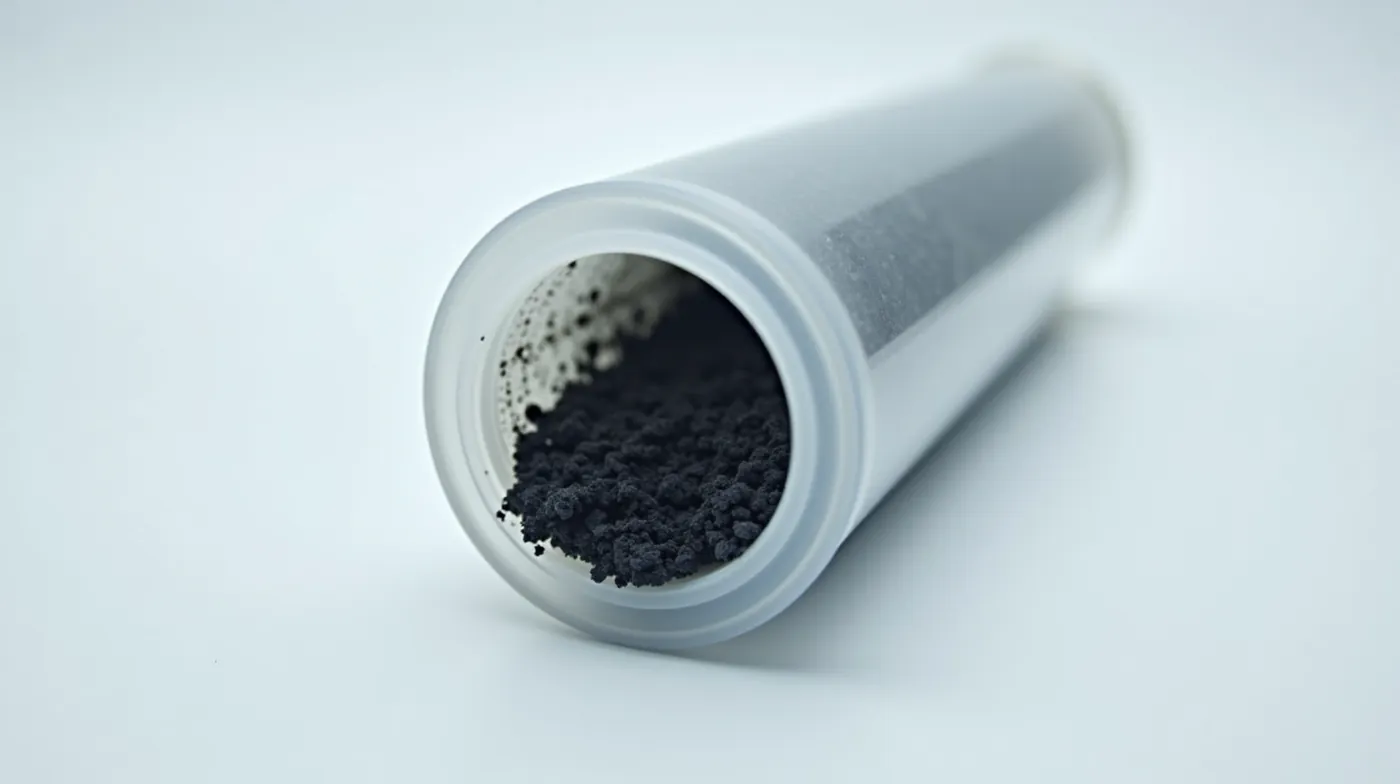
Carbon filtration is not really “filtering” in the way a sediment screen works. A mesh or cartridge traps solid particles by size; a carbon filter removes dissolved chemicals by adsorption — the process where molecules in the water stick to the surface of a solid material. Activated carbon is ideal for this because of its structure. The raw carbon (usually coconut shell, bituminous coal, or wood) is heated to 900 to 1,050 degrees Fahrenheit in a low-oxygen environment, which burns away the impurities and leaves behind a network of microscopic pores. A single pound of activated carbon can carry more than 1,000 square feet of internal surface area, giving dissolved contaminants an enormous amount of surface to grab onto.
In a well water system, water is pushed through the carbon bed under household pressure. Chlorine molecules, volatile organic compounds (VOCs), pesticides, and the organic compounds responsible for many taste and odor problems are hydrophobic — they prefer a non-polar surface like carbon to staying dissolved in water. As the water flows through, those molecules adsorb onto the carbon pores and are removed from the stream. This is the same mechanism that makes a carbon filter so effective at removing residual chlorine after you shock-chlorinate your well, or at polishing out the faint chemical edge that some wells carry naturally.
Two things make carbon different from the other stages in a well treatment system. First, it targets dissolved chemicals, which is a job most physical filters cannot do. Second, it has a finite capacity — the pores fill up over time, and once they are saturated the filter stops working and must be replaced. Understanding that capacity is the key to sizing and maintaining a carbon filter, which we cover below.
What a Carbon Filter Removes from Well Water (and What It Does Not)
One of the most common mistakes well owners make is expecting a carbon filter to do everything. It is an excellent polish stage for taste, odor, and specific dissolved chemicals — but it is not an iron filter, a softener, or a disinfectant. Before you buy anything, know exactly what a carbon filter for well water can and cannot remove, because that determines where it belongs in your system and whether you need other equipment alongside it.
| Contaminant | Removed by Carbon? | What You Actually Need |
|---|---|---|
| Chlorine | Yes — excellent | Carbon (removes residual chlorine after disinfection) |
| VOCs, solvents, gasoline compounds | Yes — strong | Carbon, ideally GAC sized for the compound |
| Pesticides & herbicides | Yes — most common ones | Carbon (GAC performs best) |
| Bad taste & organic odor | Yes — its main strength | Carbon polish stage |
| Iron & manganese | No | Iron/manganese removal system — see our iron in well water guide |
| Hardness (calcium & magnesium) | No | Water softener |
| Dissolved minerals / TDS | No | Reverse osmosis — see our TDS in well water guide |
| Bacteria & E. coli | No | UV sterilization or disinfection |
| Sand & sediment | No (and it clogs if you skip this) | Sediment pre-filter before the carbon |
The practical takeaway: a carbon filter is a targeted stage. If your main problems are iron or hardness, carbon alone will not solve them — but if your water tests clean on the safety front and simply tastes or smells off, or you need to strip residual chlorine, a carbon filter is often the single most satisfying upgrade a well owner can make.
Two Types of Carbon Filter for Well Water: GAC vs. Carbon Block
When you shop for a carbon filter for well water, you will run into two fundamentally different forms of the same media. Choosing between them is really a question of where in your home you want the carbon to work and how much water needs to flow through it at once.
1. Granular Activated Carbon (GAC)
GAC is loose, pelletized carbon — typically 0.5 to 2 millimeter granules packed into a tank. Because the water flows through the spaces between pellets rather than through a solid mass, GAC handles high flow rates well and is the standard choice for whole-house or point-of-entry carbon filtration. Water contacts many small pellets, which maximizes adsorption surface, and many GAC tanks can be backwashed to knock loose trapped sediment and extend media life. GAC is the right answer when you want to treat all the water entering the house, including after a well disinfection, or when your system demands 10 to 15 gallons per minute or more.
2. Carbon Block (Compressed)
A carbon block filter compresses fine carbon powder into a solid, porous block. Water is forced through the block’s micro-channels, which gives it a finer physical rating (often 0.5 to 10 microns) in addition to the adsorption. That makes carbon block excellent as a point-of-use polish at a drinking-water tap, where flow demand is low and you want the cleanest possible water for drinking and cooking. The tradeoff is that a block cannot handle a whole house’s peak flow, and once it is exhausted you replace the whole cartridge rather than the media.
| Feature | GAC (Granular) | Carbon Block |
|---|---|---|
| Form | Loose pellets in a tank | Solid compressed cartridge |
| Typical use | Whole house / point of entry | Under-sink / point of use |
| Flow rate | High (10 to 15+ gpm) | Low (0.25 to 2 gpm) |
| Filtration rating | 5 to 20 microns | 0.5 to 10 microns |
| Best for | Chlorine, odor, whole-home VOCs | Drinking-water polish at the tap |
| Maintenance | Replace media (1 to 3 yrs); some backwash | Replace cartridge (6 to 12 mo) |
| Typical cost | $150 to $600+ | $15 to $60 per cartridge |
How to Size a Carbon Filter for Your Well
Sizing a carbon filter comes down to matching the unit’s flow capacity to your home’s peak demand, then protecting the media so it does not clog. Follow these steps:
- Estimate your peak flow demand. Add the flow of the fixtures you would realistically use at the same time. A typical residential well system is designed around 10 to 15 gallons per minute. If you already know your pump’s rated flow, use that as your target.
- Pick GAC for whole-house treatment. Choose a GAC tank rated at or above your system’s flow rate. An undersized tank will lose pressure under load and exhaust its media quickly.
- Pick carbon block for a drinking tap. A single under-sink carbon block rated at 1 to 2 gpm is plenty for one kitchen or drinking-water faucet.
- Put a sediment pre-filter upstream. A 5 to 25 micron sediment filter before the carbon keeps sand and debris from plugging the carbon pores. This is especially important on wells that run any sediment — it can double the life of your carbon.
- Size the GAC tank for your water’s chemistry. Heavily chlorinated or VOC-laden water loads the carbon faster. When in doubt, go one tank size up for longer media life.
| Application | Recommended Type | Flow Target | Typical Size |
|---|---|---|---|
| Whole house | GAC tank | 10 to 15 gpm | 10 to 18 in. x 48 in. |
| Point of entry | GAC tank | Match pump flow | 8 to 12 in. x 44 in. |
| Drinking tap (under-sink) | Carbon block | 1 to 2 gpm | 10 in. x 4.5 in. cartridge |
Best Carbon Filters for Well Water in 2026
Based on our testing of flow performance, media quality, and long-term media cost, these are the carbon filters we recommend for well water this year. Each is linked so you can check current pricing.
Best Whole-House GAC: Whole House Carbon Water Filter System
The best carbon filter for well water when you want to treat everything entering the home. A 10-inch GAC tank with a pre-filter handles 10 to 15 gpm, strips residual chlorine and organic odor at every fixture, and is sized to sit inline with a standard submersible well system. Expect to replace the GAC media every one to three years depending on your water.
Whole House Granular Activated Carbon Water Filter
Best Under-Sink Polish: Carbon Block Drinking Water Filter
For the cleanest drinking and cooking water, a two-stage sediment-plus-carbon block under the sink is the sweet spot. The sediment stage protects the carbon, and the fine carbon block removes taste, odor, and residual chlorine at the tap. Cartridges are inexpensive and easy to swap every six to twelve months.
Carbon Block Drinking Water Filter (Under Sink)
Best Two-Stage Combo: Sediment and Carbon Combo Filter
If you want one compact unit that does both jobs, a two-stage combo filter pairs a 5-micron sediment cartridge with a carbon block in a single housing. It is the simplest way to add carbon polish to a well that runs a little sediment, and it installs in minutes under most sinks.
Two Stage Sediment and Carbon Water Filter
Best for Heavy Loading: GAC Tank with Backwash Valve
When your well carries noticeable sediment or you just want maximum media life, a GAC tank with a dedicated backwash valve lets you periodically flush the bed to dislodge trapped debris. It is the workhorse choice for higher-demand rural systems and the one we specify most often for whole-house carbon on a private well.
GAC Water Filter Tank with Backwash Valve
Where a Carbon Filter Fits in Your Well Water Treatment System
A carbon filter performs best as a polish stage — after the water has been cleaned of anything that would clog or poison the carbon, and before it reaches your fixtures. In a typical well water system the order looks like this: the well delivers water through the pump, a sediment pre-filter catches sand, any iron or manganese treatment runs next, then the carbon filter polishes out chlorine, VOCs, and taste-and-odor compounds, and finally a softener (if you have one) handles hardness. Placing the carbon before the iron filter, for example, would let iron foul the media within weeks; placing it after everything else means you are polishing already-treated water, which is exactly the job it is good at.
If your well is chlorinated or you have recently run a disinfection, the carbon filter is what removes the residual chlorine so the water does not taste like a pool at the tap. That is one of the most satisfying reasons well owners add a carbon stage: the safety work (disinfection, UV) and the taste work (carbon) are separate jobs, and doing both is what makes well water genuinely pleasant to drink.
Maintaining and Replacing Your Carbon Filter
A carbon filter does not fail suddenly — it simply gets tired. As the pores fill, the filter gradually loses its ability to grab contaminants, and the taste or odor you were treating starts to creep back. Watch for these signs and keep a simple replacement schedule:
- Carbon block (point of use): replace the cartridge every 6 to 12 months, or when flow at the tap noticeably drops, whichever comes first. Cartridges are cheap, so many owners simply swap them on a fixed calendar.
- GAC (whole house): replace the media every 1 to 3 years depending on loading. If your tank has a backwash valve, run a backwash every few months to dislodge trapped sediment and extend media life.
- Sediment pre-filter: replace this on its own shorter cycle (often 3 to 6 months on a well with sediment). A clean pre-filter is what protects your carbon and keeps its media life long.
- Exhaustion signals: chlorine or organic taste/odor returning, a measurable drop in flow, or the carbon starting to release fine black dust into the water all mean it is time to replace.
Pro tip
Keep a simple log of when you install each carbon element and what it was treating. After a couple of cycles you will know exactly how long your specific water lasts a given media — that is the single best data point for budgeting replacement cost and catching exhaustion before it affects taste.
See Also
- Chlorine Taste in Well Water 2026 — why your water tastes like a pool and the exact steps to remove residual chlorine.
- Sulfur in Well Water 2026 — causes, testing, and removal for that rotten-egg smell carbon alone cannot fix.
- Metallic Taste in Well Water 2026 — when the taste is from dissolved metals, what carbon will and will not do about it.
Frequently Asked Questions About Carbon Filters for Well Water
Can a carbon filter remove iron from well water?
No. Carbon does not remove dissolved iron or manganese — those need a dedicated iron/manganese removal system. If iron is present, it will actually foul a carbon filter and cut its life short, which is why an iron stage (or at minimum a sediment pre-filter) belongs upstream of the carbon.
How long does a carbon filter last?
A point-of-use carbon block typically lasts 6 to 12 months. A whole-house GAC tank’s media usually lasts 1 to 3 years, longer if you backwash and protect the media with a sediment pre-filter. Your specific water chemistry is the deciding factor — heavy chlorine or VOC loading exhausts carbon faster.
Do I need a sediment filter before my carbon filter?
On most wells, yes. A 5 to 25 micron sediment pre-filter keeps sand and debris from clogging the carbon pores. It is inexpensive, and it can meaningfully extend the life of the carbon media — one of the best-value additions to a carbon setup.
Will a carbon filter remove bacteria or E. coli?
No. Carbon is not a disinfectant and will not kill bacteria or E. coli. For microbiological safety you need UV sterilization or proper disinfection. Carbon’s job is dissolved chemicals, taste, and odor — a different problem entirely.
How do I know when my carbon filter is exhausted?
Watch for the treated taste or odor coming back, a noticeable drop in flow at the tap, or fine black carbon dust appearing in the water. Any of those means the media is saturated and it is time to replace the cartridge or the GAC media.
#CarbonFilter #WellWater #WaterQuality #WellWaterFilter #WaterTreatment #PrivateWell #ActivatedCarbon #CleanWater #WellOwner #DrinkingWater #WaterFiltration #WellSystem #TasteAndOdor #WellMaintenance #HomeWater