
Turn on the tap and find a film of orange residue waiting in the glass, or see rust-colored rings in the toilet bowl that no cleaner will shift — iron in well water is behind it far more often than most homeowners realize. Iron is the fourth most abundant element in the Earth’s crust, so finding some of it in groundwater is normal; the questions that matter are how much is there and in what form. It is also the single most common reason well owners call about water quality, and unlike most contaminants it is easy to spot and very easy to treat once you know which version you are dealing with. In this 2026 guide you will learn how to recognize iron in well water, what the EPA’s safe level actually says, why iron shows up in the first place, how to test for it yourself, and which removal systems actually work — with real 2026 cost ranges and a step-by-step plan you can follow.
By Thomas Reynolds, Pump Systems Engineer
Thomas has installed and serviced over 1,000 well pump systems for homeowners.
Last updated: October 29, 2026
Disclosure: As an Amazon Associate, we earn from qualifying purchases on this page. Product selections are based on independent research and real well water data.
What Iron in Well Water Looks Like
Iron announces itself visually almost every time, and the pattern of the staining tells you a lot about which form of iron is in the water. From thousands of on-site visits, the signs we check for first are:
- Orange or rust-colored staining on fixtures. Rings and film in the toilet bowl, tub, sink, and shower glass that form around the waterline and resist normal cleaning. This is the classic signature of dissolved iron oxidizing on contact with the air inside the fixture.
- Yellow, orange, or red-tinted water. When the water is already colored at the tap, the iron is suspended (ferric) rather than dissolved. Owners sometimes describe it as tea-colored, and industry shorthand calls it a red well.
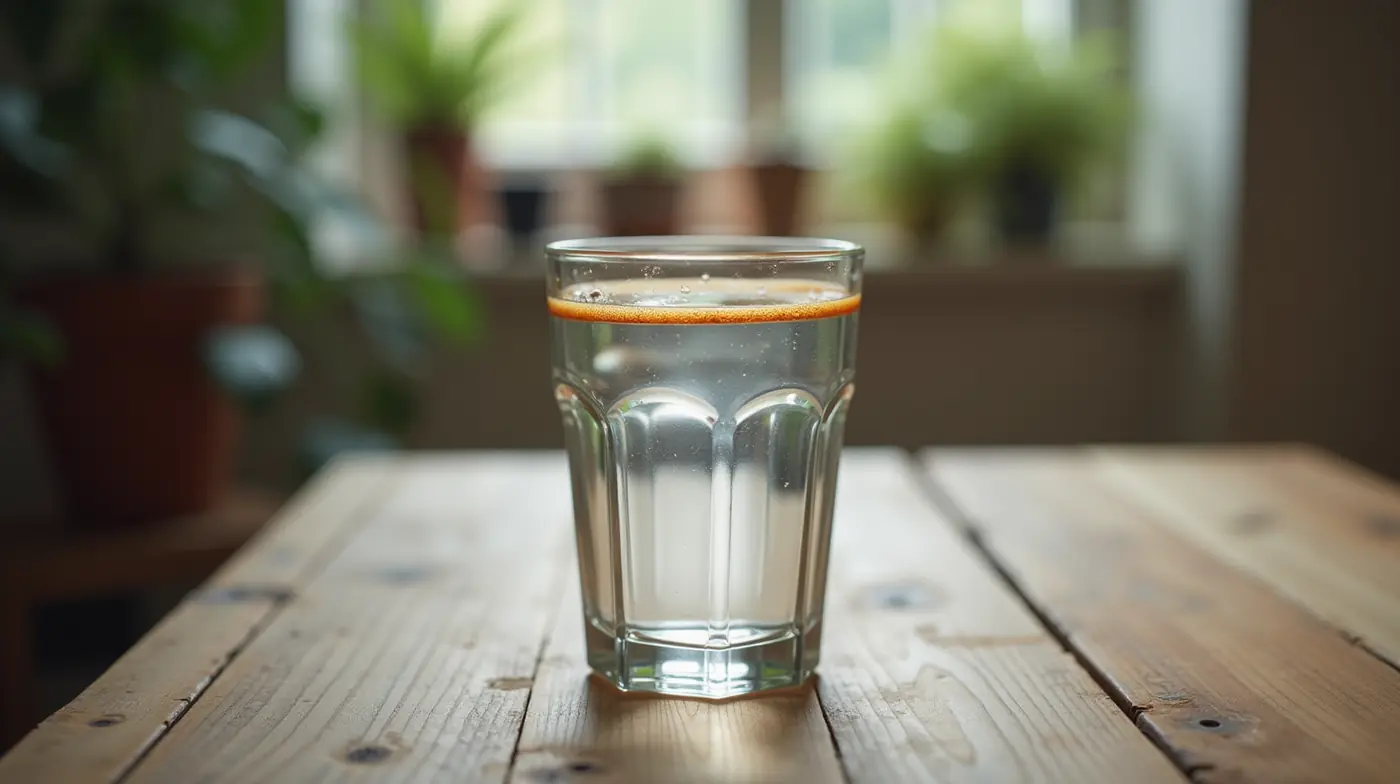
- Clear water that turns orange when it sits. Fill a clear glass and leave it for a few hours or overnight. If it starts out clear and then develops color, or a rust ring at the surface, the iron was dissolved and is oxidizing in the glass — a different treatment path entirely from red well water.
- Metallic or bitter taste. Noticeable at levels above roughly 0.3 mg/L, and strongest when the water has sat in a tank or pipe overnight.
- Dark spots and specks. Black specks on dishes or in the bowl often mean manganese is traveling with the iron — our guide to manganese in well water covers the black-staining twin of this problem.
- Stringy tan or brown masses. Hair-like clumps at the wellhead, in the pressure tank, or inside a filter housing are almost always iron bacteria — alive, active, and clogging whatever they attach to.
Quick Test: The Glass Test
Fill a clear glass at the cold tap and set it aside for 24 hours. Water that is colored immediately is carrying suspended iron. Water that starts clear and turns orange, or leaves a rust ring at the surface, carries dissolved iron. Water that stays clear but still leaves stains on fixtures has iron too — it just oxidizes on contact with air in the pipes and fixtures, not in the glass. The glass test is a screening tool, not a measurement; a lab panel is what sizes the treatment system.
Types of Iron in Well Water
Getting the type right matters more than getting the number, because the fix is different for each. There are three forms you will encounter in a private well:
- Dissolved iron (ferrous, Fe2+). Invisible in the water itself. It lives in low-oxygen aquifers in a form your eye cannot see, then oxidizes the moment it meets air — in your tank, your pipes, your glass, your laundry. The water looks clear and the stains are the tell.
- Suspended iron (ferric, Fe3+). The water is already yellow to red at the tap because the iron oxidized in the aquifer or well. It settles as a rust-colored sediment in glasses and tanks. This is the industry’s red well.
- Iron bacteria. Bacteria that consume dissolved iron or build colonies on it. They are not a human health risk in themselves, but they produce the stringy brown masses that clog well screens, pipes, and filters — and they trap manganese along the way, which is why the two problems so often appear together.
Field Insight: Type Beats Number
Two wells can both test 2.0 mg/L of iron and need completely different systems. One is a clear-water well with dissolved iron that oxidizes downstream — it wants a modest oxidation media filter. The other is a red well with suspended iron plus a bacteria problem — it wants well disinfection first, then a sediment prefilter feeding an aeration system. The measured number sizes the media; the form of the iron chooses the machine.
Iron in Well Water: Safe Levels and Health Effects
The regulatory answer surprises people: the EPA has no enforceable maximum contaminant level (MCL) for iron. Instead, the agency set a secondary drinking water standard of 0.3 mg/L (0.3 ppm) — an appearance-and-taste standard in the same class as hardness and color. It exists because staining and metallic taste are what make water feel unsafe, not because iron at these levels is acutely toxic. Several states set stricter limits for public systems, so check your state’s rules if your well supplies more than your household. The full list is in the EPA’s secondary drinking water standards.
On health, iron is one of the few contaminants that is genuinely essential — your body needs it to build hemoglobin. The levels typical of private wells are not an acute hazard. The groups that warrant real attention:
- People with hemochromatosis. An iron-overload condition means you should treat water iron as a health issue, not a cosmetic one — get a lab number and keep treated water below 0.3 mg/L.
- Very high levels (above 3 to 5 mg/L). Chronic consumption of heavily iron-laden water can cause gastrointestinal irritation and, over time, extra iron loading on the liver. Treat before relying on the water for daily drinking.
- Infants on formula. If formula is being mixed with well water and the iron level (or co-traveling manganese and nitrate) is unknown, get a certified lab test before continuing.
Here is how we classify a lab result for a private well:
| Measured Level | Classification | Recommended Action |
|---|---|---|
| Below 0.3 mg/L | At or below the EPA secondary standard | No treatment needed. Monitor with an annual lab test. |
| 0.3 to 1.0 mg/L | Above the secondary standard | Treat if staining is a nuisance; a softener may suffice where hardness is also high. |
| 1.0 to 3.0 mg/L | Elevated | Treatment recommended — an oxidation media filter is the standard fix. |
| Above 3.0 mg/L | High | Full treatment (aeration or chlorination plus media filter); retest after installation. |
Source: EPA secondary drinking water standard for iron (0.3 mg/L); state limits vary. Classifications reflect our treatment-installation practice.
Why Iron Shows Up in Well Water
Iron is the fourth most abundant element in the Earth’s crust, so a background concentration in groundwater is universal — what varies is whether it stays dissolved or comes out of solution, and whether your plumbing adds its own. From our field work, the drivers we see most often:
- Geology of the aquifer. Iron-rich sandstone, shale, and glacial deposits leach steadily into groundwater. Regions built on these formations — much of the Midwest, parts of the Mountain West and Southeast — produce iron wells at a much higher rate.
- Low pH. Acidic water (pH below 7) dissolves iron far more aggressively. A well whose pH drifts down over the years often develops a staining problem with no other visible change, which is why pH and iron are always tested together.
- Low oxygen in the aquifer. In reduced (anaerobic) conditions, iron stays dissolved and invisible until it is pumped to the surface and meets air. This is the classic clear-water, orange-stain profile.
- Rusting well infrastructure. Steel well casings, old iron or galvanized distribution pipes, and corroded fittings in the pump pit can contribute iron of their own — sometimes enough to stain fixtures even when the aquifer water tests low.
- Iron bacteria blooms. A new bacterial colony can suddenly add stringy masses and raise apparent iron and manganese levels without any change in the aquifer itself.
- Seasonal water-table shifts and well work. A dropping water table draws water from different zones of the aquifer, and drilling, surging, or pump replacement stirs up iron that had been stable in sediment for years.
Pro Tip: The Rusty-Pipe Check
If your lab test shows low iron at the tap but your fixtures still stain, the source may be your own distribution piping rather than the well. Run the coldest tap for five full minutes and test that flushed water separately. If the flushed water is clean, the pipes are the problem — and the fix is a pipe replacement or liner, not a $3,000 treatment system.
How to Test for Iron in Well Water
A certified lab test is the only number you should size equipment against. DIY tools are fine for confirming a suspected problem and for trending between lab tests, but strips under-report at low levels, and that is exactly the range where the right system choice flips. Here is the lab process:
- Order a basic well water panel from your state health department or a certified environmental lab that includes iron, manganese, pH, hardness, and coliform bacteria. Testing them together costs only a little more and prevents a second sampling trip.
- Sample from the cold tap closest to the house after running the water 2 to 3 minutes to flush the pipe. Fill the lab bottle to the line, label it, and refrigerate or cold-ship per the lab’s instructions — a warm, sitting sample gives a wrong answer, not no answer.
- Budget roughly $30 to $100 for the panel and expect results in 3 to 7 days.
For DIY screening between lab tests, two options work well:
- Well water iron test kits (liquid reagent type) detect from about 0.3 mg/L up to 10+ mg/L by color comparison — the right tool for monthly trending once you know you have a problem.
- Well water test strips give a 30-second screen with a detection floor around 0.3 mg/L. Use them to decide whether a full lab order is worth it. Our full roundup of the best options is in the well water test kit guide, and the sampling walkthrough is in our how to test your well water guide.
The Strip-Test Trap
Color strips compare against a fixed chart, and at 0.2 to 0.5 mg/L the color differences are within the margin of error of the human eye. A strip that reads 0.3 could really be 0.2 or 0.5 — and that difference decides whether a softener is enough or you need a dedicated iron filter. Trust strips for trending; trust a lab for sizing.
Best Ways to Remove Iron From Well Water
Which system is right depends on three things: your measured level, the form of the iron (dissolved, suspended, or bacterial), and what is riding along — hardness, manganese, or a hydrogen-sulfide odor. Here is how the mainstream approaches compare, based on our field data and installed-cost surveys:
| Method | Effective Range | How It Works | Typical Installed Cost |
|---|---|---|---|
| Water Softener (KPM / Mn Resin) | Up to about 1 mg/L | Ion exchange removes dissolved iron at the same time as hardness; the resin bed must be regenerated on schedule | $1,000 to $2,500 |
| Birm or Greensand Media Filter | 0.3 to 5 mg/L | Water is pre-oxidized with air or a chlorine shot, then passes through manganese-coated media that traps rust and renews itself during backwashing | $1,500 to $4,500 |
| Greensand / KPM Filter | Up to about 3 mg/L iron, plus hardness | A softener-style tank filled with potassium permanganate greensand handles iron, hardness, and some manganese in one unit | $1,200 to $3,500 |
| Aeration + Media Filter | 2 to 10+ mg/L, or any H2S odor | Air is injected or diffused to oxidize dissolved iron (and sulfur), which then falls out as rust and is caught in a media bed | $1,500 to $4,000+ |
| Point-of-Use (RO or Carbon) | Taste and odor only | A kitchen faucet RO unit or carbon filter polishes residual taste at one tap; never a whole-house answer for iron | $300 to $1,500 |
Source: Installed-cost ranges from 2026 installer quotes across the western and midwestern US; media ranges reflect manufacturer ratings.
Pro Tip: When the Softener Is the Whole Answer
If your iron is under about 1 mg/L, your water is hard, and there is no odor, a properly sized softener with KPM or manganese greensand resin is the cheapest fix that will ever work — one unit, one salt bin, one backwash valve. The moment iron climbs above roughly 1 mg/L or an odor shows up, the softener becomes a companion unit rather than the answer. Sizing details are in our water softener buyer’s guide.
How to Fix Iron in Well Water: Step-by-Step
Here is the exact sequence we follow on site, in the order it has to happen:
- Get the lab number first. A certified panel with iron, manganese, pH, and hardness. No equipment gets sized on a strip test or a glass test.
- Identify the form. Clear water with orange stains means dissolved iron. Colored water at the tap means suspended iron. Stringy masses mean iron bacteria, which means the well needs shock chlorination before any filter will hold up.
- Do the rusty-pipe check. Run the coldest tap for five full minutes and test the flushed water. If it is clean, fix the pipes, not the well.
- Match the system to the chemistry. Under 1 mg/L with hard water: softener. One to 3 mg/L: oxidation media filter with a small air or chlorine pre-oxidation stage. Above 3 mg/L or any odor: aeration plus a media filter. Add a sediment prefilter whenever the water carries visible particles.
- Install with protection. A $40 to $150 sediment prefilter in front of a media filter doubles the life of the media — it is the cheapest maintenance you will ever buy.
- Retest 2 to 4 weeks after installation. Confirm the tap is below 0.3 mg/L, then retest once a year at the same season and after any drought or well work.
Where to Buy Iron Treatment and Testing Products
Everything in this guide is available as a search-linked product. These are the items we reach for most, with the price ranges we see in 2026:
| Product | Role in the System | Typical Price |
|---|---|---|
| Well Water Iron Test Kit | Confirms and trends your iron level between lab tests | $25 to $60 |
| Well Water Test Strips | 30-second multi-parameter screen | $15 to $40 |
| Birm Media Filter, 1 cu ft | Whole-house oxidation and filtration of dissolved iron | $900 to $2,500 |
| Greensand / KPM Filter, 1 cu ft | Iron, hardness, and some manganese in one softener-style unit | $1,200 to $3,500 |
| Well Water Aeration System | Pre-oxidation for high iron levels and rotten-egg odor | $1,500 to $4,000 |
| Chlorine Injection System | Compact pre-oxidation and bacteria control for the well line | $150 to $400 |
| 5-Micron Sediment Prefilter | Protects the media filter and fixtures from rust particles | $40 to $150 |
All links are Amazon search results; compare tank capacity, flow rating, and warranty before purchasing, and confirm the unit is rated for iron at your measured level, not just for well water. For a deeper comparison of the filter families, see our iron filter buyer’s guide.
Frequently Asked Questions
Is iron in well water dangerous?
At the levels most wells produce (0.3 to 3 mg/L), no — the EPA’s 0.3 mg/L limit is a secondary, appearance-based standard, not a health MCL, and trace iron is essential to the body. The exceptions are people with iron-overload conditions like hemochromatosis, very high levels above 3 to 5 mg/L, and infants on formula mixed with untreated water. For those groups, treat it as a health issue and confirm removal with a post-treatment lab test.
Why does my well water taste metallic?
A metallic or bitter taste is the classic taste signature of iron, usually noticeable above 0.3 mg/L and strongest when the water has sat in a tank or pipe. It can also come from manganese or, rarely, from a failing pump or corroded fittings leaching metals. A lab panel tells you which metal is responsible; a point-of-use carbon or RO filter at the kitchen tap removes the taste fastest while a whole-house system solves the source.
Can a water softener remove iron from well water?
Yes — at low levels. Standard resin handles a modest iron load alongside hardness, and potassium permanganate greensand (KPM) or manganese greensand resin pushes that to roughly 1 mg/L of iron. Above that, or if you have any odor or suspended rust, the softener becomes a companion unit behind a dedicated oxidation media filter rather than the whole answer.
Why did my well water suddenly turn orange?
A sudden change means the water chemistry or the plumbing changed, not the aquifer overnight. The usual triggers: a drop in pH, a seasonal water-table shift drawing from a different zone of the aquifer, iron bacteria blooming after well work or a surge, or a rusting casing or pipe starting to contribute. Run the five-minute tap flush, test the flushed water, and order a lab panel — the pattern of the three answers tells you which cause is at work.
How do I get rid of iron bacteria in my well?
With shock chlorination (super-chlorination) of the well: a high chlorine dose left in the well for 12 to 24 hours, then drawn off completely. It is the same process as a routine well disinfection, and it is what clears the stringy masses before a filter is installed — otherwise the bacteria will clog the media within months. If blooms keep returning, a small continuous chlorine injection at the well line keeps them in check.
The Bottom Line on Iron in Well Water
Iron in well water is the most common water quality problem in private wells, it is rarely a health emergency at typical levels, and it is very treatable once you know the form. The winning sequence is always the same: confirm the level with a certified lab test, identify whether the iron is dissolved, suspended, or bacterial, check that your own piping is not the contributor, then match the system to the chemistry — softener for low levels with hard water, oxidation media for moderate levels, aeration for high levels or any odor. Retest after installation and once a year, and the orange stains stay in the past.
See Also
- Iron Filter for Well Water 2026 — the companion buyer guide: which filter family, media, and tank size fits your measured level.
- Brown Well Water 2026 — when the problem shows up as tea-colored water, how to tell iron apart from sediment and pipe corrosion.
- Water Softener for Well Water 2026 — sizing and selecting a softener when hardness is riding along with your iron.
#Iron #WellWater #PrivateWell #WellWaterQuality #WaterTesting #IronRemoval #WellOwner #WaterTreatment #WellMaintenance #Groundwater #WaterStains #WellPump #WaterSafety #HomeWell #WellInspection