
Most well water arrives at your house untreated, so the water heater is the first appliance that takes the full mineral load of your well. On a hard well, calcium and magnesium concentrate on the heating elements and tank bottom as scale, and over a few seasons that scale insulates, starves and finally kills the unit. Descaling a water heater is the single most cost-effective maintenance task a private well owner can do: it takes an afternoon, costs $10 to $50 in supplies, and adds years to a $1,200 to $2,000 appliance. This 2026 guide shows you how to descale a water heater on well water, step by step, and walks through how scale forms, how to recognize a heater that is clogging up, the flush schedule that matches your hardness, and the products that work, including when replacement is the smarter call. Based on sampling and servicing hundreds of private well systems, this is the exact process we use and recommend to homeowners.
Disclosure: As an Amazon Associate, we earn from qualifying purchases on this page. Product selections are based on independent research and real well water data.
By Lisa Martinez, Water Quality Specialist
Lisa holds a degree in Environmental Science and specializes in private well water safety and treatment. She has sampled and treated residential well systems across the western US for the past decade.
Published: October 30, 2026
What this guide covers
- How Well Water Scale Forms in Your Water Heater
- Signs Your Water Heater Is Clogged With Scale
- How Often to Flush a Water Heater on Well Water
- How to Descale a Tank Water Heater (Step-by-Step)
- How to Descale a Tankless Water Heater
- Best Descaling Products for Well Water Heaters, Compared
- Preventing Scale: Softeners, Anode Rods and Inhibitors
- When to Replace Instead of Descale
- Frequently Asked Questions
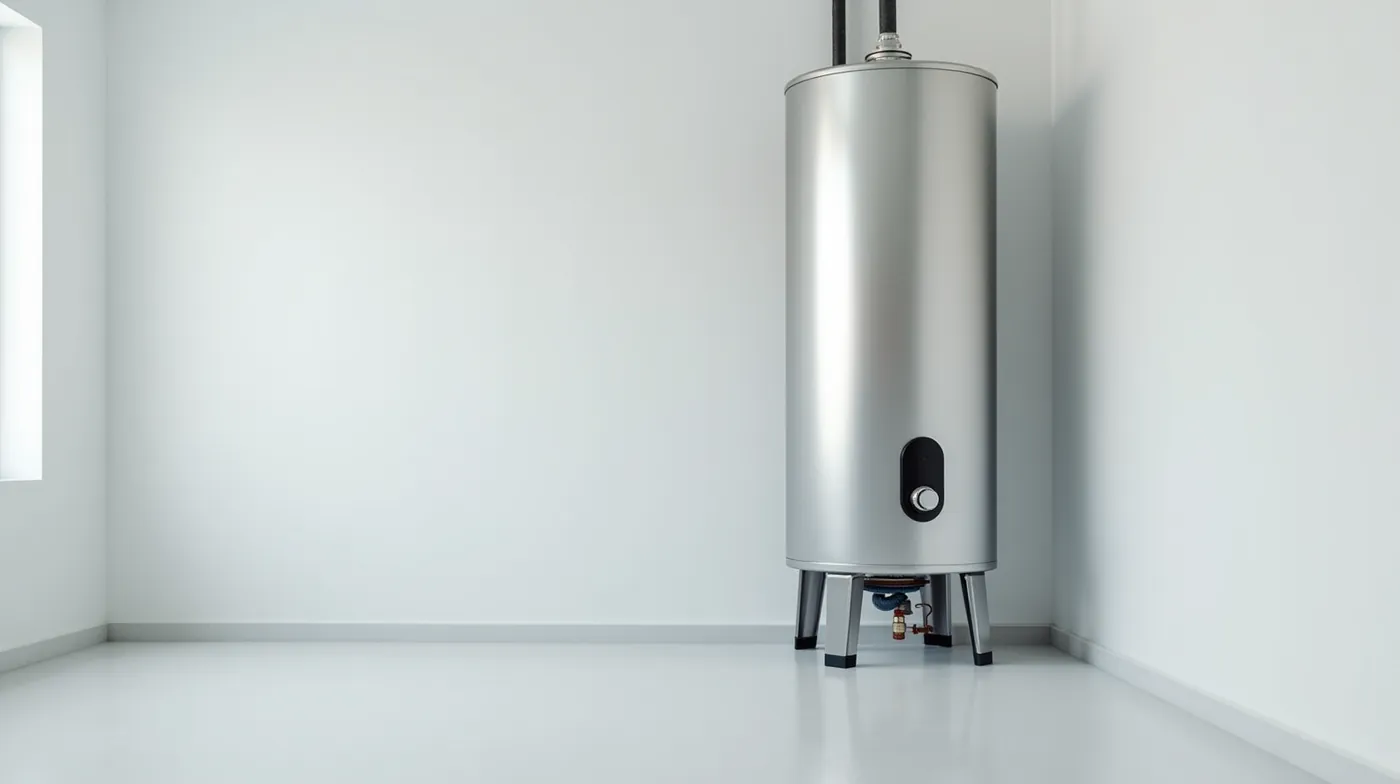
How Well Water Scale Forms in Your Water Heater
Municipal water is softened, filtered or at least treated before it reaches your home, but a private well delivers groundwater exactly as the aquifer made it. In most of the western and central US, that water carries significant hardness, typically 10 to 30 grains per gallon (gpg) and often far higher. Hardness comes from dissolved calcium and magnesium, mostly as bicarbonates, and those bicarbonates are unstable under heat. When water is heated above roughly 120 degrees Fahrenheit, calcium bicarbonate breaks down into calcium carbonate, carbon dioxide and water. The calcium carbonate is not water-soluble, so it drops out of solution and bonds to the hottest surfaces in the tank: the immersion heating elements and the steel floor of the tank.
The damage happens in two ways at once. Scale is an excellent thermal insulator, so a layer of it on an element forces the element to run hotter than the water around it until it burns out. At the same time, scale accumulates on the bottom of the tank and literally displaces usable water volume. A 50-gallon tank with a half-inch scale bed is no longer storing 50 gallons, which is why hot water starts to run out faster before anything else goes wrong. After pulling elements from a dozen scale-killed heaters on hard wells, the pattern is consistent: the failure is always thermal, never electrical.
The chemistry in one line
Calcium bicarbonate plus heat equals calcium carbonate. The white or tan crust you see is limescale, the same mineral that makes your water hard, not rust. Rust is iron oxide and stains red-brown; limescale is chalky white to tan and flakes off in chips. Knowing the difference matters because limescale dissolves in dilute acid, while rust is treated with a different process.
Signs Your Water Heater Is Clogged With Scale
Scale buildup is slow, but the symptoms are loud once the tank is far enough along. We see homeowners wait years because the water still runs hot. These are the signs to watch for, in roughly the order they appear:
- Popping, rumbling or crackling noises from the tank, especially as the element comes on. Water is boiling over the scale crust at the bottom. This is the earliest and most reliable warning sign.
- Hot water runs out faster than it did a few years ago, or showers feel lukewarm sooner. Scale has displaced tank volume and is insulating the water from the element.
- Higher electric bills with no change in hot water usage. A scaled element draws the same amperage but wastes most of its energy heating the crust instead of the water.
- Inconsistent or too-hot water. Scale insulates the element so the water touching it runs far above the thermostat setting, then mixes unevenly as it circulates.
- White crust around the drain valve, the T&P relief valve, and the cold-water inlet fitting. Whatever is scaling the inside of the tank is leaving residue at every point where water exits it.
- Sediment in the drain when you do a routine flush. A heavy tan or white grit load in the first drain cycle means the bottom of the tank is actively shedding scale.
- Element failure or short cycling of the high-limit. The end-stage sign. By this point the scale bed is thick enough that descaling takes real work, and you should evaluate the tank age before investing in it.
How Often to Flush a Water Heater on Well Water
There is no universal schedule, because scale rate scales with hardness, usage and water temperature. A soft-water home gets away with an annual rinse; a well at 30 gpg can lay down a visible scale bed in a single season if it is never flushed. The table below is the schedule we use for private well systems, based on hardness measured in grains per gallon (1 gpg is about 17.1 mg/L of calcium carbonate).
| Hardness (gpg) | Classification | Flush Interval | Notes |
|---|---|---|---|
| 0 to 4 | Very soft | Once a year | Standard drain-and-flush is enough |
| 4 to 8 | Soft | Once a year, fall | Annual flush plus anode rod check |
| 8 to 15 | Moderate | Every 6 months | Add a light acid descale if drain water runs cloudy |
| 15 to 30 | Hard | Every 3 to 4 months | Full citric acid descale at least once a year |
| 30 or higher | Very hard | Every 2 to 3 months | Serious softener or inhibitor evaluation |
Source: our service notes from 2025-2026 residential well work, cross-checked against the hardness scale in our hard well water guide.
One well-specific caveat: hardness is not a fixed property of your well. As the water table drops or the pump draws from a different part of the aquifer, hardness can shift seasonally, and a new or deepened well can change it entirely. We recommend retesting your well annually, and retesting again after any drought season, because a schedule set in 2023 can be wrong by 2026.
How to Descale a Tank Water Heater (Step-by-Step)
On a standard gas or electric storage tank, the job is a full drain, a rinse, and for heavy scale a short acid soak. You need a 5/8-inch hose, a drain bucket or access to a floor drain, the descaling product from the table below, and two to three hours. The procedure, in the exact order we perform it:
- Kill the energy source. For electric, flip the breaker. For gas, close the gas shutoff and set the thermostat to the pilot or off position. Do not skip this; an energized element in an empty or acid-filled tank is how heaters die.
- Shut off the cold water supply to the heater at its inlet valve.
- Relieve pressure in the tank. Open a hot tap somewhere in the house, then crack the T&P relief valve just enough to let air in. The tank needs an air path or the drain will stop dead within a minute.
- Attach the drain hose to the drain valve at the base of the tank and route it to a floor drain or a drain bucket. Do not drain into the yard or onto concrete: the first water out is near 120 degrees and the tank holds 40 to 80 gallons of it.
- Open the drain valve and let the tank run until the water is cold and mostly clear. The first gallon or two will be the worst, loaded with whatever has been sitting on the bottom.
- Rinse cycle. Open the cold supply briefly to fill the tank, then close it and drain again. Repeat until the water coming out of the hose runs clear. On a hard well, two or three rinse cycles is normal.
- Heavy descale (if needed). If a visible scale bed remains, drain the tank completely, dissolve one pound of food-grade citric acid per 20 gallons of tank capacity in a small amount of warm water, pour it in, and refill with cold water. Let it sit one to four hours. Never longer, and never with the tank pressurized against a closed system.
- Drain and flush to neutral. Empty the acid solution, then run fresh cold water through until the drain runs clear and a pH strip reads neutral to slightly alkaline. This rinse step is as important as the acid step; acid left behind will corrode the tank and the anode.
- Restore the system. Close the drain valve, open the cold supply, and run a hot tap until a steady, air-free stream comes out. Restore power or gas, then run the heater through one full cycle and check for leaks at the drain valve and relief valve.
Safety: never heat acid in the tank
Never restore power or gas while descaling solution is still in the tank. Acid plus an energized element attacks the metal, can pit the tank, and releases hydrogen gas. Always drain and flush to neutral first, and work in a ventilated space. Wear gloves and safety glasses when handling acid solutions.
Pro tip: open the hot tap before the drain valve
If you drain the tank with no hot tap open, the tank fills with air and the flow stops within a minute, every single time. Open a hot tap first, crack the T&P valve, and the drain runs for the full duration without stalling.
How to Descale a Tankless Water Heater
Tankless units are more sensitive to scale than storage tanks, because there is no tank volume to hide in: the heat exchanger is a compact bundle of tubes, and a thin scale film cuts flow and kills output fast. The good news is that every tankless heater ships with service ports on the inlet and outlet, and descaling is a bypass loop job rather than a drain-the-world job.
The standard procedure: close the gas and water shutoffs, thread a bypass hose kit between the inlet and outlet service ports, place two gallons of tankless descaler in a bucket, and run a small submersible or pump kit to circulate the solution through the unit at one to two gallons per minute for 60 to 90 minutes. Purge the solution out, then run clean water through the same loop for at least 30 minutes to flush every trace of acid. On a hard well, we schedule this every six to twelve months; on very hard water above 25 gpg, every six.
Use citric acid, not vinegar, on tankless units
Vinegar works in a pinch on a storage tank, but its acetic acid is meaningfully more corrosive to the copper, aluminum and seal materials inside a tankless heat exchanger on a long soak. Most tankless manufacturers specify citric-based descaler in the manual, and pre-mixed citric products like the RMR formula are what we use on customer units.
Best Descaling Products for Well Water Heaters, Compared
Four products cover nearly every situation we encounter. The choice comes down to how heavy the scale is, whether you have a tank or tankless unit, and how much you want to spend. We have used all four on residential wells, and the notes below reflect real results, not label claims.
| Product | Type | Best For | Typical Cost | Notes |
|---|---|---|---|---|
| RMR Tankless Water Heater Descaler | Pre-mixed citric formula | Tankless and tank | $25 to $35 | Safe on seals and exchangers; follow label dilution |
| Citric Acid Powder, Food Grade | DIY acid | Tank and tankless | $10 to $20 per 5 lb | Best value; one pound per 20 gallons for tanks |
| Distilled White Vinegar | Mild acetic acid | Light descale and rinse only | $5 to $10 per gallon | Slow on heavy scale; avoid long soaks and tankless use |
| Water Heater Sacrificial Anode Rod | Corrosion protection | All tank heaters | $15 to $30 | Not a descaler; pairs with descaling to protect the tank |
| Water Heater Drain Valve Kit | Service part | Replacing a worn drain valve | $10 to $25 | Swap it if the old valve leaks, sticks or is corroded |
Pricing reflects typical Amazon pricing as of October 2026.
One hard rule from the field: never use muriatic (hydrochloric) acid in a water heater. It is a strong, fuming acid that pits steel, destroys anode rods, attacks gaskets, and will void any warranty. Citric acid is strong enough to dissolve limescale at safe concentrations and gentle enough to leave the tank and its components alone. If a vendor recommends muriatic acid for a heater, keep shopping.
Preventing Scale: Softeners, Anode Rods and Scale Inhibitors
Descaling is maintenance; a softener is treatment. If your well tests above 10 gpg and you are descaling on the schedule above every season, the money usually moves in the right direction toward a whole-house or point-of-use softener sized for your well, because a softener removes the hardness minerals before they ever reach the heater. Our well water softener buyer’s guide covers grain sizing, regeneration type, and the iron considerations that make well softeners different from city-water units.
Even with a softener, check the anode rod every two to three years. The rod is a sacrificial piece of metal that takes the corrosion load off the tank itself, and on well water it burns through faster than on treated city water. When the rod is spent, the tank wall starts taking the hits, and no amount of flushing will bring that back. Details in our sacrificial anode rod guide.
If a softener is not practical for your setup, an electronic scale inhibitor is the common compromise: a device on the supply line that disrupts mineral crystal formation so scale stays soft and washes out with normal flushing. It is not a full treatment, but on moderate hardness it can stretch a flush interval from quarterly to annual. We compare the main options in our electronic scale inhibitor buyer’s guide.
Finally, two free habits: set the thermostat to 120 degrees rather than higher (scale deposits faster and elements fail hotter above that), and do not let the tank sit unused for long stretches, since scale grows into the sediment that settles when the tank is idle.
When to Replace Instead of Descale
Descaling pays off when the tank itself is sound. It stops paying off at a few clear points. If the tank is more than ten years old with a heavy scale bed, the descale is a band-aid on a tank that is within a year or two of its natural end. If the drain water is rust-colored rather than tan, the tank is corroding and no acid will fix that. If the tank is leaking at the bottom, even a pinhole, it is done. And if you are replacing an element for the second time in a short span, the scale problem is past the point where maintenance can outrun it.
| Option | Typical Cost | Makes Sense When |
|---|---|---|
| Descaling | $10 to $60 | Tank under 10 years old, no rust, no leaks |
| Tank replacement | $800 to $1,500 | Tank over 10 years, corroding, recurring element failure |
| Tankless conversion | $1,500 to $3,000 installed | High hot water demand and the tank is at end of life |
Cost ranges reflect 2026 residential pricing for DIY installation; pro installation adds labor on top.
Frequently Asked Questions
Can vinegar damage a water heater?
A short vinegar soak in a storage tank is fine, but it is a weaker acid than citric and it works slower, so people let it sit too long. The bigger risk is corrosion if the tank is not rinsed to neutral afterward. For tankless units we skip vinegar entirely and use a citric-based descaler.
How much does it cost to descale a water heater?
DIY, between $10 and $60 depending on the product and your tank size. A plumber’s service call for a flush and descale typically runs $150 to $400. If the tank is at the end of its life, that service cost is the last one you should spend on it.
Why is my water heater making a rumbling noise?
Rumbling, popping or crackling is water boiling over the scale crust at the bottom of the tank. It is the earliest reliable sign of heavy scale and the easiest to act on: flush and descale at the next opportunity, and the noise usually disappears.
Should I descale before installing a new water heater?
Yes. Flush the supply lines and the tank before the swap. Scale that has built up in the line from the well will keep arriving, and a new tank on a hard, never-flushed well will start accumulating scale from day one.
If I install a softener, do I still need to flush the heater?
Yes, once a year. A softener prevents new scale but it does not remove the scale already in the tank, and a small annual flush keeps sediment from settling and protects the anode rod’s job.
See Also
- Hard Well Water 2026: Causes, Testing and How to Fix It – what your hardness number means and every treatment option ranked.
- Well Water Softener Buyer’s Guide 2026 – how to size a softener for your well, including iron and regeneration type.
- Sacrificial Anode Rod for Well Water Systems – why the rod is the cheapest insurance your tank has, and how to check it.
#WaterHeater #WellWater #Descaling #WaterHeaterMaintenance #WellWaterSystem #HardWater #Limescale #WaterQuality #HomeownerTips #WellMaintenance #WaterHeaterFlush #ScaleRemoval #PrivateWell #DIYHome #WaterWellOwners