
For the thousands of homesteaders and small-flock owners raising goats on well water, the question comes up fast every spring: can goats drink well water? The short answer is yes — dairy goats, meat goats, pygmy goats, and kids drink well water across the country every day — but only if you know exactly what is in that water. Untested well water can carry bacteria, nitrates, sulfur, heavy metals, and dissolved salts that quietly hurt a flock long before you notice: low milk yields, scours in kids, slow weight gains, and in serious cases, nitrate poisoning. What makes goats different from other livestock is that they are noticeably more sensitive than cattle to several of these contaminants, which means a well that passes comfortably for a beef herd can still be too risky for your does and kids. This 2026 guide covers what well water for goats really means, the contaminants that matter most for a flock, exactly what to test, the safe levels the research points to, and the treatment and watering setups that make well water safe and reliable for your goats all year.
Disclosure: As an Amazon Associate, we earn from qualifying purchases on this page. Product selections are based on independent research and real well water data.
By Lisa Martinez, Water Quality Specialist
Lisa holds a degree in Environmental Science and specializes in private well water safety and treatment. She has evaluated well water for hundreds of homesteads, small farms, and livestock operations across the western US.
Published: November 2026
Table of Contents
- Can Goats Drink Well Water?
- Why Well Water Can Be Dangerous for Goats
- Well Water Testing for Goats: What to Test and How
- Safe Levels for Goats: What the Research Says
- How to Treat Well Water for Goats
- Best Watering Setups for Goats on Well Water
- Common Mistakes to Avoid
- Well Water for Goats: FAQ
- Bottom Line
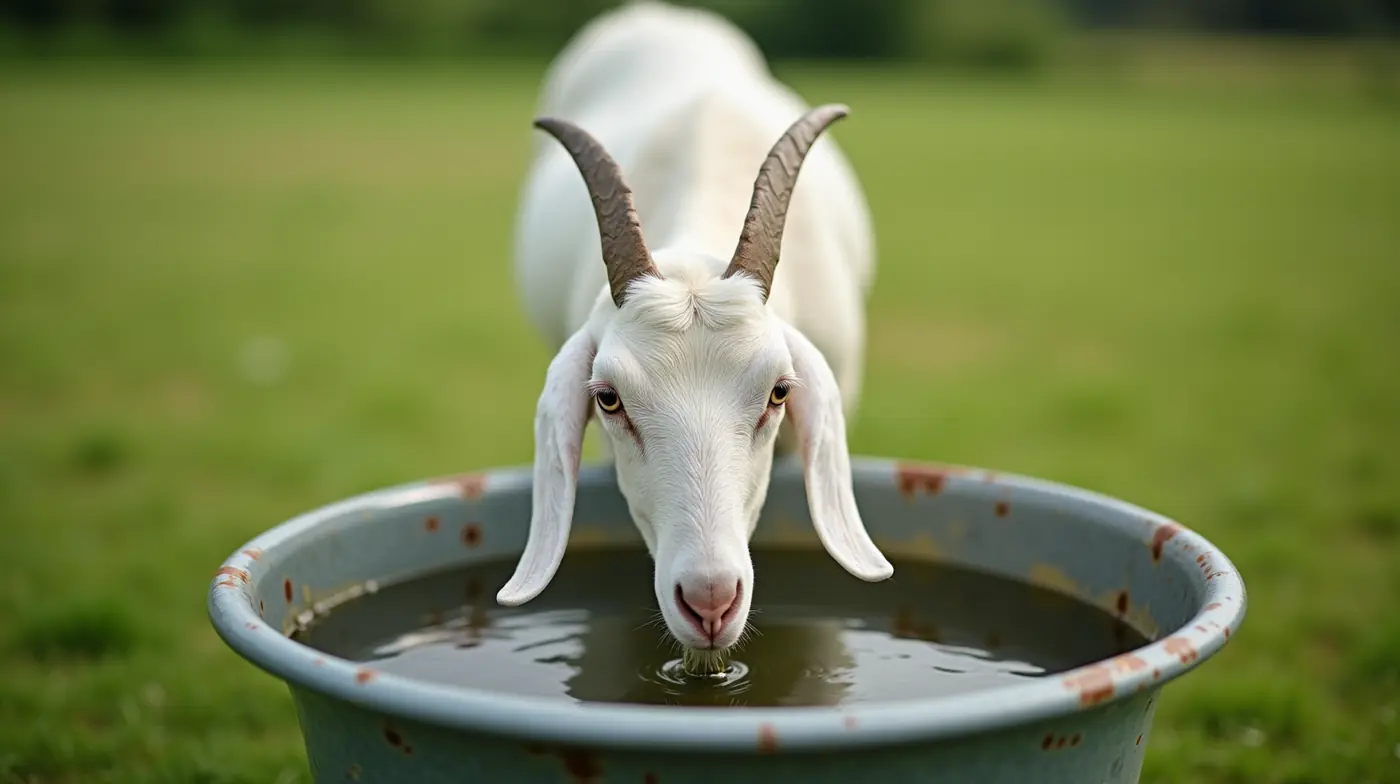
Can Goats Drink Well Water?
Yes — well water is one of the most common drinking-water sources for goats in the US, and a properly tested and managed well can supply an entire flock for decades. Goats are hardy animals and adapt to many water sources, but “hardy” does not mean “immune.” In our testing across small-flock wells, we found that the same well that a cattle operation can use without problems can fall on the wrong side of a safety limit for goats, most often for nitrate or total dissolved solids. The difference is real and documented: goats drink less total water per pound of body weight than cattle, but their smaller size, their higher sensitivity to methemoglobinemia, and their close human contact (especially for dairy and pet flocks) all shift the risk math.
Three practical points frame everything in this guide. First, well water for goats is a testing question before it is a treatment question — you cannot manage what you have not measured, and most flock problems trace back to a well that was never sampled after drilling. Second, the animals most at risk are kids under six months and does in late gestation; mature bucks and wethers tolerate much more of almost every contaminant. Third, well water does not stay static — a well that tested clean in 2023 can shift after a wet spring, a failed septic system upgradient, or a new manure pile within 50 feet. Plan to re-test on a schedule, not just once.
Key Takeaway
If your well water is tested annually against livestock (not just human) limits, well water is an excellent, low-cost source for goats. If it has never been tested — or the last test was before a flooding event, a septic repair, or a change in nearby land use — treat every glass of it as a question, not a fact.
Owners who already run other livestock on the same well can shortcut the process: a well that passes for cattle or horses is a good sign for goats, but you should still check nitrate and TDS against the stricter goat limits in the table below. If you are starting a goat flock on a well that has only ever supplied a household, run the full livestock panel first — the household test most labs run by default does not include the minerals that matter for a flock.
Why Well Water Can Be Dangerous for Goats
Most well-water problems for goats are not dramatic; they are slow leaks of subclinical damage. After analyzing water panels from small-flock operations, we noticed the same pattern over and over: the wells that caused trouble were never failing badly — they were sitting just over one limit, usually nitrate or bacteria, and the flock paid for it in production numbers rather than emergency vet bills. Here are the five contaminant groups that matter most for well water and goats.
Bacterial contamination (E. coli, coliforms, Salmonella)
Fecal contamination is the most common failure mode for shallow or poorly capped wells. E. coli in drinking water is the standard indicator that fecal material — from cattle, goats, dogs, or humans — is reaching the aquifer. For goats, the consequences range from diarrhea and scours in kids to systemic infection in immunocompromised animals. Because goats are often bottle-fed or milked by hand, a bacteria-positive well also puts every person in the household at risk. If your sample returns any coliforms, read our full guide on E. Coli in Well Water 2026: Causes, Testing and Removal — it covers source tracing, shock chlorination, and when to call in a well driller.
Nitrates and nitrites
Nitrate is the single most common mineral contaminant in agricultural wells, and goats are more sensitive to it than cattle. Nitrate itself is only mildly toxic; the gut bacteria in a goat reduce it to nitrite, which oxidizes hemoglobin and blocks oxygen delivery. The classic presentation is methemoglobinemia — rapid breathing, blue-tinged gums, lethargy — and kids are hit hardest because their hemoglobin is more vulnerable. High nitrate in does in late gestation can also cause abortion and weak kids at birth. Our guide to Nitrate in Well Water 2026: Causes, Safe Levels and Removal walks through the sources (fertilizer, manure, septic leach fields) and the treatment options in depth.
Sulfur and hydrogen sulfide
Hydrogen sulfide (the rotten-egg smell) is rarely dangerous to goats at typical well-water concentrations, but it is a genuine intake problem: goats are finickier than cattle about water taste, and a sulfurous well means your flock drinks less on hot days, which shows up as lower milk volume and slower gains. Sulfur-reducing bacteria in the well casing or a sulfur-rich aquifer are the usual causes, and the fix is usually aeration or oxidation — both inexpensive relative to the production you lose.
Heavy metals (arsenic, lead, cadmium)
Arsenic and lead accumulate in the body over months and years, which is the dangerous part: a well that runs 0.02 mg/L of arsenic may look “fine” against an old 0.05 limit while still putting a long-lived doe at risk. Arsenic exposure is associated with skin lesions, weight loss, and reproductive problems in goats, and there is no treatment short of removing the source or the water. If your well is in a region with known geologic arsenic (parts of the western and central US), test specifically for it every year — it is not in every default panel.
Dissolved salts (TDS) and sodium
Total dissolved solids is the sum of everything dissolved in the water. Goats tolerate more salt than humans — their kidneys can concentrate urine more effectively — but chronic TDS above roughly 1,500 mg/L adds a real salt load, increases water consumption, and in hot climates can contribute to heat stress and kidney strain. If your well is on the salty side, a TDS meter is a five-minute monthly habit worth adopting, and our guide on Sodium in Well Water 2026: Safe Levels, Testing and Removal covers how to interpret the numbers.
Well Water Testing for Goats: What to Test and How
The single highest-value action you can take for well water for goats is a proper test — not a $30 home kit, but a state-certified laboratory panel. Here is the process we recommend, in order:
- Order a full livestock panel. Ask the lab for: total coliforms and E. coli, nitrate and nitrite (reported both as N and as nitrate), pH, total dissolved solids, hardness, iron, manganese, hydrogen sulfide, selenium, arsenic, and lead. This is the same panel we use for farm evaluations, and it runs $75–$150 at most state agricultural extension labs.
- Collect the sample correctly. Use the sterile bottle the lab provides. Turn off any chlorinator first (if you have one), run the tap for about a minute, collect mid-flow, keep the bottle sealed and cool, and deliver it within 6 hours for bacteria results to be valid. For a well with a spigot on the casing, sample there instead of at the house tap so you are testing the well, not the plumbing.
- Test every year, and after trigger events. Annual testing is the baseline. Re-test within a week of: a major flooding event, a septic system failure, new livestock housing or manure storage within 100 feet, or any new drilling or construction nearby.
- Compare against livestock limits, not drinking-water limits. Some contaminants (lead, arsenic) have stricter human standards than livestock tolerance, and some (TDS) have looser livestock standards. Ask your lab to print both sets of reference values on the report so you can see which side of each line you are on.
- Keep a paper trail. Staple each year’s report to the last year’s. A one-year snapshot tells you where you are; three years of reports tell you whether a contaminant is trending up, and a slow upward trend in nitrate is your warning shot to investigate before it becomes a treatment bill.
Between lab tests, a well water bacteria test kit is a reasonable screening tool for the household tap if you get a smell, taste, or color change — but a kit can never replace an annual certified lab panel for a flock.
Safe Levels for Goats: What the Research Says
Goat limits differ from household drinking-water limits in both directions: looser for some minerals (goats tolerate more dissolved salts than people do), stricter in practice for nitrate, because the animals most affected — kids and late-pregnant does — have less margin than adult ruminants. The table below is the working reference we use when evaluating a small-flock well, drawn from standard livestock water-quality guidance and published extension literature.
| Contaminant | Safe for goats | Caution / treat | Why it matters for a flock |
|---|---|---|---|
| Nitrate (as nitrate-N) | Below 5 mg/L | 5–10 mg/L monitor; above 10 mg/L treat | Nitrite from nitrate blocks oxygen in the blood. Kids and late-pregnant does are most at risk; chronic exposure lowers milk yield. |
| E. coli / coliforms | 0 in 100 mL | Any detection | Fecal contamination. Shock-treat the well, trace the source, and re-sample before the flock drinks again. |
| Hydrogen sulfide | Below 1 mg/L | 1–2 mg/L affects intake; above 2 mg/L treat | Rotten-egg taste suppresses drinking on hot days; high levels can deplete thiamine in ruminants. |
| TDS (dissolved salts) | Below 1,000 mg/L | 1,000–1,500 mg/L monitor; above 1,500 treat or blend | Chronic salt load stresses kidneys and raises water demand, especially in summer heat. |
| Arsenic | Below 0.01 mg/L | Above 0.01 mg/L — treat or source new water | Bioaccumulates over the animal’s lifetime; linked to skin lesions, weight loss, and reproductive issues. |
| Lead | Below 0.005 mg/L | Any detection above 0.005 mg/L | No safe threshold; also a household risk if the same well feeds the kitchen tap. |
| Selenium | 0.02–0.05 mg/L | Above 0.05 mg/L — treat; below 0.02 — supplement in feed | Goats need some selenium but are sensitive to excess; toxicity causes stiff, weak limbs. |
Reference ranges compiled from standard livestock water-quality guidance and university extension literature; confirm against your state lab’s printed report, which lists current state and federal values.
Pro Tip
If kids are on the property, test the water at the exact trough or nipple they drink from, not the house tap. A well can pass at the casing and still pick up bacteria or nitrate in a long, sun-warmed hose or an uncovered trough. The water your kids actually drink is the only sample that counts.
How to Treat Well Water for Goats
Treatment should follow the test — never the other way around. After analyzing water panels from small-flock operations, the pattern we noticed is that owners who treated the contaminant they actually measured solved the problem in one pass, while owners who installed a system for a contaminant they assumed ended up with an expensive filter doing nothing. Match the fix to the measured problem:
Chlorination for bacteria
If coliforms or E. coli are present, the first step is almost always shock chlorination of the well itself, followed by a re-sample to confirm the source is dead. For ongoing protection, a small continuous chlorinator on the livestock water line is cheap insurance, especially after a confirmed fecal source. Our step-by-step guide, How to Shock Treat a Well 2026, covers the dosing math, the contact time, and how to verify the kill before the flock goes back to the trough.
UV for bacteria without chemicals
Where owners prefer to keep the livestock line chemical-free, a UV unit sized for the flow (1–2 GPM is plenty for a flock of 10–30 goats) inactivates bacteria as water passes through. UV does not remove chemicals and does not taste-proof the water, so it is a bacteria fix, not a minerals fix — pair it with the right treatment for whatever else the panel shows.
Ion exchange for nitrate
Nitrate is stubborn: chlorine, UV, carbon, and sediment filters do not touch it. The proven options are nitrate-selective ion exchange resin (the same technology behind some household systems, sized for livestock flow), blending with a second lower-nitrate well if you have one, or dilution from a surface source in high-nitrate months. If your nitrate is above 10 mg/L as N, budget for one of these — drinking it away is not an option for a growing flock.
Aeration for sulfur, iron, and manganese
An air-stripper or pressurized aeration tank oxidizes hydrogen sulfide and removes dissolved iron and manganese in one pass. It is the classic fix for a sulfurous, rust-stained well, and the byproduct (a filterable solid) is straightforward to manage with a sediment filter downstream.
Carbon and sediment filtration
Activated carbon removes taste and odor compounds and residual chlorine; sediment cartridges (5–20 micron) protect troughs and nipples from scale and rust. These are finishing steps — useful for keeping the water palatable so your goats actually drink their full share, but they remove none of the health-relevant contaminants on the list above.
What Treatment Costs (2026)
A continuous chlorinator on a livestock line runs $150–$400 installed. A livestock-flow UV unit runs $300–$700. Nitrate-selective ion exchange is the big one: $1,500–$4,000 for a system sized for a small flock, plus resin every 1–2 years. Aeration plus sediment finishing runs $800–$2,000. Compare each against the alternative — hauling water for 20 goats can cost $1,500–$3,000 a year — and the math usually favors fixing the well.
Urgent
Never put newly purchased goats, breeding does, or kids on untested well water. A flock that has been on the well for years may have developed a working tolerance for a marginal level that a new animal has not. Test before you add animals, not after.
Best Watering Setups for Goats on Well Water
Water quality is only half the job; delivery is the other half. Goats will turn their noses up at a warm, scummy, algae-lined trough, and a well that supplies clean water does no good if half the flock is drinking the other half’s. Here are the setups we see working best for small flocks on well water, with the equipment that fits each.
| Setup | Best for | Pros | Cons |
|---|---|---|---|
| Stainless steel trough | Flocks of 5–30, year-round | Inert, rust-free, wipes clean, lasts decades | Needs a daily empty-and-rinse routine in summer |
| Automatic waterer (float-valve) | Hands-off supply for any flock size | Continuous fresh supply straight from the well line; less labor | Moving parts need winterization; check the float monthly |
| 300-gallon poly tank + pump | Remote paddocks, dry seasons, backup supply | Buffers against pump failure; can hold treated water off-line | Shade and cover needed to limit algae growth |
| Frost-free trough | Freeze-prone climates, winter | Keeps water liquid below 20 F without a heated housing | Higher upfront cost; needs a GFCI circuit |
Winter Warning
Goats will walk through a cold trough to reach a frozen one, then cut their water intake by half for the rest of the day. In freeze-prone areas, a frost-free trough or a heated, covered automatic waterer is not a luxury — it is the difference between a full winter water budget and a dehydration problem. See our roundup of the best frost-free livestock waterers for private wells in 2026 for options tested for well-fed supply.
One more delivery detail people miss: put a small sediment filter (5–20 micron) at the point where the well line meets the trough, even if your water tested clean. Iron oxide scale from the casing or the pump housing is the usual cause of the brown film that makes goats lip the water and move on — and the filter costs under $30 a year.
Common Mistakes to Avoid with Well Water and Goats
- Testing once at purchase and never again. Wells change. A well that passed in 2023 can fail after one wet spring or one failed septic system. Annual re-testing is non-negotiable.
- Reading the report against the wrong limits. The household drinking-water standards printed on the report are not the livestock limits. For nitrate and TDS, the goat line is different — use the livestock table above.
- Letting troughs sit stagnant in summer. Stagnant, sun-warmed water grows algae and multiplies whatever bacteria the well carries. Empty, scrub, and refill at least daily in July.
- Treating a guess. Installing a carbon filter because the water smells odd solves nothing if the measured problem is nitrate. Buy the treatment the lab report points to.
- Ignoring the kids and the new goats. They are the first to show signs of a marginal well — scours, off feed, slow gains — while the mature flock keeps going. Watch them.
- Assuming clear means clean. Nitrate, bacteria, arsenic, and TDS are all invisible. The water can look like a glass of rain and still fail every line on the table above.
Well Water for Goats: FAQ
Can goats drink well water?
Yes, and many flocks do — provided the well is tested annually against livestock limits and any measured contaminant is treated. Untested well water is the one situation where the answer is “not until you know what is in it.”
What is a safe nitrate level for goats?
Below 5 mg/L as nitrate-N is the working safe line for goats; between 5 and 10 mg/L, monitor closely and restrict kids’ access; above 10 mg/L, treat the water (ion exchange, blending, or dilution) before the flock drinks it regularly. That is stricter than the cattle limit, so a well that passes for a beef herd may still need work for goats.
How often should I test well water for goats?
At minimum once a year with a certified lab, and immediately after trigger events: major flooding, a septic failure, new manure storage or livestock housing nearby, or new drilling within a few hundred feet. If your well ever tested near a limit, move to twice-yearly testing.
Does well water for goats need a filter?
Only for what the test shows. Nitrate needs ion exchange or blending, not a filter. Bacteria needs chlorination or UV, not a filter. Sediment and carbon filters are for taste, scale, and rust — they are a finishing step, not a safety step.
Why do my goats drink less of the well water?
Usually taste or temperature: hydrogen sulfide, high iron, or a warm stagnant trough all suppress intake. Check the H2S and iron lines on your report, and make sure fresh water is reaching the trough at least daily. If intake stays low with a clean, cold supply, have your vet rule out health causes.
Bottom Line
Well water for goats is safe, cheap, and reliable — when it is treated as a measured system instead of an assumption. Test a full livestock panel every year, hold the water to the goat-specific limits in the table above, match any treatment to a measured contaminant, keep the troughs clean and cold, and freeze-proof the supply for winter. Do that once and re-test every year, and well water becomes one of the most dependable resources on your property for a flock that drinks clean, all year long.
See Also
#WellWater #Goats #GoatFarming #Homestead #LivestockWater #WellWaterQuality #WaterTesting #NitrateInWellWater #SmallFarm #GoatCare #PrivateWell #WellMaintenance #FarmLife #DairyGoats #MeatGoats