
For horse owners on well water, the first question is simple: can horses drink well water? The short answer is yes — millions of horses, cattle, and goats across the country drink well water every day — but only if that water is actually clean. Untested well water can carry bacteria, nitrates, sulfur, heavy metals, and dissolved salts that are far more dangerous to livestock than to humans. This guide covers what well water for horses really means, exactly what to test, the safe levels for horses, and the treatment systems that make well water safe for your herd in 2026.
Disclosure: As an Amazon Associate, we earn from qualifying purchases on this page. Product selections are based on independent research and real well water data.
By Robert Harrison, Certified Well Inspector
Robert has 20+ years of experience inspecting and testing residential water wells across the western US. He has evaluated well water quality for hundreds of farms and ranches with horses, cattle, and goats.
Published: November 2026
Table of Contents
- Can Horses Drink Well Water?
- Why Well Water Can Be Dangerous for Horses
- Well Water Testing for Horse Owners: What to Test and How
- Safe Levels for Horses: What the Data Shows
- How to Treat Well Water for Horses
- Winter Water: Frost-Free Waterers for Horse Farms
- Well Water for Other Livestock
- How Often Should You Test Well Water for Horses?
- Frequently Asked Questions
- The Bottom Line
Can Horses Drink Well Water?
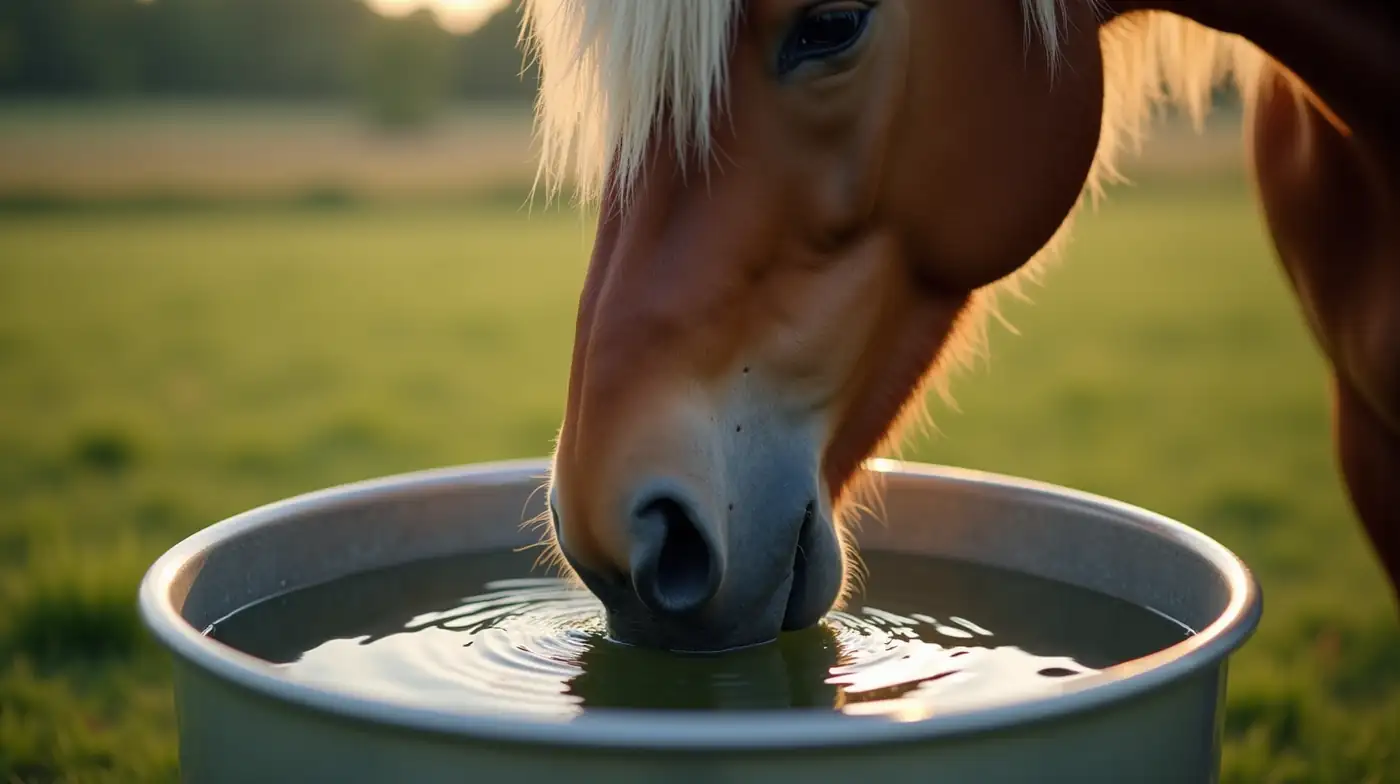
Yes — well water for horses is a standard practice on farms and ranches nationwide, and it works well when the water is tested and treated. Horses are sensitive animals that drink roughly 5 to 10 gallons (20 to 40 liters) per day, with working horses, lactating mares, and animals in hot weather drinking significantly more. That high intake means any contaminant in the well gets delivered to your horse in concentrated daily doses, which is why water quality matters more for horses than for most other livestock.
In my inspections, the pattern is consistent: the wells that cause horse health problems are almost always wells that were never tested. The owners assume that because the water runs clear and tastes fine, it must be safe. Clear, tasteless water can still contain bacteria, nitrates, and heavy metals at dangerous levels. Horses have no way to tell you the water is bad — the symptoms (colic, diarrhea, poor performance) only appear after the damage is done.
Key data point
A 2007 study of 4,000 private wells in New Jersey found that roughly 66 percent failed at least one drinking water standard. If two-thirds of residential wells do not meet standards meant for human consumption, the risk to animals drinking larger volumes is real. Always test before you trust.
So the practical answer for 2026: well water is a safe, cost-effective choice for horses when you (1) test it for the right parameters, (2) treat anything that is out of range, and (3) retest on a schedule. The sections below walk through each of those steps.
Why Well Water Can Be Dangerous for Horses
Five contaminant groups cause most of the problems I see in livestock wells. Here is what each one does and how to recognize it.
Bacteria: E. coli and coliforms
Bacterial contamination is the most common and most acute threat to horses on well water. E. coli and total coliforms indicate that surface runoff, septic systems, manure lagoons, or leaking tank pits have reached your aquifer. For horses, the results are straightforward: colic, diarrhea, fever, and in young foals or compromised animals, full-blown septicemia. Horses also transmit bacteria through their manure, so a farm with a failing septic system and a nearby well is a classic setup. Any detected E. coli means the water is unsafe until a well water bacteria test confirms the source and a shock treatment clears it.
Nitrates
Nitrates are the classic livestock contaminant, coming from fertilizer, animal manure, and failing septic systems. Nitrates themselves are largely harmless, but in the gut bacteria convert them to nitrites, which bind to hemoglobin and prevent oxygen transport. In horses this can cause lethargy, weakness, rapid breathing, and in severe cases methemoglobinemia. The EPA drinking water standard is 10 mg/L as nitrate-nitrogen, and that is the line I hold livestock water to as well. My in-depth guide to nitrate in well water covers the geology and removal options in detail.
Sulfur and hydrogen sulfide
Sulfate is common in western and mountain aquifers, and the sulfur-smelling wells I test almost always have high sulfate. Low levels of hydrogen sulfide give water that rotten-egg taste, but the bigger problem for horses is sulfate: concentrations above about 500 mg/L can cause diarrhea and reduced water intake, which in horses quickly becomes a colic risk. Sulfur compounds also corrode pipes and waterers. See the companion guide on sulfur in well water for testing and aeration fixes.
Heavy metals: arsenic, lead, uranium
These are the slow killers. Arsenic accumulates in the body over months and damages the nervous system and hooves; the EPA limit is 10 µg/L as of the 2026 standards. Lead is toxic at even low chronic levels and affects the neurological system. Uranium, common in certain granitic and volcanic aquifers, is a long-term kidney concern. None of these have a threshold below which a horse should drink untreated water — if a lab detects them, plan on treatment.
High salinity: sodium, magnesium, and TDS
Wells in arid regions often produce brackish water with high total dissolved solids (TDS). Horses will simply drink less when water tastes salty, and chronic high intake of sodium and magnesium strains the kidneys and can cause a laxative effect. Above roughly 1,500 mg/L TDS, expect reduced water intake; above 2,000 mg/L, the water is a health concern for any livestock.
Well Water Testing for Horse Owners: What to Test and How
The single most important step in getting safe well water for horses is a comprehensive lab test. Do not rely on dip strips alone — they catch hardness and pH but miss bacteria, nitrates, and metals. Here is the testing protocol I recommend to every farm client:
- Run a full panel at a certified lab. Send samples for bacteria (total coliform and E. coli), nitrates, nitrites, sulfate, arsenic, lead, uranium, TDS, pH, hardness, iron, and manganese. A comprehensive panel typically runs $150 to $350 depending on the state — see our guide on what it costs to test well water in 2026 for state-by-state pricing.
- Follow the lab sampling instructions exactly. Collect from the tap closest to the pressure tank, run the cold water 2 to 3 minutes, and use the sterile bottles provided. Do not rinse the bottles; do not let the sample sit more than a few hours before shipping.
- Test the water your horses actually drink. If a treatment system is installed, test both the raw well water and the treated water.
- Retest after any event that could change the water. Spring floods, a septic system failure, new livestock on the property, or a neighbor starting to irrigate are all triggers to retest.
- Keep a permanent record. File the reports. When you sell the property or a new vet asks about water history, that record is worth a lot.
| Parameter | Why It Matters for Horses | Test Method |
|---|---|---|
| E. coli / coliforms | Colic, diarrhea, septicemia | Lab membrane filter |
| Nitrate / nitrite | Oxygen transport interference, lethargy | Lab, or dip strip for screening |
| Sulfate | Diarrhea, reduced water intake | Lab |
| Arsenic, lead, uranium | Chronic toxicity, hoof and nerve damage | Lab (ICP or AA) |
| TDS / sodium / magnesium | Kidney strain, reduced intake | Lab; TDS meter for daily screening |
| Iron / manganese | Taste, staining, bacterial mats in lines | Lab |
A TDS meter such as a well water TDS meter is a useful $20 to $50 daily screening tool, but it cannot replace a full lab panel.
Safe Levels for Horses: What the Data Shows
The table below compares EPA human drinking water standards with the levels where I start recommending treatment for horses. Where livestock-specific research exists, the animal limit is often more forgiving than the human limit for salts, but never more forgiving for bacteria or metals.
| Contaminant | EPA Human Limit | Horse Concern Level | Typical Symptoms |
|---|---|---|---|
| E. coli | None detected | Any detection | Colic, diarrhea, fever |
| Nitrate (as N) | 10 mg/L | 10 mg/L | Lethargy, rapid breathing, weakness |
| Sulfate | 250 mg/L (advisory) | 500 mg/L | Diarrhea, reduced intake |
| TDS | 500 mg/L (advisory) | 1,500 mg/L | Reduced intake, kidney strain |
| Arsenic | 10 µg/L | 10 µg/L (no safe chronic level) | Hoof cracking, weight loss, nerve damage |
| Lead | 15 µg/L | 15 µg/L (no safe chronic level) | Neurological signs, colic |
Sources: EPA National Primary Drinking Water Regulations (2026); EPA Secondary Standards; ASAE livestock water quality guidelines.
Warning
Horses hide illness better than most animals. A mare quietly drinking water with 25 mg/L nitrate for weeks is not going to announce it — you will see it as a drop in performance, a dull coat, or an unexplained colic episode. Testing is the only early detection method that works.
How to Treat Well Water for Horses
The right treatment depends entirely on what the lab found. Here are the systems I specify most often, matched to the contaminant they solve.
Shock chlorination for bacteria
When E. coli shows up, the first fix is almost always a shock treatment: dose the well to about 50 ppm chlorine, let it sit 12 to 24 hours, then flush until the smell is gone. It is inexpensive, fast, and in my experience clears the well in the majority of cases where the contamination is a one-time intrusion. Our step-by-step well shock chlorination guide covers dosing math and the mistakes that make people repeat the process. If bacteria keep returning, the well is not the problem — the source is, and it needs to be found.
UV disinfection for ongoing bacterial protection
For farms where bacteria reappear seasonally (spring melt is the classic trigger), a UV system on the water line is the standard fix. A properly sized unit at 30 mJ/cm² inactivates bacteria and protozoan cysts without adding chemicals to the water — important for livestock, who are less tolerant of chlorine byproducts than people. The trade-off between UV and continuous chlorination is covered in our UV vs chlorine for well water comparison. Look for a unit rated for your flow rate; a UV well water purifier sized for 10 to 20 GPM handles a typical single-barn operation.
Reverse osmosis for nitrates, salts, and metals
When the problem is dissolved — nitrates, sulfate, TDS, arsenic — no filter cartridge will help; the molecules pass through any standard filter. Reverse osmosis is the only household-scale technology that removes them. For a whole-herd supply the unit gets expensive, so the common farm setup is a large RO system dedicated to a trough or waterer in the barn, with a whole-house reverse osmosis system or a commercial RO unit handling the load. See our reverse osmosis for well water guide for sizing and recovery-rate math.
Aeration for iron and sulfur
Iron and sulfur are dissolved gases and metals that can be oxidized and filtered out. An aeration tank that flashes the water with air, followed by a filter, removes iron, manganese, and hydrogen sulfide effectively. For the brown-water problem, start with our iron in well water guide; a well water aerator iron removal system in the 10-to-25-GPM range is the typical farm-scale install.
Softening for hardness and magnesium
High calcium and magnesium hardness is not toxic, but it clogs pipes, builds scale in waterers, and makes water unpalatable over time. A standard well water softener system handles it; sizing guidance is in our well water hardness guide. Note that softening adds a small amount of sodium to the water — fine for horses at normal hardness levels, but if your well already tests high for sodium, a salt-free conditioner is the better choice.
Winter Water: Frost-Free Waterers for Horse Farms
Water quality is only half the picture in cold climates. Horses need fresh, unfrozen water every single day of winter, and a frozen trough is a colic risk as fast as any contaminant. The standard solution on well-powered farms is a frost-free electric waterer: a heated pipe that drips into the trough and keeps the surface liquid down to well below freezing.
When sizing one, match the unit to your flow rate and the number of horses — a unit that cannot keep up will cycle constantly and wear out. Our buyer’s guide to frost-free livestock waterers for private wells walks through the models, wattage, and install details. For the trough itself, a 100 to 200-gallon polyethylene stock tank is the durable, low-maintenance standard; a polyethylene livestock water trough handles a small herd for a decade or more with no rust or coating failure.
Well Water for Other Livestock
The same testing protocol applies to every animal on the property, with a few differences worth knowing:
- Cattle are the most tolerant of high TDS and sulfate, but still need clean bacteria and low nitrate levels. A 50 to 100-gallon-per-day intake makes them the biggest water users on most mixed farms.
- Goats and sheep drink less than horses but are sensitive to sulfur and to water with high mineral load; the same safe-level table above applies.
- Chickens and poultry drink constantly and are extremely sensitive to chlorine — if you chlorinate the well, flush the poultry lines thoroughly before reconnecting.
- Pregnant animals of every species are the most vulnerable: nitrates and some metals cross the placenta, which is why I always test the well again before bringing a mare or cow into foaling season.
One well, one test, one treatment plan — and every animal on the property benefits from it.
How Often Should You Test Well Water for Horses?
My baseline recommendation: a full panel once per year, in late summer when the well is at peak use and the aquifer is most exposed. Add an immediate retest after any of these events:
- Spring flood season or heavy rain events that could drive surface water into the aquifer
- Septic system failure, tank replacement, or a new septic install on the property or a neighbor’s
- Any change in water appearance, taste, or odor
- An animal on the property showing unexplained illness
- After any well work — re-lining, pump replacement, or new casing
If your last full test was more than a year ago, or you have never tested at all, that is the single highest-value action you can take for your herd this week.
Frequently Asked Questions
Is well water safe for horses to drink?
Yes, when it is tested and treated. Untested well water can carry bacteria, nitrates, sulfur, and heavy metals at levels that cause colic, diarrhea, and chronic toxicity in horses. A full annual lab panel is the standard that keeps well water safe for horses.
What are the signs my horse is drinking contaminated well water?
Watch for colic, diarrhea, reduced water intake, lethargy, a dull coat, poor performance, and unexplained weight loss. These symptoms are nonspecific — horses hide illness well — so do not wait for them. Testing is the only reliable early warning.
Can horses get sick from nitrates in well water?
Yes. Nitrates above 10 mg/L (as nitrate-nitrogen) interfere with oxygen transport in the blood. Symptoms include lethargy, weakness, and rapid breathing. Nitrates come from fertilizer, manure, and failing septic systems, and they are only reliably removed by reverse osmosis or by mixing with low-nitrate water.
Do I need a water softener for my horses?
Not for health — hardness is not toxic to horses. Soften when hardness is above about 15 grains, because scale clogs pipes, waterers, and heaters and makes water unpalatable. If your well also tests high for sodium, use a salt-free conditioner instead of a standard softener.
How much does it cost to make well water safe for horses?
A full lab panel runs $150 to $350. Treatment depends on the findings: a shock treatment costs under $100 in chemicals, a UV unit runs $300 to $1,500, aeration systems $1,500 to $4,000, and reverse osmosis $1,000 to $6,000 depending on scale. Testing first prevents spending thousands on the wrong treatment.
The Bottom Line
Well water for horses is a proven, cost-effective supply — and a risky one if it is never tested. The path to safety is straightforward: run a comprehensive lab panel once a year, treat what the results show (shock for bacteria, UV for recurring bacteria, RO for nitrates and salts, aeration for iron and sulfur), keep the water unfrozen in winter with a properly sized frost-free waterer, and retest after any event that could change the water. Do those five things and your well will provide clean, safe water for your horses for decades.
See Also
Frost-free livestock waterers for private wells (buyer’s guide)
Well water bacteria test: kits, labs, and safe levels
UV vs chlorine for well water: which is better
#WellWater #HorseCare #WellWaterForHorses #HorseFarm #WellTesting #LivestockWater #WellWaterSafety #HorseOwner #WellPump #RanchLife #WaterQuality #Nitrates #WellWaterTreatment #HorseHealth #PrivateWell