
Published: May 14, 2026
By Robert Harrison, Certified Well Inspector
Robert has 20+ years of experience inspecting and testing residential water wells across the western US.
From inspecting residential wells over the past two decades, I can tell you this: most well problems start small and get expensive the longer they are ignored. The guidance below reflects what I have actually seen in real well systems, not just what the manuals say.
Introduction
Your well pump is likely the most expensive component in your home’s water system — $800-2,000 for the pump alone, $1,500-4,000 installed. And it can be destroyed in a single electrical event for zero dollars of protection.
Voltage problems are the silent killer of well pumps. Unlike mechanical failure that gives you warning, voltage damage happens instantly and without a sound. This guide covers everything you need to know to diagnose and prevent electrical damage to your well pump — what to look for, how to test, and what protection actually works.
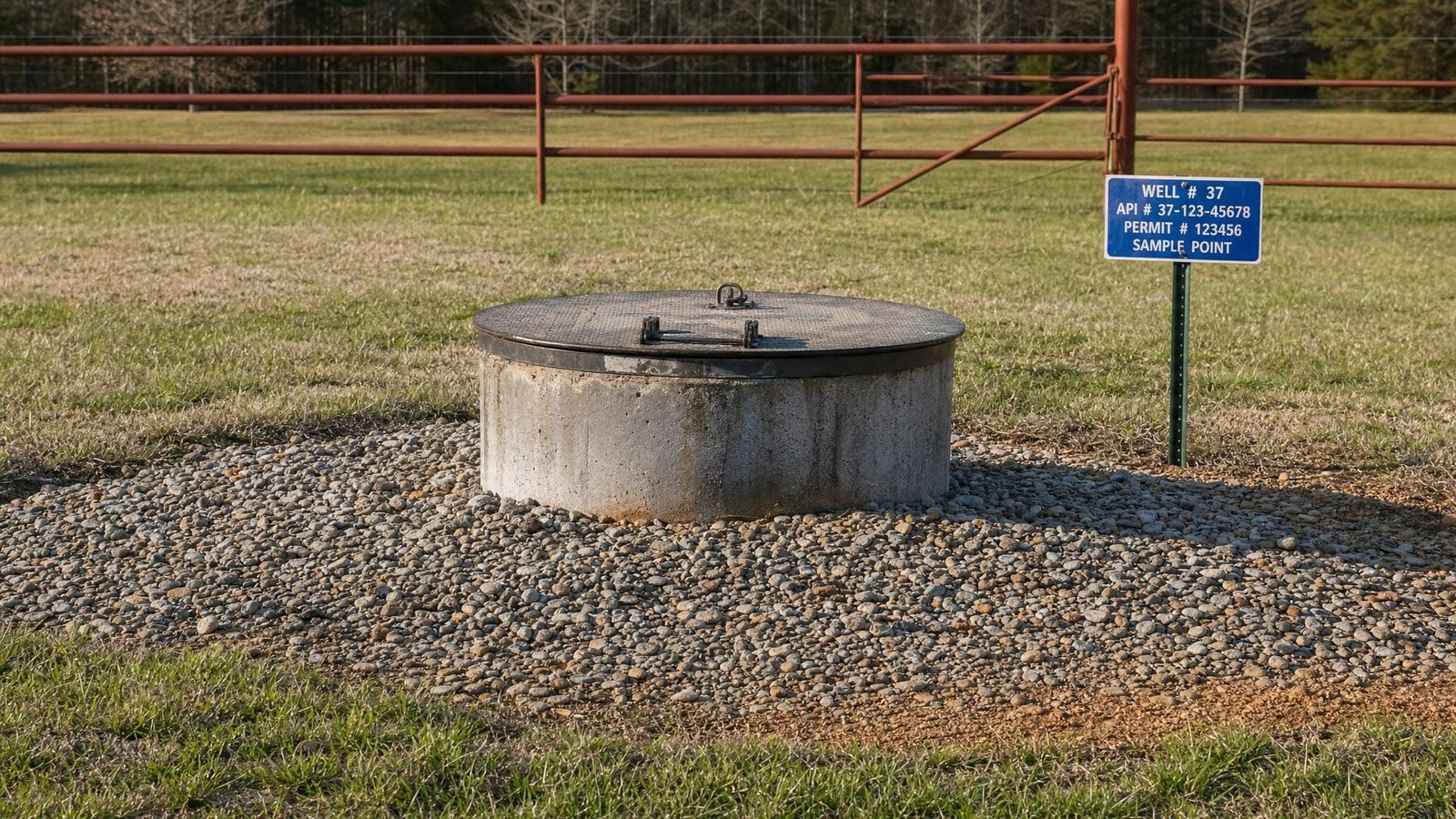
How Voltage Destroys Well Pumps
Understanding how voltage damage works helps you spot the problem before it kills your pump. There are four main mechanisms:
Voltage Surges (Spikes)
A surge is a sudden increase in voltage above normal levels. They can reach thousands of volts from a single lightning strike or nearby power line fault. Most residential surges are in the 1,000-5,000 volt range but last only microseconds.
What it does: Burns the motor windings’ insulation, creating short circuits. The damage is often internal and invisible — the pump might run for a few weeks after a surge then fail completely. This is the most common cause of sudden pump death with no prior warning.
Voltage Drops (Brownouts)
When voltage drops below 80% of nominal (below 208V on a 230V system), the pump draws more current to maintain power, causing the motor to overheat.
What it does: Overheats motor windings, degrades insulation, and gradually kills the motor. Brownouts during drought or high demand periods are especially dangerous because the pump runs for hours at reduced voltage. This is a slow-kill scenario you might not notice until the pump is halfway dead.
Voltage Imbalance (Three-Phase Systems)
In three-phase systems, if the voltage between any two phases differs by more than 2%, the motor experiences unbalanced current. A 3.5% imbalance can kill a motor in 40 hours.
What it does: Creates uneven magnetic fields, causing vibration, overheating, and premature bearing failure. Most residential wells are single-phase, but larger properties and commercial systems may be three-phase.
Poor Grounding
When your electrical system isn’t properly grounded, the pump motor has no safe path for stray electricity.
What it does: Creates voltage differentials between the pump housing and the surrounding soil, leading to galvanic corrosion. This slowly eats away at the motor housing, shaft, and impellers — and it can happen over years without any electrical “event” to trigger it. Poor grounding is the most insidious problem because it’s invisible until the pump fails.
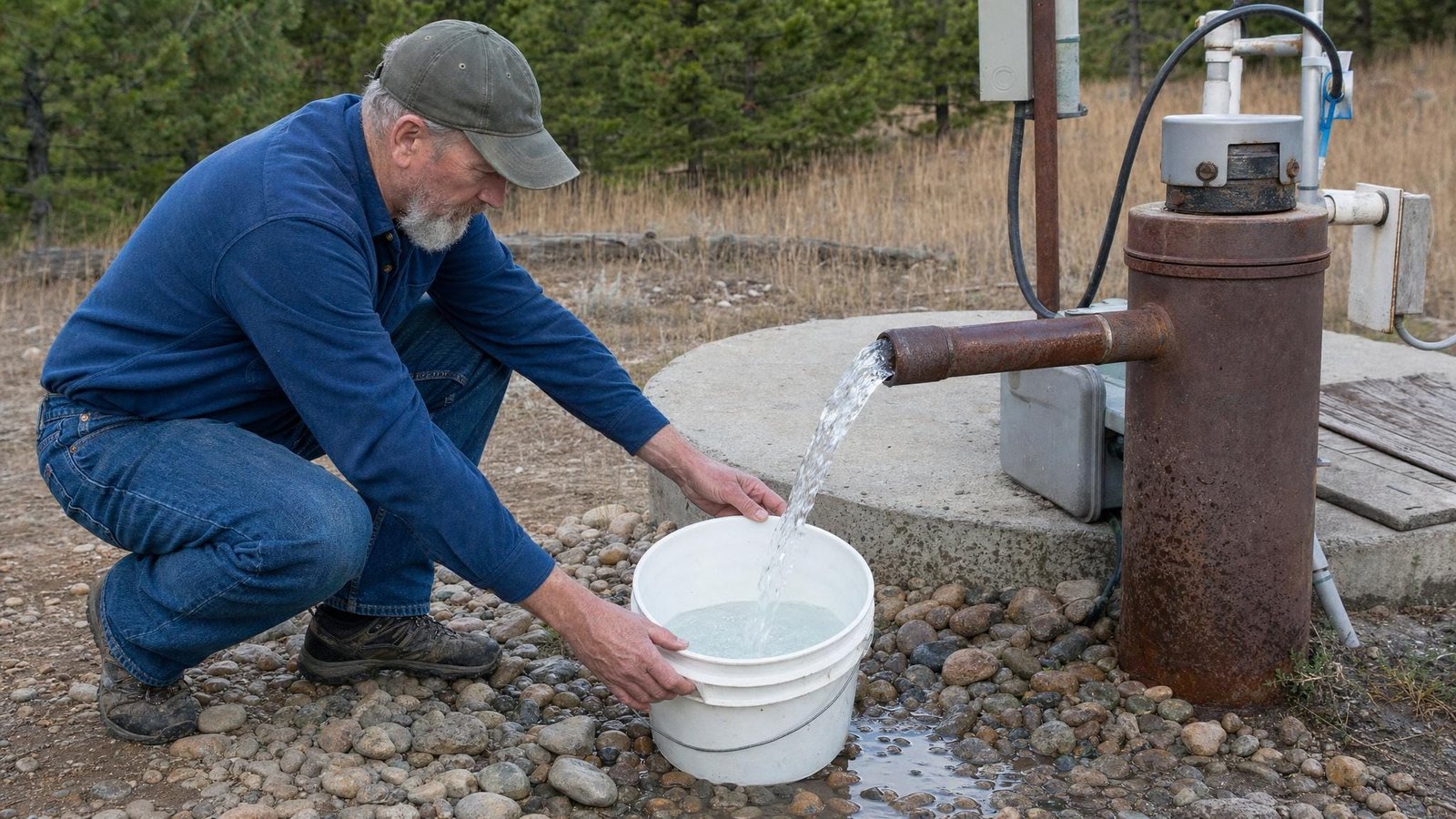
Signs Your Well Pump Has Electrical Damage
Immediate Signs (After a Surge or Event)
- Pump won’t start at all
- Breaker trips immediately when you turn it on
- Burning smell from the control box
- Visible scorch marks on wiring or the junction box
Gradual Signs (Over Weeks or Months)
- Pump runs but produces less water than usual (motor is losing power)
- Pump takes longer to build pressure
- Pump makes a humming or buzzing sound (motor is struggling)
- Pump cycles more frequently than normal
- Water heater has strange metallic taste (could indicate a grounding issue)
Intermittent Signs (Hard to Diagnose)
- Pump works fine some days, fails on others
- Pump dies after storms or during high-heat summer days
- Pump only works after resetting the breaker
“If your pump has a history of intermittent failures, don’t just replace the pump. Test the voltage first — the new pump will die too if the electrical problem isn’t fixed.”
Diagnostic Tools You Need
Essential Tools
Digital multimeter ($20-80).
Clamp ammeter ($30-150).
Voltage recorder/logger ($50-300).
Insulation resistance tester ($50-200).
Optional but Helpful
- Thermal imaging camera ($100-500)
- Power quality analyzer ($200-1,000)
- GFCI outlet tester ($15-30)
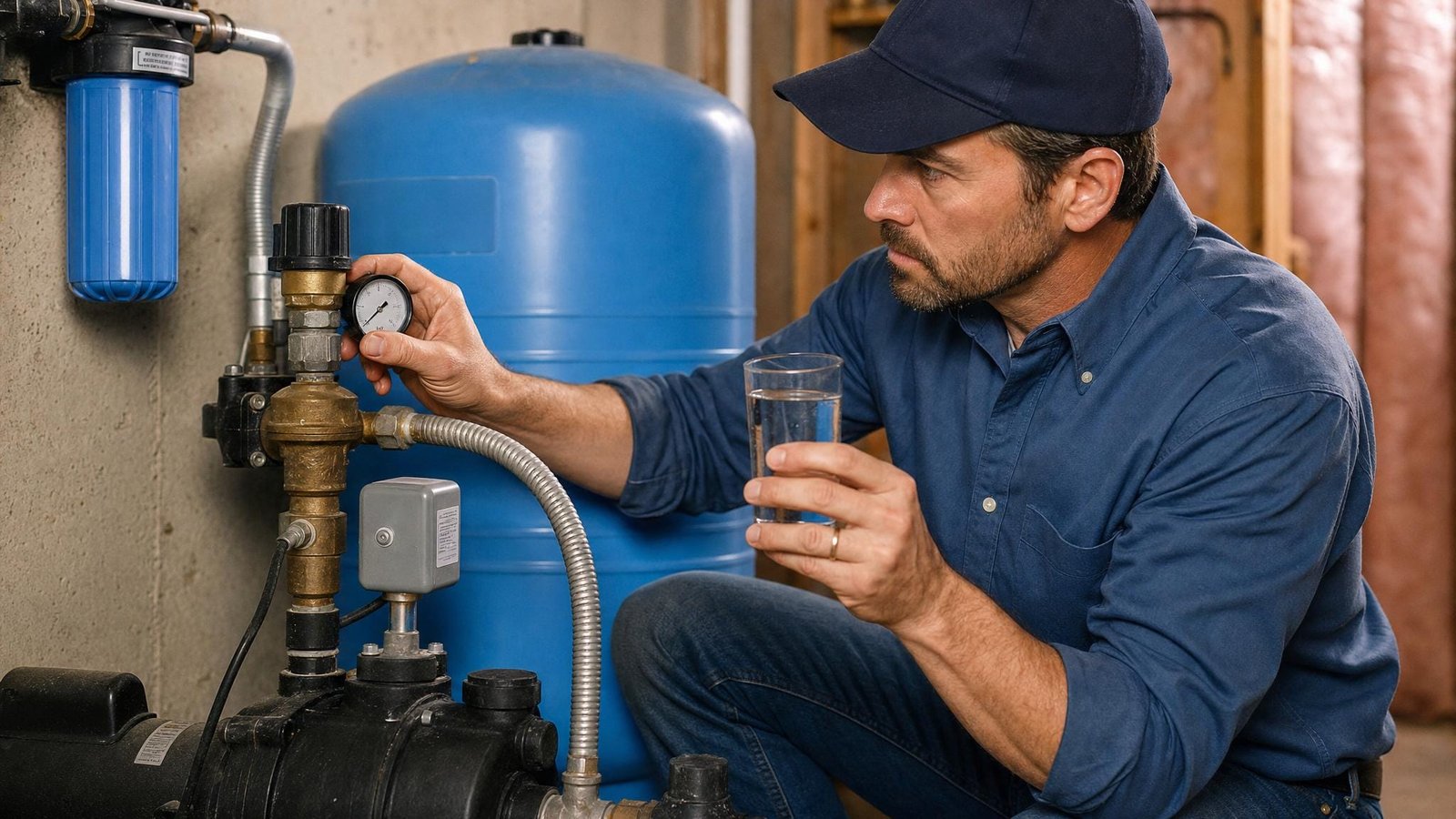
How to Test Your Well Pump Voltage
Step 1: Test Voltage at the Control Box (With Pump Running)
For a 230V pump:
Normal voltage: 210-250V (within ±10% of nominal)
Warning: 195-210V or 250-265V (marginally acceptable but concerning)
Danger: Below 195V or above 265V (take immediate action)
For a 115V pump:
Normal voltage: 103-127V
Warning: 97-103V or 127-132V
Danger: Below 97V or above 132V
Connect your multimeter to the load terminals of the contactor (where the power connects to the pump). Take the reading while the pump is running. Note: voltage drops when the pump is under load compared to when it’s off.
Step 2: Measure Amperage (Amps Pull)
Compare the pump’s amp draw to its rated FLA (Full Load Amps) on the nameplate:
| Amp Draw vs FLA | What It Means | Action |
|---|---|---|
| Within 10% of FLA | Normal operation | No action needed |
| 10-25% above FLA | Pump working too hard | Check for restricted flow, clogged impellers |
| Over 25% above FLA | Immediate action required | Something is wrong — investigate now |
| Over 50% above FLA | Motor will burn out quickly | Shut off and diagnose |
| Significantly below FLA | Pump running dry or severely restricted | Check water supply and flow path |
Step 3: Test Voltage at the Breaker Panel
Measure at the breaker panel feeding the pump. Compare this to the voltage at the control box:
- If voltage at the breaker is normal but voltage at the pump is significantly lower, you have a wiring problem (undersized wire, loose connections, or corroded terminals)
- The acceptable voltage drop from panel to pump is 3-5% maximum
- If both readings are low, the problem is at the utility or service entrance level
Step 4: Test for Voltage Fluctuations
For intermittent problems, install a voltage logger at the pump’s electrical supply. Let it record for at least one week. Look for:
- Short-duration surges (lightning, utility switching)
- Extended brownouts (high demand periods)
- Voltage dips during pump startup
- Any readings outside the ±10% range
Step 5: Test Insulation Resistance
With the pump disconnected and power off:
- Set your megger to 500V DC
- Test between each motor lead (black, white, green) and the motor housing (ground)
- Any reading below 2 megohms indicates insulation failure
- A reading below 0.5 megohms usually means the motor is dead or dying
If you don’t have a megger, a multimeter on the highest resistance scale can give you a rough indication, but it won’t be as accurate. A reading below 1 megohm on a multimeter suggests insulation is compromised.
Common Electrical Culprits
Undersized Wire
Running a well pump on wire that’s too small causes voltage drop. Check the wire gauge against these minimums:
| Well Depth | Minimum Wire Gauge (Copper) | Minimum Wire Gauge (Aluminum) |
|---|---|---|
| 0-50 ft | 14 AWG | 12 AWG |
| 50-100 ft | 12 AWG | 10 AWG |
| 100-150 ft | 10 AWG | 8 AWG |
| 150-200 ft | 8 AWG | 6 AWG |
| 200-300 ft | 6 AWG | 4 AWG |
Note: These are minimums for 230V systems. 115V systems require larger wire because the current (amps) is higher at the same power. Always use the next larger gauge if you’re unsure — it costs $20-30 more in wire but could save you a $2,000 pump.
Loose or Corroded Connections
Every connection point in your pump’s electrical system is a potential failure point:
- Junction box at the well head — exposed to moisture and temperature cycles
- Control box contactor terminals — wear from repeated arcing
- Breaker panel connections — can loosen over time from thermal cycling
- Wire splices — the most common failure point. Wirenuts and tape degrade over time, creating resistance and heat
Aging Control Box
The control box contains the pressure switch, contactor, and overload protection. Over time:
- The contactor contacts wear and create resistance
- The overload relay may trip prematurely or fail to trip
- The timer (if present) degrades
- Moisture enters the box, causing corrosion
Control boxes typically last 10-15 years. If yours is older, consider replacing it proactively rather than waiting for failure.
Faulty Breaker or Switch
Breakers can wear out and trip at lower currents than rated. If your breaker is tripping at unexpected times, replace it. This is a $15 part that’s often mistaken for a $1,000 pump problem.
Poor Service Entrance
The connection between your utility and your panel can develop issues over time, causing voltage drops at the source. This is less common but worth checking if both your panel and pump readings show low voltage.
Protective Measures
Surge Protection (Non-Negotiable)
Type 1 Surge Protector (Whole-House). Installed at your main electrical panel. Protects against external surges (lightning, utility switching).
Type 2 Surge Protector (Point-of-Use). Installed at the well pump’s disconnect or control box. Provides a second layer of protection, intercepting surges before they reach the pump motor.
Recommendation: Install both. A single Type 1 unit ($30-100) at your panel is a must. A Type 2 unit ($50-150) at the pump is highly recommended. The combination provides the best protection for the cost.
Voltage Stabilizer / Regulator
For areas with chronic voltage problems (rural areas with long service drops, areas with heavy industrial load): a voltage regulator maintains constant voltage regardless of input fluctuations.
Cost: $200-800 for a unit sized for your pump
Payback: One pump replacement is $1,500-4,000
Soft Starters
A soft starter ramps the motor voltage up gradually during startup, reducing:
- Inrush current (which causes voltage drops for your entire house)
- Mechanical stress on the pump and piping
- Power surges from the pump starting
Cost: $100-300. Can extend pump life significantly, especially for pumps that cycle frequently.
Proper Grounding
Ensure your entire electrical system is properly grounded:
- Ground rod at the well pit (if required by code)
- Ground wire from pump to equipment grounding conductor
- Ground at the breaker panel
- Ground rod at the panel if required
- Ground resistance below 25 ohms
Check your grounding with a ground resistance tester or have an electrician verify it. Proper grounding is your cheapest insurance against electrical damage.
Voltage Monitoring
Install a voltage monitor ($20-50) that displays real-time voltage at the pump. If it drops below or rises above your set threshold, you get immediate visual alert. This is particularly valuable for rural properties where you can’t see your utility’s power quality.
When to Call an Electrician
Call a licensed electrician if:
- You measure voltage outside the ±10% range consistently
- You find insulation resistance below 2 megohms
- You see burn marks, corrosion, or melted wire insulation
- The breaker trips repeatedly without an obvious cause
- You’re uncomfortable working with 230V electrical systems
- You need to run new wire to the well head
- You suspect the service entrance is the problem
Don’t attempt to diagnose three-phase issues, service entrance problems, or utility-side voltage problems on your own. These require specialized training and equipment.
Cost Comparison: Prevention vs. Replacement
| Protection Measure | Cost | What It Prevents |
|---|---|---|
| Whole-house surge protector | $30-100 | Lightning and utility surges |
| Point-of-use surge protector | $50-150 | Residual surges at pump |
| Soft starter | $100-300 | Inrush current, mechanical stress |
| Voltage regulator | $200-800 | Chronic voltage problems |
| Proper grounding inspection | $100-200 | Galvanic corrosion, stray voltage |
| Total protection system | $500-1,350 | Everything |
| Well pump replacement only | $800-2,000 | (happens anyway without protection) |
| Well pump replacement installed | $1,500-4,000+ | (with labor) |
The most cost-effective protection is the surge protector at your panel. It costs less than a gallon of premium gasoline and protects your pump for years. Every well owner who doesn’t have surge protection on their pump is gambling with $1,500-4,000.
The 5 Most Common Mistakes Well Owners Make With Electrical
- Ignoring voltage problems. “The pump still works” is not a valid diagnosis. A pump running on 190V is slowly dying and may fail catastrophically later. Test your voltage at least once a year.
- Using the wrong wire gauge. Cheap contractors use 14 AWG for a 200-foot run when 8 AWG is required. The voltage drop is enormous and kills the pump. Always check wire gauge against the distance and pump amperage.
- No surge protection. Lightning strikes the power line 500 feet from your house, and your pump takes the hit. It’s not a matter of if, but when. Install surge protectors before you need them.
- Neglecting the control box. It’s the heart of your pump system, and it fails just as often as the pump itself. Replace it proactively every 10-15 years.
- Poor grounding. A floating ground creates a minefield of electrical problems that no surge protector can fix. Verify your grounding with a professional if you’re unsure.
Quick Diagnostic Flowchart
Use this guide to triage your pump’s electrical issues:
Pump Won’t Start
Breaker tripped? → Reset once. If it trips again → electrical fault, call electrician.
Pressure switch working? → Test continuity, check contacts.
Voltage present at control box? → If no → wiring problem or breaker issue.
Voltage at pump (while running)? → If below 210V (230V system) → voltage drop issue.
Amps pull > 25% above FLA? → Motor or pump is failing.
Insulation < 2 megohms? → Motor winding insulation failure.
Pump Runs But Low Pressure
Voltage normal? → If no → voltage drop is the problem.
Amps pull normal? → If low → pump is worn or running dry.
Amps pull high? → Check for restricted flow, clogged impeller, or motor issues.
Test at multiple times of day? → Intermittent problems need a logger.
Unusual Pump Noise
Humming → Electrical issue (capacitor, contactor, or single-phasing)
Rattling/grinding → Mechanical failure (bearings, impeller, or wear sleeve)
Squealing → Bearing failure (requires pump replacement or rebuild)
Final Verdict
Electrical damage to well pumps doesn’t discriminate — it doesn’t matter how new your pump is, how well you maintain it, or how much you paid for it. A single moment of voltage chaos can kill it.
The difference between a $1,500 pump replacement and a $700 protection system is entirely within your control. Invest in the protection first, test your voltage regularly, and never ignore the small electrical symptoms. Your pump will last years longer and you’ll sleep better at night knowing that when the next lightning storm hits, your pump won’t be the one paying the price.
💡 Your action plan:
- Today: Buy and install a Type 2 surge protector at your pump disconnect ($50-150)
- This week: Test your pump voltage with a multimeter (if it’s outside ±10%, investigate)
- This month: Have an electrician verify your grounding and check all connections
- Ongoing: Install a voltage logger and monitor for intermittent problems
Sources
The guidance in this article is informed by the following authoritative sources:
- USGS — Ground Water — U.S. Geological Service data on groundwater levels, well construction, and water quality.
- EPA — WaterSense — EPA guidance on water conservation and water quality standards.
- CDC — Water and Wellness — Centers for Disease Control and Prevention guidance on safe drinking water.
External links open in a new tab. Verify current details with the source before relying on them.