
Published: May 18, 2026
By Robert Harrison, Certified Well Inspector
Robert has 20+ years of experience inspecting and testing residential water wells across the western US.
From inspecting residential wells over the past two decades, I can tell you this: most well problems start small and get expensive the longer they are ignored. The guidance below reflects what I have actually seen in real well systems, not just what the manuals say.
**Red Flag:** The EPA estimates that **one in four** private well owners does not test their water at least annually. Your well could be contaminated right now and you would never know.
EZ TOC
1. [Why Well Water Testing Matters](#why-well-water-testing-matters)
2. [What to Test For](#what-to-test-for)
3. [DIY Testing Methods](#diy-testing-methods)
4. [Professional Testing](#professional-testing)
5. [How to Collect Water Samples Properly](#how-to-collect-water-samples-properly)
6. [Reading Your Results](#reading-your-results)
7. [Annual Testing Checklist and Schedule](#annual-testing-checklist-and-schedule)
Why Well Water Testing Matters
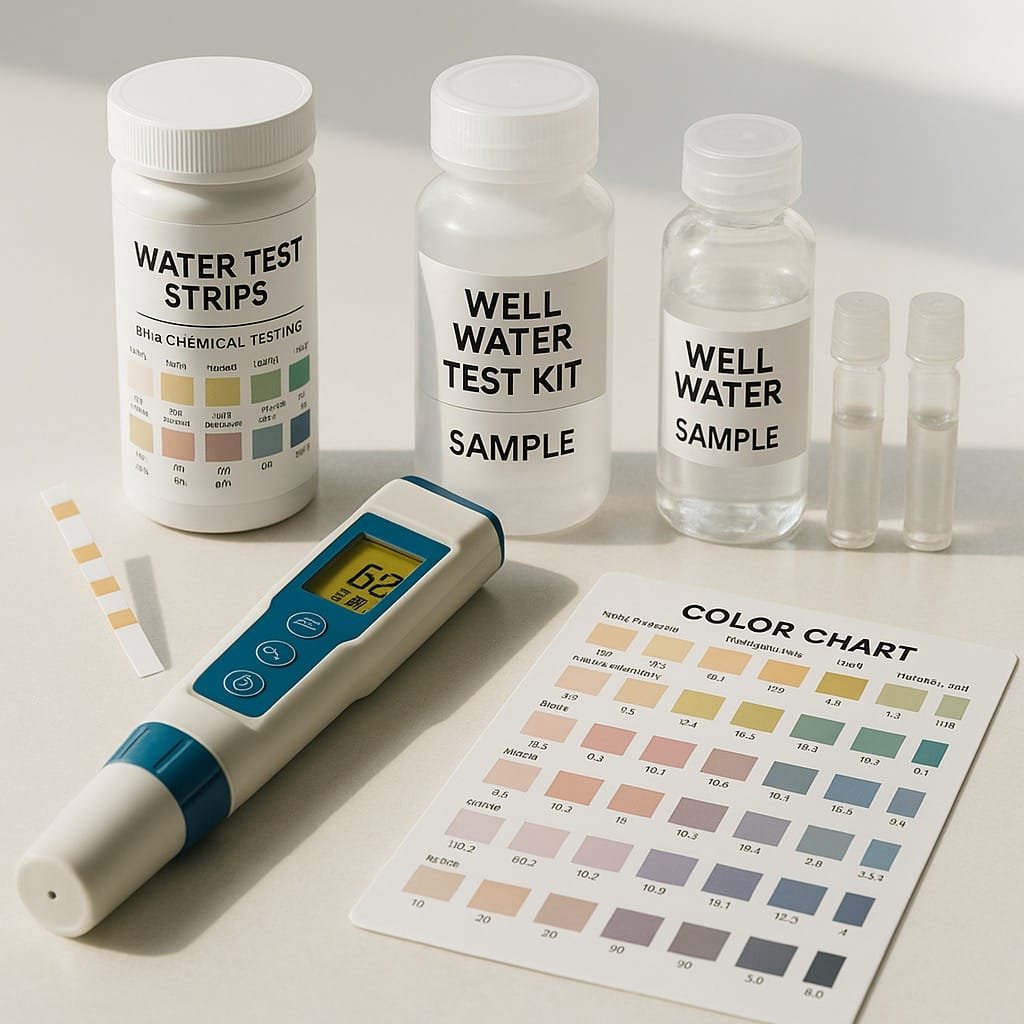
Unlike municipal water, private wells are entirely your responsibility. No federal or state agency treats your water before you drink it. The EPA regulates public water systems, but private wells are exempt from federal drinking water standards. That means you are the sole guardian of your household’s water safety.
Health Risks
Well water can harbor dangerous contaminants without any change in taste, smell, or appearance:
– E. coli and coliform bacteria cause gastrointestinal illness, kidney failure, and in severe cases death. The CDC links contaminated private wells to hundreds of outbreaks annually.
– Arsenic exposure causes skin lesions, cardiovascular disease, and is a known carcinogen. Over 3 million Americans in rural areas drink arsenic-contaminated groundwater.
– Nitrates from agricultural runoff pose particular danger to infants, causing “blue baby syndrome” (methemoglobinemia), which reduces oxygen delivery in the blood. Levels above 10 mg/L are considered dangerous.
– Lead causes irreversible neurological damage in children and kidney problems in adults. The Flint water crisis demonstrated what happens when lead leaches into drinking water.
– Radon dissolved in well water is the second-leading cause of lung cancer in the United States, according to the EPA.
Legal Requirements
Well water testing laws vary by state. Some key examples:
| State | Requirement |
|—|—|
| Minnesota | Annual bacterial test required; nitrate and lead testing every 5 years |
| Wisconsin | Well construction standards; testing recommended annually |
| New York | Annual bacterial test required for new wells; radon testing required in certain counties |
| Maine | Annual total coliform and E. coli testing mandated |
| Florida | No statewide testing mandate, but county ordinances may apply |
| Texas | No statewide testing requirement for private wells |
| Colorado | No state requirement, but recommended annually |
Always check your state’s Department of Environmental Quality or Health Department for local requirements. Some states require testing before property transfer or new well permit issuance.
Insurance Implications
Many homeowners insurance policies exclude well water contamination damage. However, a documented testing history can help:
– Some insurers offer well water endorsement riders ($50-$150/year) that cover contamination cleanup costs
– Property buyers often request well water test results, which can affect home sale value
– Certain health insurance claims related to waterborne illness may be defended with proof of regular testing history
– Rural homestead tax credits in some states require water quality documentation
Bottom line: Testing isn’t just about safety. It’s a financial and legal protection for you and your family.
What to Test For
Essential Parameters (Test Every Year)
| Parameter | Health Risk | EPA Max Level | Typical Cost to Test |
|—|—|—|—|
| Total coliform / E. coli | Bacterial illness, gastrointestinal disease | 0 CFU/100mL | $5 – $100 |
| Nitrates | Blue baby syndrome, reproductive issues | 10 mg/L | $5 – $30 |
| Lead | Neurological damage, kidney damage | 0.015 mg/L (action level) | $10 – $50 |
| Arsenic | Cancer, skin lesions, heart disease | 0.010 mg/L | $10 – $60 |
| pH | Corrosion, metal leaching, effectiveness of treatment | 6.5 – 8.5 recommended | $1 – $30 |
| Hardness | Pipe scaling, appliance damage, skin irritation | No MCL (advisory only) | $5 – $30 |
| Iron | Staining, metallic taste, plumbing damage | 0.3 mg/L (secondary standard) | $5 – $30 |
| Manganese | Neurological effects, staining | 0.05 mg/L (secondary standard) | $5 – $30 |
Optional Contaminants (Test Based on Your Location)
| Parameter | When to Test | Health Risk | Typical Cost to Test |
|—|—|—|—|
| PFAS / PFOA / PFOS | Living near industrial sites, firefighting training areas, or waste sites | Cancer, immune system damage, developmental issues | $50 – $300 per chemical |
| Radon | Living in granite or uranium-rich geology areas | Lung cancer (2nd leading cause) | $20 – $150 |
| Volatile Organic Compounds (VOCs) | Near gas stations, landfills, chemical plants, agricultural areas | Liver, kidney, nervous system damage; cancer | $50 – $200 |
| Uranium | Uranium mining areas, certain geological formations | Kidney damage, cancer | $20 – $80 |
| Hydrogen sulfide | Rotten egg odor present | Corrosive, unpleasant taste/odor | $5 – $30 |
| Fluoride | Natural levels vary widely; dental health consideration | Dental fluorosis (high levels), dental benefits (optimal levels) | $10 – $50 |
| Glyphosate / pesticides | Agricultural areas, orchards | Potential carcinogen, endocrine disruption | $30 – $150 |
| Mercury | Near mining operations, certain industrial zones | Kidney damage, neurological damage | $20 – $100 |
| Sulfate | Taste issues, laxative effect at high levels | 250 mg/L (secondary standard) | $5 – $25 |
| Copper | Corrosive water contacting copper plumbing | 1.3 mg/L (action level), liver/kidney damage | $10 – $40 |
Red Flag: If your well is within 100 feet of any of these, test for VOCs and nitrates immediately:
– Agricultural fields (pesticides, nitrates)
– Gas stations or underground storage tanks (VOCs)
– Landfills or waste disposal sites (VOCs, heavy metals)
– Industrial facilities (PFAS, heavy metals, VOCs)
– Septic systems (bacteria, nitrates)
– Mining operations (heavy metals, radon)
DIY Testing Methods
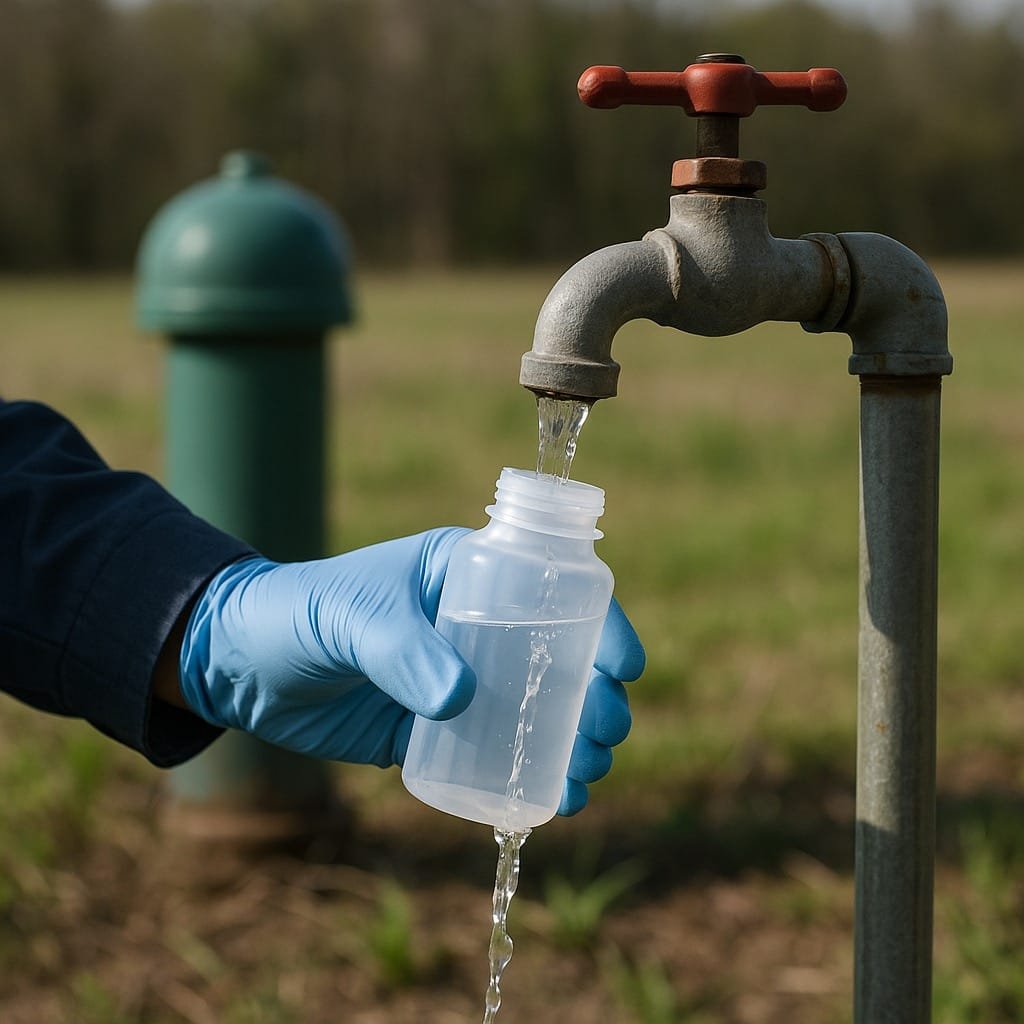
Test Strips ($5 – $30)
Test strips are the simplest and cheapest option. You dip the strip in water and compare color changes to a reference chart.
What they measure: pH, chlorine, hardness, iron, nitrates, nitrites, lead, copper, alkalinity, chlorine, bromine, water safety.
| Product | Price | Parameters | Accuracy | Best For |
|—|—|—|—|—|
| AquaChek 7-Way Pool & Spa Strips | $8 – $12 | pH, chlorine, alkalinity, hardness, calcium | Moderate | Basic water chemistry checks |
| Milgram 16-in-1 Water Test Strips | $10 – $15 | pH, hardness, chloramine, chlorine, copper, iron, nitrate, nitrite, sulfate, total alkalinity | Moderate | Multi-parameter screening |
| LaMotte EcoliColi Express Test | $25 – $35 | E. coli / total coliform | Good (comparable to lab) | Bacterial screening |
| Red Labs PFAS Test | $99 – $120 | PFAS/PFOA/PFOS | Limited (qualitative) | PFAS screening |
Pros:
– Inexpensive and immediately available at hardware stores or online
– No waiting time for results (minutes, not days)
– Easy to use with no technical training required
– Great for routine screening of basic parameters
Cons:
– Limited accuracy compared to laboratory testing
– Cannot detect many dangerous contaminants (arsenic, radon, most heavy metals at low levels)
– Color interpretation is subjective
– Expiration dates matter — old strips give false readings
– Not legally defensible as test results
Digital Meters ($20 – $100)
Digital meters provide precise readings for specific parameters.
| Meter Type | Price Range | What It Measures | Accuracy |
|—|—|—|—|
| TDS Meter | $10 – $25 | Total dissolved solids (ppm) | Good for trend monitoring |
| pH Meter (digital pen) | $15 – $40 | pH level | Very good when calibrated |
| EC Meter | $20 – $60 | Electrical conductivity (salinity) | Good |
| Multi-parameter Meter | $40 – $100 | pH + TDS + EC + temperature | Very good |
Pros:
– Quantitative, numeric results (no color interpretation)
– Reusable hundreds of times
– Excellent for monitoring trends over time
– Some models connect to smartphones for data logging
Cons:
– Calibration required every 1-3 months (calibration solutions cost $10-$25)
– Battery dependent
– Each meter measures only specific parameters
– Initial investment higher than strips
– Not suitable for bacterial detection
Home Test Kits ($25 – $150)
These are liquid reagent-based kits where you add chemicals to water samples and compare the resulting color to a chart.
| Kit | Price | Parameters | Accuracy | Testing Time |
|—|—|—|—|—|
| LaMotte Basic Water Testing Kit | $35 – $55 | pH, alkalinity, hardness, iron, copper, nitrate, nitrite, chlorine | Good | 15-30 min |
| Red Lakes Phosphate Test Kit | $30 – $45 | Phosphate, silicate, ammonia, pH, alkalinity, hardness, iron | Good | 10-15 min |
| ApriaCore Well Water Kit | $80 – $120 | Bacteria, nitrate, lead, iron, hardness, pH | Very Good | 24-72 hrs |
| Hach Lite 2 Kit | $70 – $100 | Multi-parameter water analysis | Very Good | 15-45 min |
| Safe Water Foundation Bacterial Kit | $25 – $40 | E. coli, total coliform | Very Good | 24 hrs |
Pros:
– Better accuracy than strips for the parameters they test
– Can detect bacteria (strips and meters cannot)
– Reasonably affordable for the accuracy provided
– No calibration required like digital meters
– Results are more reliable than strips for decision-making
Cons:
– Reagents expire (typically 1-2 years) and must be stored properly
– Longer turnaround for bacterial tests (24-72 hours)
– Color interpretation still somewhat subjective
– Cannot test for arsenic, lead at low levels, radon, PFAS, or VOCs
– Requires careful technique for accurate results
DIY Testing: Quick Comparison
| Factor | Test Strips | Digital Meters | Home Test Kits |
|—|—|—|—|
| Upfront cost | $5-$30 | $20-$100 | $25-$150 |
| Cost per test | $1-$3 | $0.05 (ongoing) | $2-$8 |
| Accuracy | Low-Moderate | Moderate-High | Moderate-High |
| Detection range | Basic only | Limited parameters | Moderate range |
| Speed | Minutes | Seconds | Minutes-hours |
| Bacterial testing | No | No | Yes (some) |
| Retest capability | Yes | Yes | Yes (limited) |
| Technical skill | Minimal | Moderate | Moderate |
Recommendation: Use test strips for quick monthly screening of pH and basic chemistry. Use a home test kit for annual bacterial testing. Always supplement DIY results with professional lab testing at least every 2-3 years.
Professional Testing
When to Hire a Lab
You should send water to a certified laboratory:
– Annually for total coliform/E. coli (more reliable than DIY for bacteria)
– Every 2-3 years for a full contaminant panel (arsenic, lead, nitrates, VOCs)
– Immediately after flooding, construction, new drilling, or a sharp change in water taste/smell/clarity
– Before purchasing or selling a property with a private well
– After a well repair or pump replacement
– If anyone in your household has a compromised immune system
– After a nearby contaminant spill or release
– If you notice red staining, metallic taste, or sediment that DIY tests can’t explain
Cost Breakdown for Professional Testing
| Test Type | What’s Included | Typical Cost | Turnaround |
|—|—|—|—|
| Bacterial only | Total coliform, E. coli | $15 – $50 | 24-48 hrs |
| Basic inorganic panel | Bacteria + pH, hardness, iron, manganese, nitrates, alkalinity | $50 – $120 | 3-5 days |
| Standard residential panel | Bacteria + metals (lead, arsenic, copper, iron, manganese) + nitrates + pH + hardness | $100 – $250 | 5-7 days |
| Comprehensive panel | Everything in standard + VOCs + PFAS + radon + uranium + fluoride | $250 – $500+ | 7-14 days |
| Full source water assessment | Bacteria + full metals suite + organics + isotopic analysis | $500 – $2,000+ | 2-4 weeks |
| PFAS-specific test | PFOA, PFOS, PFNA, PFHxS per chemical | $50 – $80 each | 7-10 days |
| Radon-specific test | Radon-222 dissolved in water | $50 – $150 | 5-7 days |
Choosing a Certified Lab
Not all labs are equal. Here’s what to verify:
1. State certification — The lab must be certified by your state’s primacy agency (usually the Department of Environmental Quality or Health Department). Search “[your state] certified drinking water laboratory list” for approved labs.
2. EPA accreditation — Look for labs accredited under the National Primary Drinking Water Regulations (NPDWR). This ensures they follow EPA-approved analytical methods.
3. ISO/IEC 17025 accreditation — International standard for testing and calibration laboratories. Indicates rigorous quality management.
4. Specific contaminant expertise — Not all labs test for everything. If you need PFAS or VOC analysis, confirm they offer those specific tests. Some labs need to subcontract those analyses.
5. Sample collection support — Good labs provide free sample bottles, collection instructions, and chain-of-custody forms. Some even offer pickup services.
6. Turnaround time — Standard results take 5-7 business days. Rush service (24-48 hours) typically costs 2-3x normal rates.
7. Price transparency — Request an itemized quote. Some labs bundle tests; others charge per parameter. Compare apples to apples.
Well Water Testing Cost Comparison Summary
| Option | Annual Cost | Accuracy | Best Use Case |
|—|—|—|—|
| DIY strips only | $30-$50 | Low | Basic screening, monthly checks |
| DIY strips + digital meter | $50-$100/year | Moderate | Routine trend monitoring |
| DIY strips + home kit | $75-$150/year | Moderate-High | Annual bacterial + basic chemistry |
| Professional basic (bacteria + basic) | $65-$170 | High | Recommended minimum annual testing |
| Professional comprehensive (annual) | $250-$500 | Very High | Complete peace of mind, property transactions |
| Professional comprehensive (every 2-3 yrs + DIY) | $120-$200/year | Very High | Cost-effective balance of safety and savings |
Red Flag: Never use a lab that claims to be “EPA certified” without specifying which accreditation. The EPA does not “certify” labs — it approves testing methods and works with states to accredit them. Legitimate labs display their certification number and can provide documentation.
How to Collect Water Samples Properly
Step-by-Step Sample Collection for Bacteria Testing
1. Get sample bottles from the lab — Use only bottles provided or approved by your testing lab. Most contain a preservative powder (sodium thiosulfate) to neutralize chlorine. Do NOT rinse these bottles.
2. Prepare the faucet — Remove the aerator from the spout. Choose your cold water tap closest to the well (usually the basement or outdoor faucet). This represents the water as it enters your home.
3. Sanitize the faucet — Turn the cold water on full. Let it run for 5-15 minutes to flush the pipes. This is critical for getting a representative sample of well water rather than standing water.
4. Flame-sterilize (if applicable) — If the lab requires it, carefully pass a flame (lighter or alcohol lamp) over the faucet tip for a few seconds. Let it cool for 30 seconds before collecting.
5. Collect the sample — Open the cold water tap to a steady flow. Hold the bottle by the bottom with the label-side facing you. Fill to the fill line — do not touch the inside of the bottle or cap. Replace the cap immediately without touching the inside of the lid.
6. Label and seal — Write the date, time, and sample location on the bottle label. Double-check the seal is tight. Wipe the outside clean.
7. Transport immediately — Delivers the sample within 8 hours of collection for accurate results. If you cannot deliver it that quickly, refrigerate (4°C/40°F or below) and deliver within 30 hours. Do not freeze.
8. Complete the chain-of-custody form — Fill out all required information accurately. Incomplete forms may delay or invalidate results.
Common Sample Collection Mistakes (And How to Avoid Them)
| Mistake | Consequence | How to Avoid |
|—|—|—|
| Rinsing the sample bottle | Contamination or chemical dilution | Never rinse lab-provided bottles |
| Not letting water run long enough | Testing standing water, not flowing well water | Run water 5-15 minutes minimum |
| Touching the inside of the bottle or cap | Introducing contaminants from your hands | Hold only outside surfaces |
| Filling beyond the fill line | Affects chemical concentration and test accuracy | Fill exactly to the line |
| Not labeling immediately | Results get mixed up or lost | Label at the tap, not at home |
| Delaying sample delivery | Bacteria may grow or die, falsifying results | Deliver within 8 hours or refrigerate |
| Testing after shock chlorination too soon | False negative for bacteria | Wait 2-4 weeks after chlorination |
| Testing only the kitchen faucet | Misses well water quality (filtration skews results) | Test from the source (first-point-of-entry) |
| Taking samples right after water treatment | Chemical interference with bacteria test | Wait 24 hours after chlorination or treatment |
Sample Collection for Metal Testing (Lead, Arsenic, Copper)
Metal testing requires a first-draw sample (opposite of bacteria testing):
1. Do not run the water before collecting the sample. The water sitting in your pipes overnight has accumulated metals from plumbing.
2. First thing in the morning, remove the aerator from the tap.
3. Turn on the cold water and let it run for 1-2 minutes to clear standing water from the house plumbing, then turn it off.
4. Wait 6 hours (do not use any water, including toilets, during this time).
5. Collect the sample from the same cold tap without rinsing the bottle.
6. Label, seal, and deliver within 8 hours.
This “first-draw” method measures the actual concentration of metals in the water you would drink from the tap after it has been sitting in your plumbing.
How Often Should You Test?
| Scenario | Frequency |
|—|—|
| Annual routine testing (bacteria + basic chemistry) | Every 12 months |
| Full contaminant panel (metals, nitrates, VOCs) | Every 2-3 years |
| After flooding or well contamination event | Within 1 week, then 1 month later |
| After new well drilling or well repair | Within 1 month of completion |
| Before property sale or purchase | Within 6 months of listing |
| Change in water taste, odor, color, or flow | Immediately |
| Pregnancy or infant in household | Annual bacteria test, full panel if never tested |
| After nearby construction or chemical spill | Within 1 week |
| PFAS concern area | Annually for PFOA and PFOS specifically |
| Radon in your area | Once, then retest every 5-10 years if levels are below action level |
| Seasonal changes (heavy rainfall, drought) | After extreme weather events |
Reading Your Results
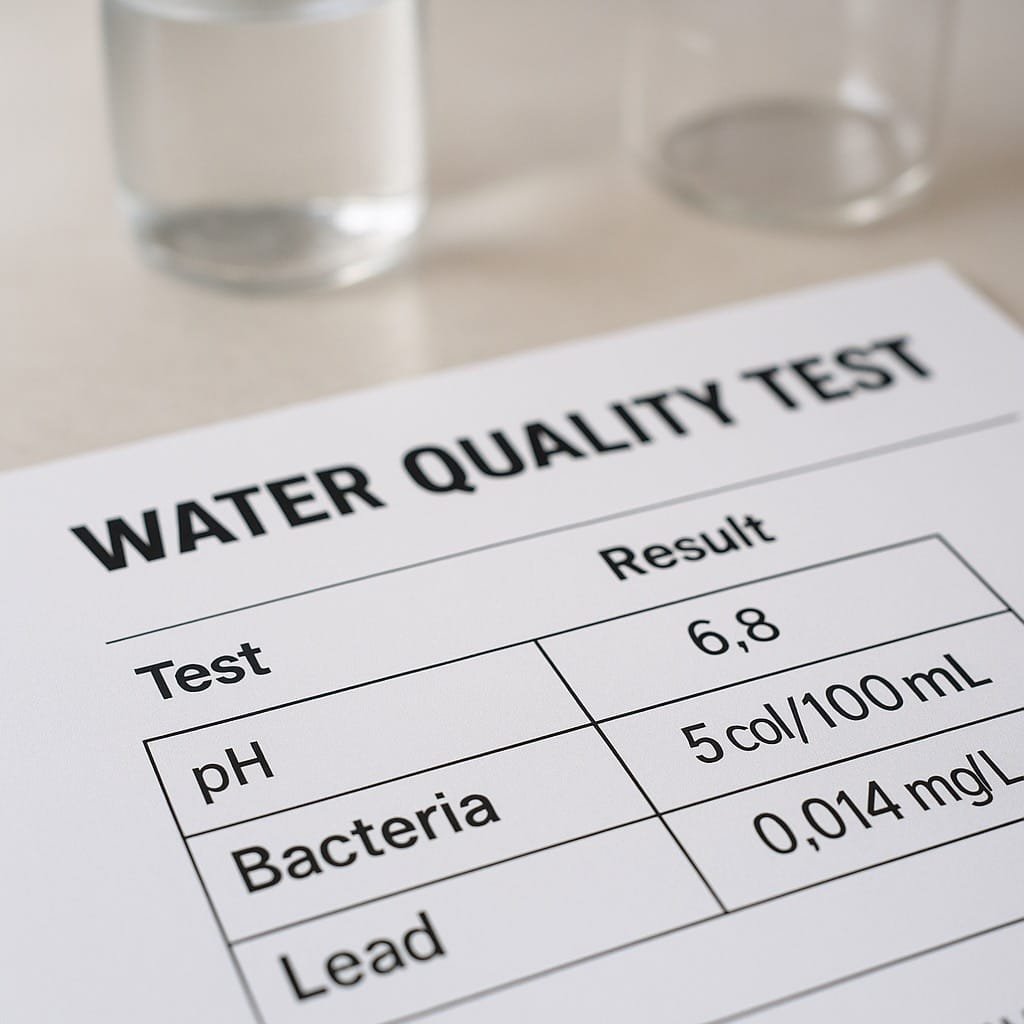
Standard Reference Tables
#### pH Levels
| pH Level | Interpretation | Action Needed |
|—|—|—|
| Below 6.0 | Acidic — corrosive, may leach metals from pipes | Install pH correction system |
| 6.0 – 6.5 | Slightly acidic — borderline | Monitor quarterly; consider neutralizing filter |
| 6.5 – 8.5 | Acceptable range | No action needed |
| 8.5 – 9.0 | Slightly alkaline — may cause scaling | Consider water softener if hardness is high |
| Above 9.0 | Highly alkaline — soapy feel, poor lathering | Water treatment consultation recommended |
#### Hardness Levels
| Hardness (mg/L as CaCO3) | Classification | Impact |
|—|—|—|
| 0 – 60 | Soft | No treatment needed; may be corrosive |
| 61 – 120 | Slightly hard | Minimal impact |
| 121 – 180 | Moderately hard | Possible scaling; monitor |
| 181 – 300 | Hard | Water softener recommended |
| Above 300 | Very hard | Water softener strongly recommended; will damage appliances |
#### Iron Levels
| Iron (mg/L) | Appearance | Action |
|—|—|—|
| Below 0.3 | Invisible | No action needed |
| 0.3 – 0.5 | Noticeable after sitting | Consider filtration |
| 0.5 – 2.0 | Orange/red staining, metallic taste | Treatment recommended (aeration + filtration or oxidation) |
| 2.0 – 3.0 | Heavy staining, bacterial slime possible | Active treatment required |
| Above 3.0 | Severe staining, treatment essential | Professional water treatment system needed |
#### Manganese Levels
| Manganese (mg/L) | Interpretation | Action |
|—|—|—|
| Below 0.02 | No issues | No action needed |
| 0.02 – 0.05 | Borderline | Monitor; may cause black staining |
| 0.05 – 0.5 | Secondary standard exceeded | Filtration recommended |
| Above 0.5 | Health advisory exceeded | Treatment required |
#### Lead Levels
| Lead (mg/L or ppb) | Status | Action |
|—|—|—|
| Below 0.005 (5 ppb) | Below CDC concern level | Annual monitoring |
| 0.005 – 0.015 (5-15 ppb) | Below EPA action level but above background | Investigate plumbing; test more frequently |
| 0.015 – 0.020 (15-20 ppb) | Approaching EPA action level | Install filtration; investigate source immediately |
| Above 0.015 (15 ppb) | EPA action level exceeded | Install treatment system immediately; stop drinking without treatment |
| Above 0.050 (50 ppb) | Significant contamination | Professional remediation required; consider alternative water source |
#### Arsenic Levels
| Arsenic (mg/L or ppb) | Status | Action |
|—|—|—|
| Below 0.003 (3 ppb) | Below concern threshold | Annual monitoring |
| 0.003 – 0.010 (3-10 ppb) | Below EPA MCL but elevated | Monitor annually; consider treatment for peace of mind |
| At or above 0.010 (10 ppb) | EPA Maximum Contaminant Level exceeded | Install treatment system (reverse osmosis or activated alumina) |
| Above 0.050 (50 ppb) | Severe contamination | Professional remediation; alternative water source |
#### Nitrate Levels
| Nitrate (mg/L as N) | Status | Action |
|—|—|—|
| Below 3 mg/L | No concern | Annual monitoring |
| 3 – 5 mg/L | Moderate | Monitor quarterly during growing season |
| 5 – 10 mg/L | Elevated | Consider treatment, especially for infants |
| At or above 10 mg/L | EPA MCL exceeded | Stop drinking untreated water; install nitrate removal (ion exchange or reverse osmosis) |
| Above 20 mg/L | Severe contamination | Alternative water source required for infants |
#### Bacteria Results
| Result | Interpretation | Action |
|—|—|—|
| Total coliform negative, E. coli negative | Clean | No action needed |
| Total coliform positive, E. coli negative | Possible contamination | Retest in 24-48 hours; if still positive, shock chlorinate |
| Total coliform positive, E. coli positive | Active fecal contamination | Do not drink. Shock chlorinate well. Retest after 2 weeks. If positive again, consult well professional immediately. |
| Total coliform positive, E. coli negative (repeated) | Intermittent contamination | Investigate well seal, cap, and surrounding conditions; consider permanent chlorination system |
Red Flag Results — What They Mean
| Combination of Results | Likely Cause | Immediate Action |
|—|—|—|
| Bacteria positive + low pH | Corrosive water damaging well seal | Fix pH, chlorinate, inspect well integrity |
| Lead elevated + low pH + soft water | Corrosion of old plumbing | Install pH correction + point-of-use filtration |
| Arsenic elevated + high iron + manganese | Natural geology contamination | Professional treatment system (oxidation + filtration) |
| Nitrates elevated + bacteria positive | Surface contamination (septic, agricultural) | Investigate source; likely well seal failure or surface intrusion |
| High TDS + high chloride + high sulfate | Possible saltwater intrusion (coastal areas) | Professional hydrogeological assessment needed |
| Hydrogen sulfide + bacteria | Sulfate-reducing bacteria in well | Shock chlorination; consider continuous chlorination system |
| Radon elevated + high uranium | Uranium-rich geology | Radon mitigation system; consider uranium treatment |
Understanding Your Lab Report
A professional lab report will include:
1. Sample information — Date, time, location, and collector name
2. Analyte name — The specific parameter tested
3. Result — Your water’s measured concentration with units (mg/L, ppb, CFU/100mL, etc.)
4. Method used — The analytical method (EPA SW-846, EPA 200.7, etc.)
5. Detection limit — The minimum level the lab can detect
6. Regulatory standard — The EPA MCL or health advisory for that contaminant
7. Flag/indicator — Usually an asterisk or symbol if your result exceeds a standard
8. Lab certification number — For verification
Important: If your result is “below detection limit,” that means the contaminant was not detected at the lab’s detection threshold — not necessarily that it’s zero. Compare your result to the detection limit to understand the sensitivity of the test.
Annual Testing Checklist and Schedule
Seasonal Testing Schedule
| Season | Months | Test | Method | Estimated Cost |
|—|—|—|—|—|
| Spring | March-May | Total coliform, E. coli, nitrates | Lab or home kit | $30-$80 |
| | | pH, hardness, iron | DIY strips or meter | $5-$15 |
| Summer | June-August | Iron, manganese, clarity check | DIY strips | $5-$10 |
| | | TDS reading | DIY meter | Already owned |
| Fall | Sept-Nov | Full panel: bacteria, metals, nitrates, VOCs | Professional lab | $100-$250 |
| | | Lead, arsenic (if not in spring panel) | Lab | $20-$60 |
| Winter | Dec-Feb | Radon (if applicable) | Lab or radon test kit | $50-$150 |
| | | PFAS (if in PFAS-prone area) | Lab | $50-$300 |
| | | pH check (winter baseline) | DIY strips or meter | $0-$15 |
Complete Annual Testing Checklist
Printable Annual Testing Calendar
What to Do If Your Test Results Are Problematic
| Result | Next Steps | Timeline |
|—|—|—|
| Bacteria positive | Shock chlorinate; retest in 14 days; if still positive, call a well professional | 2-4 weeks |
| Nitrates > 10 mg/L | Install ion exchange or reverse osmosis system; never use untreated water for infant formula | 1-2 weeks |
| Lead > 15 ppb | Install point-of-use reverse osmosis or activated alumina filter; stop drinking tap water until treated | Immediate |
| Arsenic > 10 ppb | Install reverse osmosis or activated alumina system; consider professional assessment | 2-4 weeks |
| Low pH (< 6.5) | Install neutralizing filter or calcite feeder to raise pH and reduce pipe corrosion | 1-2 weeks |
| High iron/manganese | Install aeration filtration or manganese greensand filter | 2-4 weeks |
| PFAS detected | Install activated carbon (GAC) or reverse osmosis system; contact state health department | 2-4 weeks |
| Radon > 4 pCi/L | Install aeration-based radon mitigation system | 2-4 weeks |
Estimated Annual Testing Budget
| Testing Approach | Annual Cost | Coverage Level |
|—|—|—|
| DIY strips and meter only | $30-$50 | Basic chemistry screening only |
| DIY + annual bacteria lab test | $80-$130 | Basic + bacterial |
| DIY + comprehensive lab panel (annual) | $280-$550 | Full coverage annually |
| DIY + comprehensive lab panel (every 2 years) | $120-$200/year | Full coverage cost-optimized |
| DIY + comprehensive lab panel + PFAS/Radon (annual) | $330-$700/year | Maximum coverage |
Red Flag: If your annual testing budget is below $50, you are likely missing critical contaminant testing. DIY strips cannot detect the most dangerous contaminants (arsenic, lead at low levels, radon, PFAS, bacteria at infectious levels). Budget for at least an annual professional lab test for bacteria and a comprehensive panel every 2-3 years.
Sources and Further Reading
– U.S. EPA. “Ground Water and Your Drinking Water.” epa.gov/wateradvisor
– U.S. EPA. “Private Wells.” epa.gov/privatewells
– U.S. Geological Survey. “Quality of Water from Private Wells in the United States.” pubs.usgs.gov
– Centers for Disease Control and Prevention. “Drinking Water and Septic System.” cdc.gov/safe water
– National Ground Water Association. “Private Well Owner’s Guide.” ngwa.org
– World Health Organization. “Guidelines for Drinking-water Quality.” who.int/water_sanitation_health
– National Institute of Building Sciences. “Private Well Water Testing Guidelines.”
– American Water Works Association. “Private Well Management.” awwa.org
—
This article is for informational purposes only and does not constitute professional advice. Consult your state’s environmental health agency and a licensed water treatment professional for guidance specific to your well and location.
Sources
The guidance in this article is informed by the following authoritative sources:
- USGS — Ground Water — U.S. Geological Service data on groundwater levels, well construction, and water quality.
- EPA — WaterSense — EPA guidance on water conservation and water quality standards.
- CDC — Water and Wellness — Centers for Disease Control and Prevention guidance on safe drinking water.
External links open in a new tab. Verify current details with the source before relying on them.