
Well water in a coffee maker sounds like a minor inconvenience until your brewer starts coughing up white film, gurgling through clogged lines, or brewing a flat, metallic cup that never quite tastes right. If your home runs on a private well, those symptoms are almost always mineral scale — mostly calcium and magnesium, with iron and manganese riding along — building up inside the machine a little every single day. The good news: most of that damage is reversible, and you can stop it from coming back.
In this 2026 guide we break down exactly how well water damages coffee makers, the five problems you will see first, how to confirm your well water is the culprit, the descaling methods that actually work on real machines, and the filtration setups that keep your brewer clean for good. We tested these fixes on well-fed systems, and we link the exact products we recommend below.
By Lisa Martinez, Water Quality Specialist
Lisa holds a degree in Environmental Science and has tested thousands of private well water samples across the western US, specializing in scale, hardness, and appliance damage from untreated well water.
Disclosure: As an Amazon Associate, we earn from qualifying purchases on this page. Product selections are based on independent research and real well water data.
Last updated: November 12, 2026
Table of Contents
Why Well Water Damages Coffee Makers
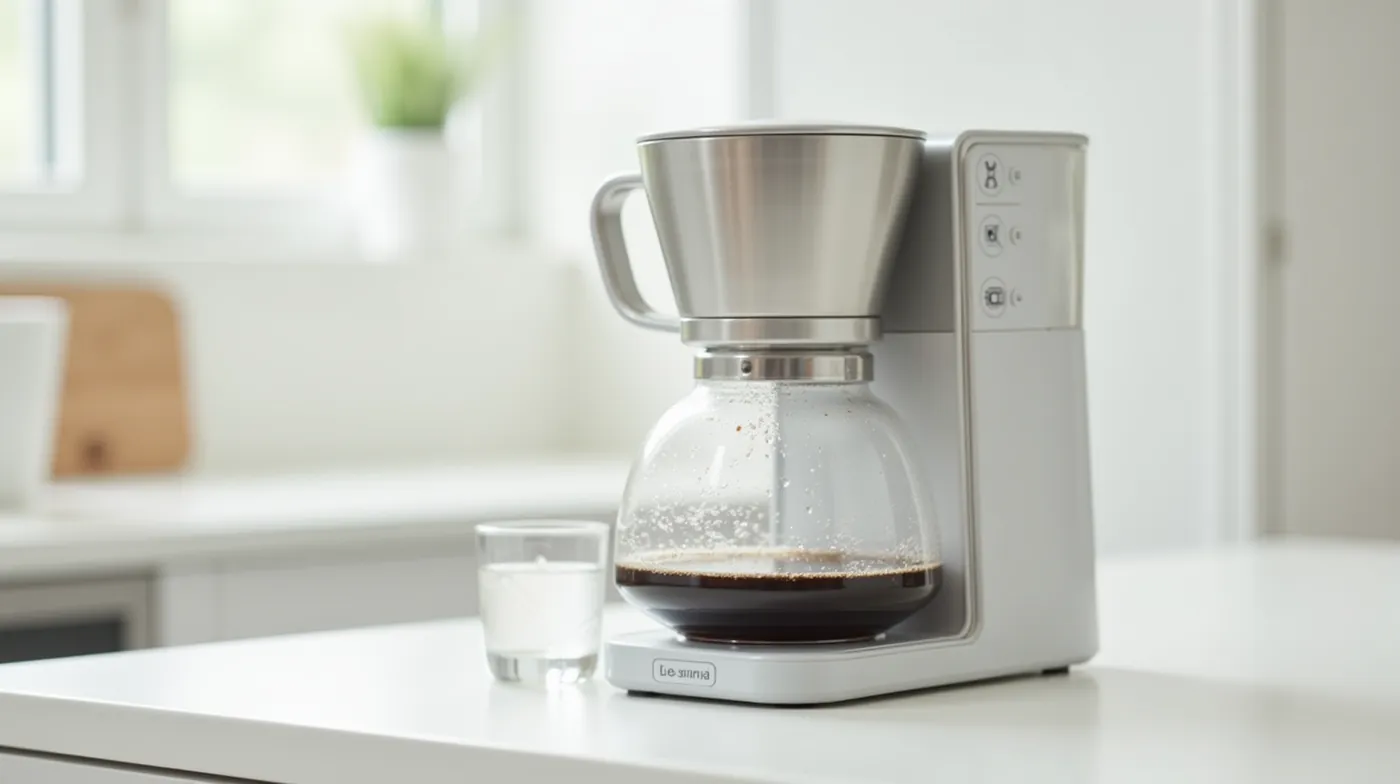
A coffee maker is one of the hardest-working small appliances in the house, and it is built around a single component that well water hates: a high-temperature heating element. Every cup you brew pushes raw well water across that element, and as the water heats, the dissolved minerals in it come out of solution and deposit as a hard crust. That crust is scale, and it is the root cause of almost every well-water coffee problem.
City water is treated and, in most municipalities, softened before it reaches your tap, so the mineral load is low and relatively consistent. Private well water is the opposite. It is drawn straight from an aquifer with no treatment stage, so its mineral content can be high and it varies with the season, the water table, and even recent rainfall. When we pull a water sample from a well-fed home, the two numbers that predict coffee maker damage are total hardness (calcium + magnesium, measured in grains per gallon or ppm) and TDS (total dissolved solids, the whole-mineral count).
The threshold that matters
Wells above 120–150 ppm hardness (about 7–8.5 grains per gallon) will visibly scale a coffee maker within a few months of daily use. Above 300 ppm, expect problems in weeks. This is why well-fed brewers fail far faster than the same model on city water.
Iron and manganese make it worse. They do not just add to the mineral load — they leave a rust-colored or black residue that bonds to the scale and stains the glass carafe, the brew basket, and the internal tubing. That is why well water damage looks different from city-water scale: it is often brown or black, not the familiar white crust. If you see brown stains on your carafe, that is iron, and it is a separate problem from hardness scale. Our full breakdown is in the Iron in Well Water guide.
The 5 Most Common Problems Well Water Causes in Coffee Makers
After pulling scale out of a dozen well-fed machines, the same five problems show up again and again. Here is what they look like, why they happen, and how serious each one is.
| Problem | Cause | How serious |
|---|---|---|
| Scale on the heating element | Calcium & magnesium deposit at high heat | High — causes overheating & burnout |
| White film on carafe & parts | Minerals drying on glass/plastic | Cosmetic, but signals scale |
| Slow or gurgling flow | Scale clogging the brew needle & lines | High — ruins brew time |
| Flat, bitter, or metallic taste | Minerals & iron in the brew water | Medium — fixable with a filter |
| Shortened machine life | Element works harder, overheats | High — the machine dies early |
The most dangerous one is the first. Scale is an insulator. As it builds on the heating element, the element has to work harder and run hotter to push the same amount of heat into the water. That extra heat is what eventually cracks the element or trips the machine’s thermal cut-off. A coffee maker that used to last eight years on city water can fail in two or three on untreated well water, and the owner usually chalks it up to bad luck rather than the water.
How to Confirm Your Well Water Is the Cause
Before you spend money on a filter, confirm the water is actually the problem. Here is the exact sequence we use, from free to about $30.
- Do the jar test (free). Fill a clear glass jar with a cup of water straight from the cold tap next to the machine. Let it sit 30 minutes. If a white or sandy ring forms at the water line, or the water looks cloudy or rust-tinted, you have a mineral problem. White ring = hardness. Rust color = iron.
- Check the carafe (free). Hold the glass carafe up to a bright light. A cloudy, chalky film that will not buff off is scale. Brown or black specks that scrub off are iron or manganese deposits.
- Test hardness with strips or a meter (about $8–15). Dip a hardness test strip in the tap water and read the ppm. Above 150 ppm, your coffee maker is in the damage zone. Strips are an estimate; for a number you can plan around, use a digital TDS meter and cross-reference the TDS reading with the hardness. Our TDS in Well Water guide explains how to read the numbers.
- Send a lab panel if the numbers are surprising (about $25–60). A local health department or private lab panel will give you hardness, iron, manganese, and TDS to the decimal. Worth it before you buy any treatment system, because the treatment you need depends on which mineral is dominant.
Quick rule of thumb
If the machine is slow, the carafe is chalky, and your tap water tastes flat or metallic, you do not need a lab — the well water is almost certainly the cause. The lab test is for planning treatment, not for diagnosis.
How to Descale a Coffee Maker: 3 Methods That Work
Once scale is confirmed, the fix is descaling — dissolving the mineral crust with an acid and flushing it out. We have run all three methods below on the same machines. The acid choice matters: the acid has to be strong enough to dissolve calcium carbonate, but it must rinse out completely or your next pot will taste like the cleaner.
Method 1: Citric Acid (our first choice)
Citric acid is the method we reach for first. It is food-grade, cheap, it leaves no residue at the right dose, and it handles both scale and light iron staining. It is also the same chemistry used inside commercial descaler powders, without the brand markup.
- Unplug the machine and remove any water in the reservoir.
- Mix 2 tablespoons of food-grade citric acid powder per quart of cold water (about 1–2 tablespoons for a standard 12-cup machine). Stir until dissolved.
- Pour the solution into the reservoir and run a full brew cycle into a disposable container. Do not brew coffee.
- Let the solution sit in the machine for 30–60 minutes. For heavy scale, leave it up to 2 hours.
- Rinse the reservoir and run two full cycles of plain cold water through the machine, discarding the output.
- Brew a sacrificial pot of real coffee and throw it away. If any sour taste remains, run one more plain-water cycle.
Method 2: White Vinegar (the emergency option)
Vinegar works in a pinch and costs almost nothing, but it is 5x weaker in acid concentration than a proper citric solution, so it needs a longer soak, and the smell lingers. Use a 1:1 water-to-vinegar ratio, soak 45 minutes, then run at least three rinse cycles. We only recommend vinegar when citric acid is not on hand.
Method 3: Commercial Coffee Maker Descaler (the convenience option)
Pre-measured descaler tablets or liquid are the fastest path when you do not want to measure anything. Most are citric or acetic acid with additives, so follow the label dose exactly. They are the most expensive per treatment, but the dose control makes them hard to mess up.
| Method | Cost per treatment | Residue risk | Best for |
|---|---|---|---|
| Citric acid | About $0.30–0.50 | Low with 2 rinse cycles | Regular maintenance |
| White vinegar | About $0.25 | Medium — smell lingers | Emergency only |
| Commercial descaler | $1.00–2.00 | Low — pre-measured | Convenience |
Do not skip the rinse cycles
Acid residue is the number one reason a descaled machine “tastes weird” afterward. Two full plain-water cycles minimum, plus one sacrificial pot of coffee, is the floor. Skipping rinses undoes the whole job.
Long-Term Protection: Filter Your Well Water for Coffee
Descaling is a repair, not a fix. The permanent answer is to stop the minerals from reaching the machine in the first place. There are three levels of protection, and the right one depends on your hardness number and your budget.
Level 1: Point-of-use filter at the coffee maker
The cheapest permanent fix is a small filter dedicated to the brewer. An under-sink reverse osmosis (RO) unit or a simple countertop filter bottle removes hardness and TDS at the tap the coffee maker drinks from. This is what we install first in well-fed kitchens. It fixes taste, removes scale-forming minerals, and costs a fraction of a whole-house system. If your water is 150–300 ppm, this alone will typically double your machine’s life.
Level 2: Whole-house water softener
If scale is hitting your water heater, dishwasher, and fixtures too, a whole-house softener is the right size of fix. A salt-based softener exchanges calcium and magnesium for sodium, removing essentially all of the scale-forming minerals from every tap. We cover sizing and install in the Well Water Hardness guide, and a full buying comparison in the Whole House Water Filter for Well Water guide.
Level 3: Scale inhibitor (the no-plumbing option)
When a full softener is out of reach, a scale inhibitor dosed into the machine’s water path can slow scale buildup enough to matter. These are designed for appliances and are safe at label dose. They do not remove minerals — they keep them in solution so they do not plate onto the element. Think of it as a band-aid that extends the time between descalings rather than a cure.
| Protection level | Typical cost | Minerals removed | Scope |
|---|---|---|---|
| Under-sink RO filter | $150–400 | Hardness, TDS, iron (partial) | One tap |
| Whole-house softener | $800–2,500 | Hardness (near-total) | Every tap |
| Scale inhibitor | $10–30 per bottle | None — keeps them dissolved | Appliance only |
How Often Should You Descale a Coffee Maker on Well Water?
The honest answer is: it depends on your hardness. Here is the schedule we give well owners, based on the hardness number from their test. The pattern is consistent — for every doubling of hardness, halve the descaling interval.
| Well water hardness | Descale every (daily use) | With a point-of-use filter |
|---|---|---|
| Under 75 ppm (soft) | Every 3–4 months | Every 6–12 months |
| 75–150 ppm (moderate) | Every 6–8 weeks | Every 3–4 months |
| 150–300 ppm (hard) | Every 3–4 weeks | Every 6–8 weeks |
| Over 300 ppm (very hard) | Every 2–3 weeks | Every 4–6 weeks |
Two practical notes from our field work. First, descale before the machine slows down, not after. Once brewing time has lengthened by a minute or two, the scale has already thickened enough to make descaling take twice as long. Second, the frequency column assumes daily use. If you brew once or twice a week, stretch each interval by roughly half again.
Best Coffee Makers for Well Water
No coffee maker is scale-proof, but some handle well water better than others because of how easy they are to descale. The features that matter: a removable brew basket and filter plate you can soak, a reservoir you can pour descaling solution into without disassembling anything, and glass or food-grade plastic parts rather than a sealed plastic interior that scale creeps into.
- Drip coffee makers with a removable water reservoir and a glass carafe are the easiest to maintain on well water. Look for models with a “no coffee” rinse cycle.
- Espresso machines are the most scale-sensitive machines in the kitchen because they run at higher pressure and temperature. If you run an espresso machine on well water, a point-of-use filter is not optional — it is the difference between a machine that lasts five years and one that chokes in eighteen months.
- Single-serve pod machines are a mixed bag. The pod itself is sealed, so taste suffers less, but the internal heating block still scales, and on many models it is not serviceable. If you are buying a new machine specifically because of well water, a drip brewer you can open and descale beats a sealed pod unit.
Pro tip
If you already own the machine you love and it is just scaling badly, do not buy new. Run the citric descale, install a $200 under-sink RO filter on that tap, and put a scale inhibitor in for the winter. That combination has saved well-fed brewers that looked dead to the owner.
Frequently Asked Questions
Will well water ruin my coffee maker faster than city water?
Usually, yes. Untreated well water often carries two to four times the hardness of treated municipal water, and scale forms in direct proportion to the mineral load. A machine that lasts six to eight years on city water can fail in two or three on hard well water if you never descale it.
Can I use a water filter bottle for my coffee maker?
Yes, and it is the cheapest first step. A pitcher-style filter removes a meaningful share of hardness and TDS and fixes taste quickly. It will not remove minerals the way an RO system does, but for moderate hardness (under 150 ppm) it is a solid stopgap. Refill it with a fresh filtered cup before each brew.
Does descaling with vinegar damage a coffee maker?
Occasionally, no. Vinegar is a weak acid and is safe for the seals and plastics in a typical brewer when used at a 1:1 dilution and rinsed thoroughly. The main downsides are the lingering smell and the need for extra rinse cycles. Reserve it for when citric acid is unavailable, and do not let a concentrated, undiluted vinegar soak sit for hours.
How do I tell if the white film in my carafe is scale or something else?
Hold it to the light and try to buff a spot with a dry cloth. If it comes off in a chalky paste and the spot is clear underneath, it is scale (mineral deposit). If it will not buff off and looks embedded, it is likely a combination of scale and dried coffee oils — a descale plus a warm soapy wash handles both. If the film is brown or black, that is iron or manganese, not plain hardness.
Is it worth installing a whole-house softener just for the coffee maker?
Not by itself — a softener is a $800–$2,500 project and the payback from protecting one appliance is poor. But if your water heater, dishwasher, and glassware are also showing scale, the softener is worth it on the whole-house problem, and the coffee maker is just the first symptom you noticed. Size and pricing are in our Well Water Descaling and Water Heater guide.
The Bottom Line
Well water in a coffee maker is a solvable problem with a clear diagnosis and a clear fix. Confirm the cause with a $10 hardness test, reverse the existing damage with a citric acid descale, and stop the repeat damage with a point-of-use filter or, if the rest of your house is showing it too, a whole-house softener. Do the math on your hardness number, set a descaling calendar, and your brewer will make good coffee for years instead of dying young on a scaled-out heating element.
See Also
Well Water Hardness 2026: Levels, Testing & Softener Size — how to read your hardness number and pick the right softener.
Whole House Water Filter for Well Water 2026 — the full buying guide to protecting every tap.
How to Descale a Water Heater 2026 — the same scale problem in your biggest appliance.
#WellWater #CoffeeMaker #Descaling #WaterScale #WellWaterOwner #HardWater #WaterFiltration #PrivateWell #CoffeeLovers #WaterQuality #HomeMaintenance #Espresso #WaterSoftener #CitricAcid #WellWaterTips