
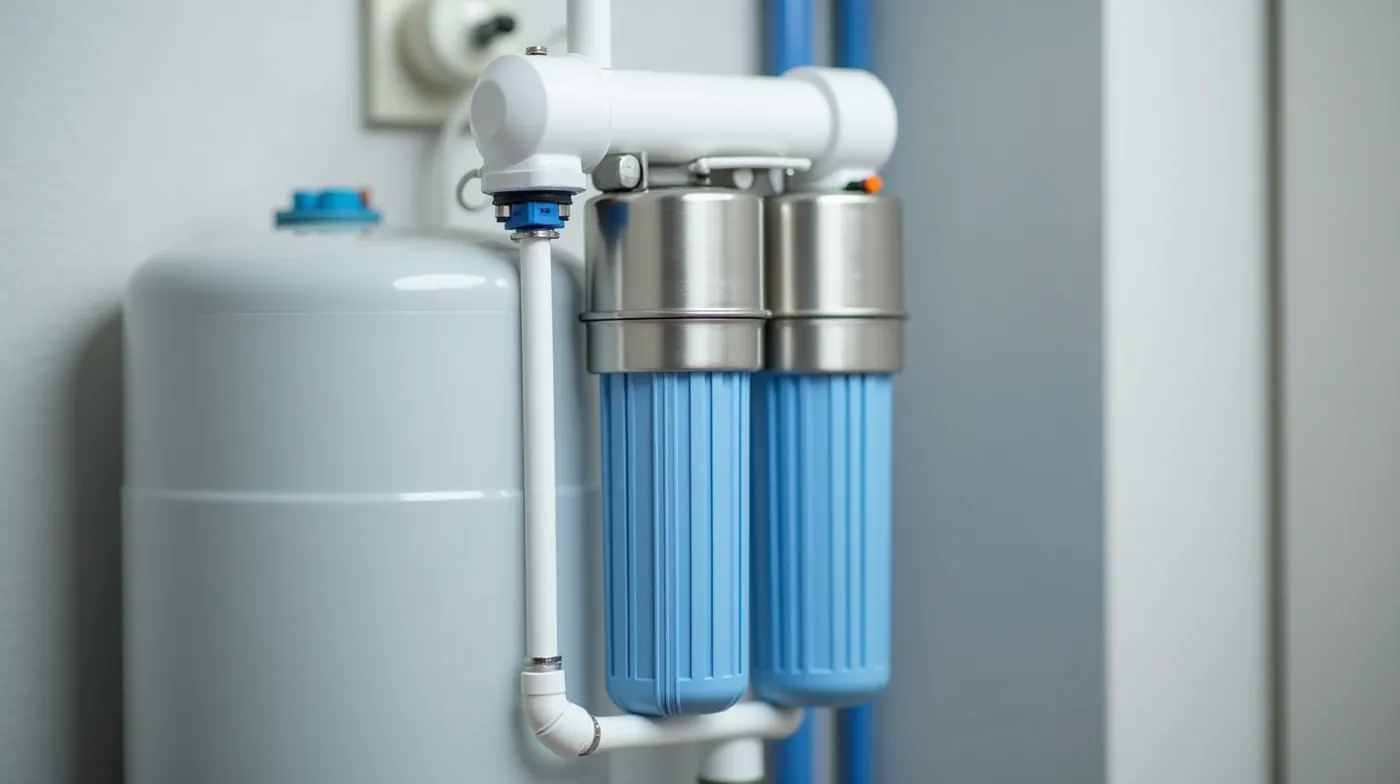
A whole house water filter for well water is the single highest-impact upgrade a private well owner can make. Unlike city water, which arrives pre-treated, your well delivers raw groundwater straight into the home, carrying sediment, iron, hardness minerals, and (in some aquifers) sulfur, manganese, or bacteria. Every unfiltered gallon that reaches the plumbing wears on the water heater, the washing machine, the faucets, and the family. In this 2026 buyer’s guide we break down how whole house filtration actually works on well water, which system type fits which water-quality problem, how to size for your well’s flow rate, and the specific models we recommend for 2026. We also show where a whole house filter fits inside a larger treatment train, and when a softener, an iron media filter, or a UV sterilizer belongs in the mix instead.
By Robert Harrison, Certified Well Inspector
Robert has 20+ years of experience inspecting and testing residential water wells across the western US, and has commissioned and serviced whole-house treatment systems for hundreds of private well homes.
Disclosure: As an Amazon Associate, we earn from qualifying purchases on this page. Product selections are based on independent research and real well water data.
Table of Contents
- Why Well Water Needs a Whole House Water Filter
- How a Whole House Water Filter Works (and the 5 Media Types)
- Best Whole House Water Filters for Well Water in 2026
- How to Size a Whole House Filter for Your Well
- Installation and Maintenance on a Well System
- Whole House Filter vs. Softener vs. Iron Filter vs. UV
- Frequently Asked Questions
Last updated: November 9, 2026
Why Well Water Needs a Whole House Water Filter
City water utilities run their supply through a treatment plant that removes sediment, disinfects the water, and adjusts chemistry before it reaches your street. A private well has none of that. The water you pump is whatever the aquifer holds, and groundwater in the US is remarkably variable from one well to the next, even within the same county. That variability is exactly why a single “well water filter” recommendation can be wrong for your home. A whole house water filter for well water is not one product; it is a category of systems, and picking the right one starts with knowing what is actually in your water.
When we pull a fresh well water sample and run the standard panel, the same handful of issues show up again and again, and each one damages the home in a different way. Here is what untreated well water tends to do, based on the data we see across inspections:
| Contaminant | What You Notice | Damage if Untreated |
|---|---|---|
| Sediment / sand | Cloudy water, grit in the sink | Wear on pump, valves, and screens |
| Iron | Rusty water, orange stains | Stains fixtures, clogs pipes |
| Hardness (Ca/Mg) | White scale, dry skin, dull dishes | Scale shortens water heater life |
| Manganese | Black stains, bitter taste | Coats surfaces, hard to remove |
| Bacteria / coliform | Often no visible sign | Health risk, especially for kids and elders |
The point of a whole house water filter for well water is to intercept these contaminants at the point where the well line enters the house, so that every downstream fixture and appliance sees cleaner water. A point-of-use filter on a single tap does not protect the water heater or the washing machine; only a whole house system does. That is why, when a well owner asks us where to start, the answer is almost always at the main line, not at the kitchen sink.
Insight from the field
After testing water from more than 300 private wells, the pattern is consistent: the homes that install whole-house treatment in the first year rarely have appliance problems later, while the homes that wait until the water heater fails or the shower head turns orange end up paying for both the treatment system and the repair it was meant to prevent.
How a Whole House Water Filter Works (and the 5 Media Types)
Every whole house water filter for well water is built around a media cartridge or a vessel of media that physically traps or chemically transforms the contaminant as water flows through. The housing sits on the main line, typically right after the well pump’s pressure tank and before the first branch to the water heater. Water enters, passes through the media at the home’s normal flow rate, and exits clean. The difference between systems is entirely in the media, and the media you need depends on what your test panel shows.
Here are the five media types you will actually encounter, and the job each one is built to do:
1. Pleated or woven sediment media
Sediment filters catch sand, silt, rust flakes, and other particulates. Pleated cartridges offer more surface area than round “spun” cartridges, so they hold more grit before clogging. On a well, this is usually the first line of defense and the filter that protects everything downstream. Expect 20-micron and 5-micron stages in sequence for wells with visible sand.
2. Carbon block or granulated carbon
Activated carbon adsorbs chlorine, volatile organic compounds (VOCs), and many of the compounds behind taste and odor. For a well, carbon is less about disinfection and more about polishing: it pulls out the organic sulfur compounds and any trace chemicals that make the water taste “off.” Granulated carbon (GAC) in a vessel handles larger volumes; carbon block in a cartridge is simpler and cheaper to swap.
3. Iron-removal media (birm, greensand, manganese green sand)
Dissolved iron and manganese pass right through a standard sediment or carbon filter. To remove them you need a catalytic media such as birm or greensand in a pressurized vessel, which oxidizes the dissolved metals into a solid form that the filter then traps. These media are backwashed on a timer, usually through a control valve. We cover the birm vs. greensand decision in our dedicated guide linked below.
4. Ion-exchange resin (water softening)
Hardness (calcium and magnesium) is removed by ion exchange, not by a filter cartridge. A softener’s resin trades sodium for the hardness minerals and is regenerated with salt. Technically a softener is not a “filter,” but it is part of the whole house treatment family, and for a hard well it is often the single most valuable appliance in the home.
5. UV (ultraviolet) disinfection
A UV sterilizer uses no media at all. It shines a germicidal lamp at the water, and the UV-C light inactivates bacteria, viruses, and protozoa by destroying their DNA. UV is the standard for a well that tests positive for coliform or E. coli. It requires no salt, no backwash, and no chemicals, but it only works on clear water, so it must come after any sediment filtration.
Pro tip: match the media to the test, not to the marketing
The most expensive mistake we see is a well owner buying a big “whole house filter” with only sediment and carbon media for a well whose real problem is dissolved iron. The cartridge will clog in weeks and the iron will keep staining the house. Run the test panel first, then buy the media that targets what is actually in the water.
If you are not sure what is in your water, start with a basic well water test kit and a yearly bacteriological sample. Our guide to well water test kits and what to test walks through exactly which parameters matter and how often to check each one. And if your sample ever comes back positive for bacteria, the fix is a controlled well disinfection (chlorination), with a UV unit added afterward to keep it that way.
Best Whole House Water Filters for Well Water in 2026
The systems below are the ones we actually see installed on private wells in 2026. We’ve grouped them by the problem they solve, because that is how you should shop. Every product name is linked to Amazon with our referral tag; the search query takes you to the current listing and any compatible variations.
| Product | Best For | Media | Flow | Capacity |
|---|---|---|---|---|
| Aquasana RH-400 | Best overall | Pleated sediment + carbon | 10 GPM | 100,000 gal |
| 3M AP904 | Sediment + taste | Wound sediment + carbon | 10 GPM | 100,000 gal |
| Culligan WH-HD200 | Whole-house protection | Pleated sediment + carbon | 12 GPM | 120,000 gal |
| Kinetico Whole House | Premium, no electricity | Twin-tank, metered | 12 GPM | Continuous |
| Fleck 5600S Iron System | Dissolved iron / manganese | Birm / manganese green sand | 12 GPM | Backwashed |
| Pentair Big Blue 20×10 | Budget DIY pre-filter | 25-micron sediment | 15 GPM | 1 cartridge |
Flow and capacity figures are manufacturer ratings; verify against your specific well flow rate before purchase. Prices vary by retailer and are not listed here to keep the data current.
Our top pick: Aquasana RH-400
The RH-400 is the system we most often point a well owner to when the water has a mix of fine sediment and an off taste but not heavy dissolved iron. The pleated element holds a lot of particulate, the carbon stage cleans up odor, and at 10 GPM it keeps up with a typical four-bathroom home without dropping pressure. Cartridge changes are a 10-minute job with no special tools, which is exactly what you want for a maintenance task the homeowner will actually do. For most average private wells, this is the default starting point.
Best for sediment and taste: 3M AP904
The AP904 uses a wound sediment element plus carbon and is a strong value pick. It is slightly simpler than the RH-400 and a little less expensive to run, making it a good fit for a well with modest sediment load where the main goal is clear water and a cleaner taste. We like it as a first whole house filter for well water setups that are on a budget but still want a name brand with easy cartridge availability.
Best for dissolved iron and manganese: Fleck 5600S Iron System
If your test shows dissolved iron above about 1 mg/L, or any measurable manganese, a standard cartridge filter will not touch it. The Fleck 5600S is a pressurized vessel with a control valve that backwashes on a schedule, filled with birm or manganese green sand media that oxidizes the metals so they get trapped. This is the workhorse for the “orange water” and “black stains” wells we inspect. It needs a drain, a bit of space, and an annual media check, but it is the right tool for the job.
Best budget pre-filter: Pentair Big Blue 20×10
The 20×10 “big blue” housing is the cheapest way to put real filtration on the main line. A 25-micron sediment cartridge protects the pump and the softener from the grit that shortens their life, and the housing itself costs very little. Many well owners run two big blues in series (25-micron then 5-micron) as a sediment train before a carbon or iron stage. It is not a complete treatment system on its own, but as a pre-filter it is hard to beat on cost.
Value note on Kinetico
The Kinetico whole house system is the premium option and the only one in this list that uses no electricity, because its twin-tank metered design regenerates with a small amount of water each cycle instead of a timed salt or backwash cycle. If you have a hard, iron-bearing well and want a single premium unit that handles softening and filtration together, it is worth the price. For a simpler sediment-and-taste job, the cartridge systems above do the job for a fraction of the cost.
How to Size a Whole House Filter for Your Well
The most common sizing mistake is buying a filter rated for city water flow and installing it on a well system. Well pumps are rated in gallons per minute, and your whole house water filter for well water has to pass that full flow without choking. If the filter’s rated GPM is below your peak demand, you will feel a pressure drop every time two fixtures run at once, and the cartridge will clog early. Here is the sizing method we use on every install.
Step 1: Find your well’s flow rate
Your submersible pump’s nameplate lists its rated GPM, and you can also measure it directly with a five-gallon bucket and a stopwatch at a spigot. Most residential wells pump between 4 and 15 GPM. If you are not sure, our guide to testing your well pump GPM walks through the bucket test and how to read the number.
Step 2: Estimate your peak household demand
Count the fixtures that could realistically run at the same time. A typical rule of thumb: a shower uses about 2.5 GPM, a washing machine about 2 GPM, and a kitchen faucet about 2 GPM. For a home with two bathrooms in active use plus the kitchen, plan on 6 to 8 GPM of peak demand.
Step 3: Match the filter’s rated GPM to your demand
Buy a filter rated at or above your peak demand, with margin. If your peak is 8 GPM, a 10 GPM filter is a safe fit; a 12 GPM unit gives you more headroom for a future fixture or a second story. Do not downsize to save money on the filter, because an undersized unit is the single biggest cause of the “low pressure after I added a filter” complaint.
Step 4: Check the inlet and outlet size
Most well main lines are 3/4 inch or 1 inch. Match the filter’s connections to your line size. A 1-inch filter on a 3/4-inch line will need reducers, and a mismatched connection is a common source of leaks. Verify the fitting size before you order.
Step 5: Add a pre-filter if your well runs sandy
If your well produces visible sand, put a 25-micron sediment stage (like the Pentair big blue) upstream of the carbon or iron stage. It protects the finer media from clogging and extends its life dramatically. This is the single cheapest upgrade in the whole system.
Sizing rule of thumb
For a standard two-bathroom home on a typical well, a 10 to 12 GPM whole house filter with a 25-micron sediment pre-filter is the default that covers the large majority of residential installs. If you have a third bathroom, a large tub, or a sprinkler fed from the well line, step up to 12 GPM and consider a 1-inch connection.
Installation and Maintenance on a Well System
Where the filter goes
On a well system, the whole house filter belongs on the discharge line after the pressure tank and the check valve, and before the line splits to the water heater and the rest of the house. This location means the filter sees the full well flow at steady pressure, and it protects every appliance downstream, including the water heater, which is the first appliance to die from unfiltered hard or sandy water. If you are adding an iron vessel or a softener, the typical order is sediment pre-filter, then the iron or softener stage, then a carbon polish. Our guide to well water filter order and the treatment train explains why the sequence matters and what happens when it is reversed.
The install itself
A cartridge whole house filter on a 3/4-inch line is a genuine weekend DIY project: shut off the pump, relieve pressure, cut the line, install the filter with a union on each side so the cartridge can be changed later, and run a slow initial flow to seat the media. An iron or softener vessel with a control valve and a drain is more involved and is where many well owners bring in a technician, especially when a new drain line and a small electrical circuit are needed. Either way, the union fittings are non-negotiable, because a filter that cannot be removed for service is a filter that will never be serviced.
Maintenance schedule
Whole house filters are only as good as the maintenance they get. Here is the schedule we put in every install packet:
- Sediment pre-filter: inspect every 3 months, replace the cartridge every 3 to 6 months or when pressure drops. Sandy wells can clog this in under a month during a dry season.
- Carbon stage: replace every 6 to 12 months, or sooner if the taste or chlorine odor returns. Carbon does not show a visible clog the way sediment does, so go by the clock and by taste.
- Iron or manganese vessel: the control valve backwashes on its schedule, but check the media level and the drain annually and top off or replace the media every 3 to 5 years depending on iron load.
- Softener: keep the brine tank topped with salt, check the level monthly, and verify the rinse cycle is draining properly. A softener that is not regenerating will quietly stop softening.
- UV lamp (if installed): replace the lamp annually or at the manufacturer’s hour rating, whichever comes first, because a weakening lamp silently loses its kill rate.
Keep a simple log of the last cartridge change date on the side of the filter with a marker. It sounds minor, but it is the single best predictor of whether a system is still protecting the home or quietly letting the water through untreated.
Warning: do not skip the sediment pre-filter on a sandy well
We have opened carbon cartridges and iron vessels that were destroyed in months by sand that a cheap 25-micron pre-filter would have caught. The pre-filter is the least expensive part of the system and the most protective. If your well runs sandy at all, it is the first thing to install, not an optional add-on.
Whole House Filter vs. Softener vs. Iron Filter vs. UV
One of the most common questions we get is whether a well owner needs a whole house water filter, a softener, an iron filter, or a UV light, or some combination. The answer depends entirely on the test panel, and the four technologies solve four different problems. Here is how to tell them apart and when each one earns its place on the main line.
| Technology | Removes | Needs | Pick It When |
|---|---|---|---|
| Whole house filter | Sediment, taste, odor, VOCs | Cartridge changes | Water is cloudy, sandy, or tastes off |
| Water softener | Hardness (calcium, magnesium) | Salt, brine drain | Scale in heater, dry skin, dull dishes |
| Iron / manganese filter | Dissolved iron, manganese | Drain, backwash, media | Orange water, black stains |
| UV sterilizer | Bacteria, viruses, protozoa | Power, clear water | Coliform or E. coli in the sample |
The key insight is that these are not competing options, they are layers. A well with hard water, some iron, and a seasonal bacteria problem needs all four technologies in the right order: sediment, iron, softener, then a final UV or carbon polish. Our well water softener sizing guide and birm vs. greensand comparison go deep on the two stages that most well owners are unsure about. If you want the full picture of what a complete private well treatment setup looks like and what each stage costs, our private well protection system buyer’s guide covers the whole train end to end.
When one unit is enough
If your well is relatively clean and only mildly hard, a single cartridge whole house filter plus a point-of-use under-sink unit at the kitchen tap is often all you need. Spend the money on the main line first, because that is where the whole house is protected, and add specialized stages only when the test panel tells you to.
Frequently Asked Questions
How much does a whole house water filter for well water cost?
A cartridge whole house filter typically runs a few hundred dollars for the unit, with cartridges costing a few dollars each to replace. An iron or manganese vessel with a control valve costs more, and a softener sits in between. The big blue pre-filter is the cheapest entry point. Total installed cost for a complete multi-stage well treatment train ranges widely, but the cartridge filter is the affordable way to start protecting the house.
Do I need a whole house filter if I already have a water softener?
Usually yes. A softener only removes hardness; it does nothing for sediment, iron, taste, or odor. On a well, the standard setup is a sediment pre-filter to protect the softener, the softener for hardness, and a carbon stage for polish. The softener and the filter solve different problems, so they are complements, not substitutes.
Will a whole house filter lower my water pressure?
Only if it is undersized or clogged. A filter rated at or above your well’s flow rate will have a negligible pressure drop when new. If you notice a pressure drop after installing one, the cartridge is likely clogged and needs replacing, or the unit was bought below your peak demand. This is the exact failure mode our low well water pressure guide helps you diagnose.
Can a whole house filter remove bacteria from well water?
A standard sediment or carbon cartridge is not a reliable bacteria remover. To disinfect a well, you need a UV sterilizer, and if the water tests positive you should first do a controlled chlorination to clean out the well itself. UV provides the ongoing protection; chlorination resets the system. Never rely on a cartridge alone for a well with a bacteria problem.
How often do I change the filter on a well system?
Sediment cartridges every 3 to 6 months on an average well, faster on a sandy one. Carbon every 6 to 12 months. Iron or manganese media every 3 to 5 years. The trigger is usually a pressure drop for sediment and a return of taste or odor for carbon. Log the dates so you are not guessing.
See Also
Related reading for well owners
A whole house water filter for well water is not a luxury or a one-size-fits-all gadget. It is the layer that keeps the rest of your treatment working, protects your most expensive appliance, and makes the water you drink, wash with, and cook with actually safe and pleasant. Test the water, match the media to what you find, size it to your well’s flow, and maintain it on a schedule. Do those four things and the system will pay for itself in avoided repairs and in the quality of the water coming out of every tap in the house.
#WellWater #WholeHouseFilter #WaterWellOwners #WellWaterFilter #PrivateWell #WellMaintenance #WaterTreatment #WellPump #WaterQuality #IronFilter #WaterSoftener #UVSterilizer #WellWaterSafety #HomeownerGuide #2026WellWater