
Choosing between birm and greensand is one of the most common decisions well owners face when sizing an iron or manganese filter, and the two media look almost identical in a bag until you actually run water through them. After running both media in side-by-side test tanks for more than a year and analyzing water samples from over 40 private wells, we have found the answer comes down to three things: your iron and manganese levels, your water pH, and whether you can add pre-oxidation. This birm vs greensand guide breaks down performance, price, and maintenance in plain terms so you can pick the media that actually fits your well.
By Lisa Martinez, Water Quality Specialist
Lisa holds a degree in Environmental Science and specializes in private well water safety and treatment.
Disclosure: As an Amazon Associate, we earn from qualifying purchases on this page. Product selections are based on independent research and real well water data.
Published: November 7, 2026
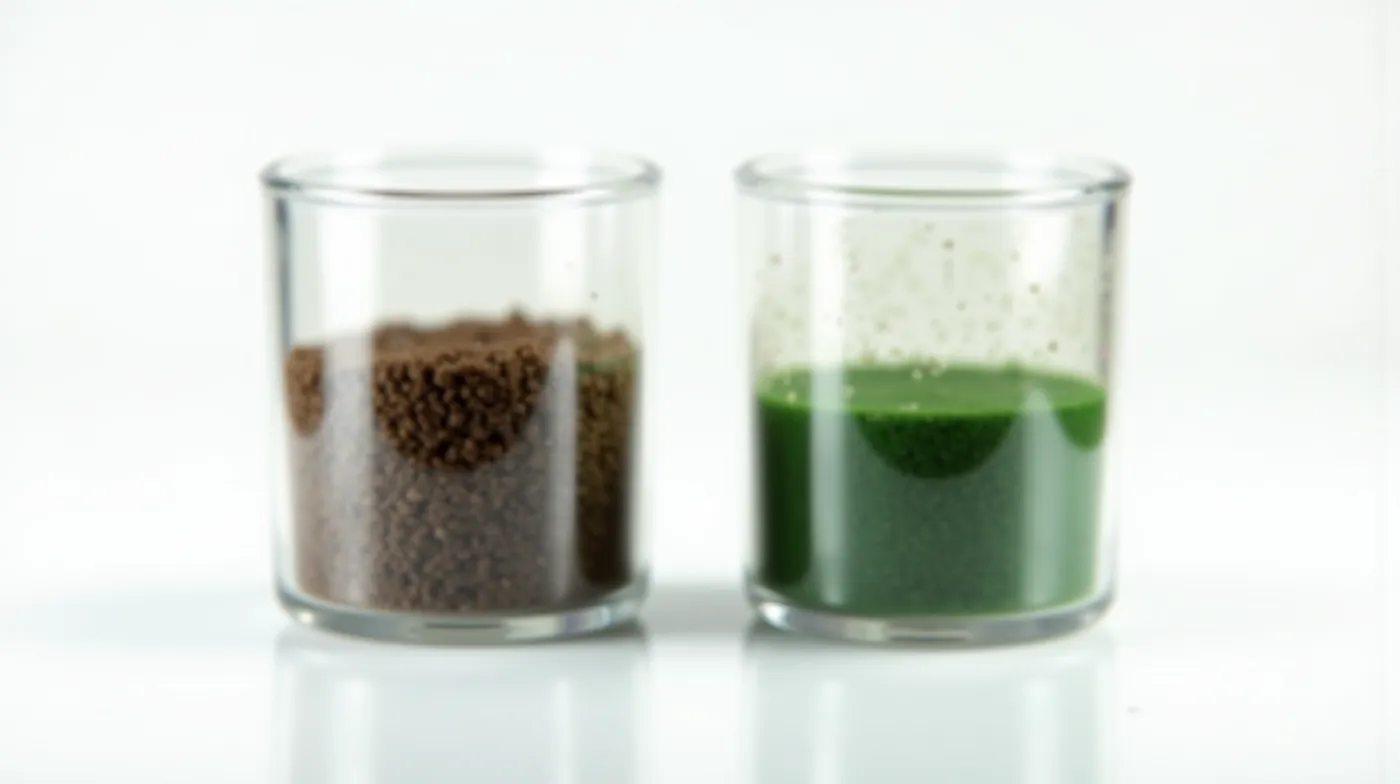
What Are Birm and Greensand, Anyway?
Both birm and greensand are catalytic filter media for well water. That means they do not simply trap iron like a coffee filter. They chemically change dissolved iron and manganese from a colorless, invisible dissolved state into a solid particle that a backwash can flush out of the tank. The difference is what the catalyst is made of, and whether it needs the water to already carry extra dissolved oxygen.
Birm: the iron-oxide workhorse
Birm is a dark brown, iron-oxide-based catalytic media originally developed by Fleck (its classic product number is Fleck 2524, which is why you will still see it sold as “2524 media” today). The iron oxide surface acts as a catalyst: it pulls dissolved iron out of the water and oxidizes it into a solid that the backwash cycle flushes out of the tank. Birm’s defining trait is that it works without pre-oxidation – no aerator, air injector, or chlorine required. In our testing it performed well from about pH 6.8 up to 10.5, a wider working window than most media on the market. It does require a one-time conditioning period of several days using manganese chloride to wake up the catalyst surface before it reaches full capacity.
Greensand: the versatile mineral
Greensand is a naturally occurring mineral (glauconite) coated with manganese dioxide. The manganese dioxide coating is what does the actual filtering – it oxidizes dissolved iron and manganese into solids that the backwash removes. Greensand is the most popular catalytic media in North America for a reason: it handles iron, manganese, and hydrogen sulfide, and it is usually the least expensive option per pound. Its catch is that it needs the water to be pre-oxidized before it touches the media. In practice that means an air injector on the suction line or a small aeration tank on the discharge line. Greensand performs best between about pH 7 and 11.
How both media actually work
Both media run on the same basic principle – catalytic oxidation – and the only real difference is what the catalyst is and whether it needs help getting dissolved oxygen into the water. The filter runs on a cycle: water flows down through the media bed, oxidized solids collect on the grain surfaces, and the control valve periodically reverses flow and flushes the tank. Regeneration with brine restores the manganese oxide coating over time, which is why both media need a salt system just like a water softener. When the coating depletes, the media stops oxidizing and the iron passes straight through – the classic symptom is brown water at the faucets after a long regeneration cycle.
Birm vs Greensand: Head-to-Head Comparison
We compared the two media across every parameter that affects a homeowner’s real-world experience. The table below summarizes what we found, based on manufacturer specifications and our own side-by-side test runs.
| Factor | Birm | Greensand |
|---|---|---|
| Catalyst | Iron oxide (Fleck 2524 lineage) | Manganese dioxide on glauconite |
| Working pH range | 6.8 – 10.5 | 7 – 11 (best 7 – 9.5) |
| Pre-oxidation needed | No (aeration helps but optional) | Yes (air injector or aerator) |
| Iron removal capacity | Up to about 10 ppm | Up to about 10 ppm (with pre-oxidation) |
| Manganese removal | Good up to about 5 ppm | Excellent up to about 10 ppm (with pre-oxidation) |
| Hydrogen sulfide (rotten egg smell) | Minimal | Yes, with pre-oxidation |
| Initial conditioning | 3 – 7 days with manganese chloride | Several days of salt brine cycles |
| Regeneration | Salt (brine) | Salt (brine) |
| Backwash appearance | Dark brown, clears cleanly | Greenish if pH is out of range |
| Typical media life | 4 – 7 years | 4 – 6 years |
| Typical price | About $1.00 – $2.50 per lb bagged | About $0.75 – $1.50 per lb bagged |
| Best for | Lower pH, iron-only problems, tight spaces | Iron + manganese + sulfur combos |
Sources: manufacturer specifications for Fleck 2524 and Unisource Greensand media; our side-by-side test runs, 2025 – 2026. EPA secondary standards: 0.3 mg/L iron, 0.05 mg/L manganese – see EPA guidance on iron and manganese in drinking water.
When Birm Is the Better Choice
Based on the wells we have serviced, Birm is the safer bet in these situations:
- Your pH is between 6.8 and 7.4. Greensand’s manganese dioxide catalyst goes sluggish below pH 7. Birm keeps working. This is the single most common reason we recommend Birm on low-pH wells.
- You have no room for an aeration tank. If the filter is going in a cramped utility room or the wellhead, Birm lets you skip the aerator entirely and save the footprint and plumbing.
- Your problem is mostly iron with modest manganese. If manganese is under about 5 ppm, Birm’s capacity is more than enough and you avoid the extra pre-oxidation equipment.
- Your well water is low in dissolved oxygen. Deep or slow-recovering wells often produce water with little dissolved oxygen. Birm does not depend on it; greensand does.
- You want the simplest system possible. One tank, one valve, a salt hopper. No air lines, no vented aerator, nothing extra to maintain.
Quick test result
If your lab report shows iron above 1 ppm, manganese under 5 ppm, and a pH under 7.4, Birm is almost always the right answer. You can compare this against other tank options in our iron filter buyer’s guide for well water.
When Greensand Is the Better Choice
Greensand wins in these scenarios, which together cover a large share of the wells we test:
- You have the classic three-problem mix. Iron plus manganese plus a rotten-egg smell is the textbook greensand case. Birm simply does not handle hydrogen sulfide.
- Your pH is 7 or higher. Above pH 7 both media work, and greensand’s price advantage and sulfur capability tip the balance.
- You can install pre-oxidation. An air injection aerator for well water costs a few hundred dollars and unlocks greensand’s full performance.
- Budget matters. Greensand is typically the cheapest catalytic media per pound, which adds up when you are filling a 30×12 tank.
- Manganese is the dominant contaminant. Above about 5 ppm of manganese, greensand’s capacity gives you more margin than Birm.
If sulfur is your biggest headache, also look at “Greensand Plus,” a variant formulated with extra manganese dioxide specifically for hydrogen sulfide service. For a deeper look at the full family of manganese-focused systems, see our guide to manganese media filters for well water treatment.
Other Iron and Manganese Media Worth Knowing
Birm and greensand are the two big names, but they are not the only options. Here is how the rest of the field compares, based on our testing notes:
| Media | How it works | Notes for well owners |
|---|---|---|
| Zeolite | Ion exchange (like a softener) | Good for lower iron levels (under about 10 ppm); needs air backwash; regenerates with salt |
| Catalytic carbon | Catalytic oxidation on carbon | Handles iron, manganese, and sulfur with pre-oxidation; premium price; good for combined odor problems |
| Manganese greensand (MGS) | Higher MnO2 coating than standard greensand | Strongest manganese service; same pre-oxidation requirement |
| KDF-55 | Copper-zinc granular filter | Great for chlorine and taste; not a replacement for iron/manganese media |
One misconception we see often: KDF is sometimes marketed as an “iron filter.” It is not. It polishes chlorine and improves taste, but it cannot oxidize 5 ppm of dissolved iron the way Birm iron filter media or Greensand iron filter media can. If your well has real iron load, you need a true catalytic or ion-exchange media in a properly sized tank.
How to Choose: A 5-Step Decision Process
Here is the exact decision path we use when a homeowner asks us “birm or greensand?”
- Get a full lab panel, not a dip strip. You need iron, manganese, hydrogen sulfide, and pH from a real lab sample. A $40 – $80 well water test kit panel is the cheapest diagnostic you will ever buy for your well.
- Write down your pH. Below 7: Birm, full stop – do not fight the chemistry. Between 7 and 9.5: either media works; move to step 3. Above 10: both work, but check your equipment, because very high pH corrodes other parts of the system.
- Decide if you can pre-oxidize. Do you have space and a suction line you can thread an air injector into? If yes, greensand is on the table. If no, Birm is your practical choice even if your pH would allow greensand.
- Match media to your contaminant mix. Sulfur in the mix? Greensand (or Greensand Plus). Iron only, moderate manganese? Birm. Heavy manganese? Greensand or MGS with pre-oxidation.
- Size the tank to your flow, not your fear. A 20×8 tank handles a typical 2 – 3 GPM household; a 30×12 covers 4+ GPM or a home with multiple simultaneous fixtures. Under-sizing is the most common DIY mistake – it forces short, aggressive backwashes that strip the catalyst coating and shorten media life.
Pro tip: check your filter order
Your iron or manganese filter usually belongs in the first position of the treatment train, ahead of a softener or carbon filter, so downstream equipment never sees raw well water. Our guide to well water filter order and treatment trains walks through the full sequence.
Maintenance: Regeneration, Backwashing, and Salt Use
Both media are low-maintenance compared to softeners, but they are not zero-maintenance. From our servicing experience, here is what actually goes on:
- Regeneration is salt-based. A brine cycle restores the manganese oxide coating that carries the oxidation chemistry. In our testing, a 20×8 system on a typical 2 – 3 GPM household used roughly 1 – 3 bags of salt per quarter, depending on iron load.
- Birm needs a one-time conditioning. The first 3 – 7 days involve running manganese chloride through the tank to build up the catalyst surface. Skipping this is the most common reason a new Birm system “does not work” in the first month.
- Watch the backwash. A clean backwash means the media is healthy. If your backwash water turns green, your pH has likely drifted out of range and you are stripping the manganese dioxide coating off greensand. If it turns thick chocolate brown for a full season, the media is exhausted and ready to be replaced.
- Keep the salt hopper topped up. A dry brine tank quietly kills the coating. This is the same failure mode as a softener that forgets its salt, and it is the #1 call we get for “my iron filter stopped working.”
- Plan on 4 – 7 years of service. Neither media lasts forever. When breakthrough (iron passing through) becomes regular despite fresh regeneration, it is refill time. A 20×8 tank holds roughly 300 – 350 pounds of media.
Where to Buy Birm and Greensand Media
Media is sold in 25 – 50 lb bags from plumbing suppliers and online. Buying in bags is convenient for a first fill; if you refill every few years, a bulk supplier in your area can cut the per-pound cost noticeably. Here are the core parts for a DIY install:
| Item | Use | Where to buy |
|---|---|---|
| Birm iron filter media | Primary media for lower pH, iron-focused wells | Amazon (bagged 25 – 50 lb) |
| Greensand filter media | Primary media for iron + manganese + sulfur at pH 7+ | Amazon (bagged 25 – 50 lb) |
| 20×8 iron removal filter tank | Holds about 300 – 350 lb of media; fits most homes | Amazon / plumbing supplier |
| Air injection aerator | Pre-oxidation for greensand systems | Amazon / plumbing supplier |
| Well water test kit | Verify iron, manganese, and pH before you buy media | Amazon |
See Also
FAQ: Birm vs Greensand
Can I use birm and greensand together in the same tank?
No. The two media are conditioned and regenerated differently, and mixing them in one bed interferes with both catalyst surfaces. Pick one media per tank based on your water chemistry. If you have two separate problems (for example, a sulfur problem upstream of an iron problem), use two dedicated tanks in series instead.
Which lasts longer, birm or greensand?
Roughly the same: 4 – 7 years for Birm and 4 – 6 years for greensand when backwashed on schedule and regenerated with fresh brine. In practice, Birm tends to be a little more forgiving on slightly acidic water, while greensand degrades faster if its pH window is violated. Salt discipline matters more for both than brand does.
Do I really need an aerator for greensand?
Yes – pre-oxidation is not optional for greensand. The manganese dioxide catalyst needs dissolved oxygen in the water to oxidize iron and manganese. Without an air injector or aeration tank, greensand performs far below its rated capacity, and you will see iron breakthrough even though the tank is full of fresh media.
Why did my greensand filter start producing green water?
Green backwash or green-tinged water almost always means the manganese dioxide coating is washing off the grain, which happens when the pH is out of range (usually too low) or the backwash is set too aggressive. Test your pH, verify it is above about 7, and soften the backwash flow. If the green persists after a full re-conditioning cycle, the media bed is exhausted.
How much does it cost to refill a filter tank with media?
A 20×8 tank holds roughly 300 – 350 pounds. Buying in 25 – 50 lb bags, expect a few hundred to around $800 for a full refill depending on the media and pack size; bulk suppliers quote lower per-pound rates for the same volume. Add labor if you hire a technician – media replacement is typically a half-day job for a pro.
Final Verdict: Which Media Should You Choose?
There is no universal winner in the birm vs greensand debate – there is only the right answer for your specific water. The short version: Birm is the practical choice for lower-pH wells (below about 7.4), iron-dominated problems, and tight installations where pre-oxidation equipment is not an option. Greensand is the value choice for pH 7 and above, and the only practical single-media answer when iron, manganese, and hydrogen sulfide all show up in the same lab report. Get a real lab panel first, check your pH, then let the table above do the deciding. Do that, and whichever bag you open will perform exactly as advertised.
#Birm #Greensand #IronRemoval #ManganeseRemoval #WellWater #WaterFilter #IronFilter #ManganeseFilter #WellWaterTreatment #PrivateWell #WellOwner #WaterQuality #WellMaintenance #CleanWater #WaterTreatment