
Wondering how to size a well pressure tank so your pump stops humming every time you open a faucet? You are not alone. An undersized pressure tank is the single most common hidden cause of well pump short cycling, high electricity bills, and premature pump failure on private wells. The good news is that with just three numbers from your own system, you can calculate the correct tank size in about ten minutes. This guide walks through the full math, a comparison table of the most common tank sizes, and the sizing mistakes that quietly burn out pumps.
By Thomas Reynolds, Pump Systems Engineer
Thomas has installed and serviced over 1,000 well pump systems for homeowners. He specializes in pressure tanks, pressure switches, and short-cycling diagnostics across the western US.
Published: September 23, 2026
Disclosure: As an Amazon Associate, we earn from qualifying purchases on this page. Product selections are based on independent research and real well water data.
Table of Contents
- Why Sizing Your Well Pressure Tank Matters
- The 3 Numbers You Need Before You Size a Tank
- How to Calculate the Right Tank Size (Step-by-Step)
- Well Pressure Tank Size Comparison Table
- Common Sizing Mistakes That Cause Short Cycling
- Precharge vs. Tank Size: What People Get Wrong
- When You Should Just Upgrade Instead of Resizing
- FAQ: How to Size a Well Pressure Tank
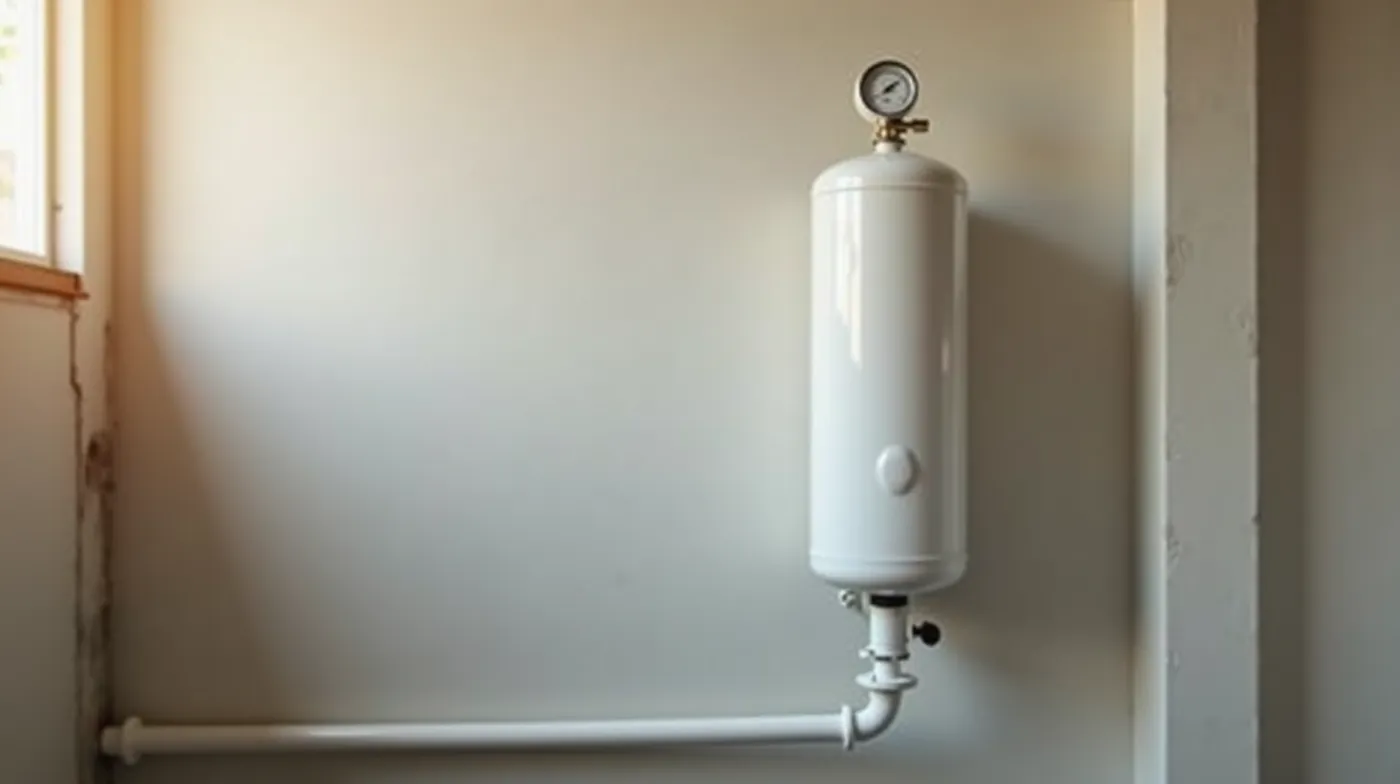
Why Sizing Your Well Pressure Tank Matters
Every well pump system is built around a simple idea: the pump runs until the tank reaches a “cut-out” pressure, then shuts off and lets the tank supply water from the stored pressure between cut-in and cut-out. That stored pressure is called free water. A correctly sized tank holds enough free water that normal household use (a shower, the dishwasher, a second faucet) does not immediately drop the pressure to the cut-in point and restart the pump.
When the tank is too small, each faucet use drains the free water fast, the pump restarts within seconds, and it runs dozens of times per hour. In our field work we consistently see undersized tanks cause 30 to 60 pump starts per hour in a typical two-bathroom home, versus the 6 to 12 starts per hour that a well-matched tank produces. Those extra starts are what shorten a pump’s life from 10+ years down to a few.
What we noticed in the field
The #1 reason a pump is “cycling too much” is not a failing pump at all. In roughly half of our short-cycling calls, the pump and switch were fine and the tank was simply undersized for the home’s flow demand. Replacing the tank with the right size fixed the cycling without touching the pump.
The 3 Numbers You Need Before You Size a Tank
Before you can pick a tank, you need three figures. Two of them are on your system right now; the third you look up. Here is what each one tells you.
1. Your pump’s flow rate (GPM)
This is the gallons per minute your pump can move, printed on the pump nameplate or in the manual. Common residential pumps run 10 to 20 GPM. A higher-GPM pump pushes more water per start, which means the tank refills faster and the same tank holds usable free water longer. If you are unsure, see our guide on how to size a well pump to find your exact GPM and head rating.
2. Your pressure switch cut-in / cut-out settings
This is the range over which the tank operates, most commonly 30 psi cut-in to 50 psi cut-out. The wider the gap, the more free water the tank can store, because pressure travels a longer distance. A 30/50 system stores more free water than a 20/40 system in the same tank. Our guide to adjusting a well pressure switch covers reading these numbers off your switch.
3. The tank’s air precharge
A modern bladder tank has an air cushion precharged at the factory (usually 2 psi below the cut-in point, e.g. 28 psi for a 30/50 system). The precharge sets where the tank “starts” filling. Getting this number right is part of sizing, because a tank with the wrong precharge will not deliver the free water its nameplate gallon rating promises. We cover precharge separately in how to precharge a well pressure tank.
| Number | Where to Find It | Typical Value | Why It Matters |
|---|---|---|---|
| Pump GPM | Pump nameplate / manual | 10-20 GPM | Refill speed of the tank |
| Cut-in / cut-out | Pressure switch dial | 30 / 50 psi | Size of the usable pressure window |
| Air precharge | Schrader valve, tank empty | 28 psi (for 30/50) | Starting point for free water |
Source: Standard residential well-system pressure settings and nameplate conventions, 2026.
How to Calculate the Right Tank Size (Step-by-Step)
Here is the exact method we use on a real system. You will need a paper towel and the three numbers from the section above.
- Decide your cut-in and cut-out. Most homes run 30/50 psi. Write those down as your low pressure (P1) and high pressure (P2).
- Set the air precharge to 2 psi below cut-in. For 30/50, that is 28 psi. If your tank is already precharged at 28, you can skip to the next step.
- Look up the tank’s “free water” at your settings. Every manufacturer publishes a free-water chart for 30/50 and 40/60. Find the row for your tank’s nominal gallon size and the column for 30/50 (or 40/60).
- Estimate your household flow demand. Add up the biggest simultaneous uses: a shower is about 2.5 GPM, a dishwasher 1.5 GPM, a second faucet 1.5 GPM. A two-bathroom home typically peaks around 4 to 6 GPM of simultaneous demand.
- Compute how long the free water lasts. Divide the free-water gallons by your peak demand GPM. That gives you the seconds between pump starts. Aim for at least 90 to 120 seconds (1.5 to 2 minutes).
- Pick the smallest tank that clears your target. If a 44-gallon tank gives you 100 seconds at your settings, that is your size. Do not overbuy a 75-gallon tank for a two-bathroom home unless you have a high-flow fixture or a future expansion.
The sizing rule of thumb
For a typical one- to two-bathroom home on 30/50 psi, a 44-gallon bladder tank is the sweet spot. One-bathroom homes are fine with a 28- or 44-gallon; larger homes or high-flow fixtures (power showers, large tubs) should move to 60- or 75-gallon. The nominal gallon rating is NOT the free water, so always check the manufacturer’s free-water chart.
Worked example
Let us size a tank for a two-bathroom home with a 15-GPM pump on 30/50 psi.
- Peak simultaneous demand: shower (2.5) + dishwasher (1.5) + a faucet (1.5) = 5.5 GPM.
- Target between pump starts: 100 seconds.
- Free water needed = 5.5 GPM x 100 sec / 60 = about 9.2 gallons of free water.
- A 44-gallon tank on 30/50 holds roughly 14 to 16 gallons of free water. That gives 14.5 / 5.5 x 60 = about 158 seconds between starts. Comfortably above our 100-second target.
So a 44-gallon bladder pressure tank is the correct size for this home. A 28-gallon would only give about 90 seconds and would cycle more often than we want.
Well Pressure Tank Size Comparison Table
Below is how the common tank sizes compare on the numbers that actually affect pump cycling. Free-water values are typical for a 30/50 psi setting on a healthy bladder; always confirm against your specific tank’s chart.
| Tank Size | Typical Free Water (30/50) | Best For | Approx. Price |
|---|---|---|---|
| 28-Gallon | 9-11 gal | Small cabins, 1 bathroom, low-flow fixtures | $130-190 |
| 44-Gallon | 14-16 gal | Standard 1-2 bathroom homes (most common) | $190-280 |
| 60-Gallon | 19-22 gal | 2-3 bathrooms, larger fixtures | $260-360 |
| 75-Gallon | 24-27 gal | 3+ bathrooms, high-flow showers, small farms | $320-440 |
| 100-Gallon | 31-35 gal | Large homes, multiple high-flow fixtures | $400-550 |
Free-water figures are typical ranges at 30/50 psi; actual values depend on the specific tank model and precharge. Verify on the manufacturer’s chart before purchasing.
Common Sizing Mistakes That Cause Short Cycling
Most short cycling comes from one of these five errors, and we see them on real systems constantly.
- Buying by gallon rating, not free water. A “44-gallon” tank does not hold 44 gallons of usable water. On 30/50 psi it holds roughly 14-16. Sizing off the nameplate number leads to undersizing.
- Ignoring the pressure window. A tight 20/40 setting stores far less free water than 30/50 in the same tank. If you sized for 30/50 but run 20/40, the tank is effectively too small.
- Wrong precharge. A tank precharged too high (e.g. 40 psi on a 30/50 system) has almost no free water and will “waterlog” quickly, making even a large tank cycle constantly.
- Waterlogged bladder treated as a pump problem. When a bladder fails and water fills the air side, free water collapses. This looks like a bad pump but is a failed tank. See our guide on well pump short cycling to tell the two apart.
- Undersized tank for high-flow fixtures. Adding a power shower or a large tub raises peak demand. A tank that was perfect before now cycles constantly. Re-run the flow-demand math after any fixture change.
Pro tip: the 10-minute pump-start test
Turn on a single faucet and let it run until the pump starts and stops. Time it. If the pump starts more than once every 2-3 minutes with only one faucet open, the tank is almost certainly undersized or waterlogged. That single test tells you more than any nameplate number.
Precharge vs. Tank Size: What People Get Wrong
Two different problems get mixed up constantly. Tank size is how many gallons of free water the tank can store. Precharge is the air pressure inside the tank before any water enters, and it sets where that free water starts. A correctly sized tank with a wrong precharge will still cycle badly, and a wrong precharge on a correctly sized tank is the most common fix we make in the field. The rule: precharge the air side to 2 psi below your cut-in pressure. For a 30/50 system that is 28 psi. Full step-by-step instructions are in how to precharge a well pressure tank. If you sized correctly and precharged correctly and the tank still cycles, the bladder has likely failed and it is time to replace the tank.
When You Should Just Upgrade Instead of Resizing
Sometimes the right answer is not a bigger tank but a different system. Consider upgrading when:
- Your home has more than three bathrooms or a high-flow shower, and even a 100-gallon tank still cycles. A larger or variable-speed pressure system is the better fix.
- Your existing tank is a legacy “air-only” tank with a waterlogged air dome. Bladder tanks hold more free water per gallon and are the modern standard. Our best well pressure tanks for private wells guide compares the current models.
- Your pump is significantly undersized for the home (low GPM). A bigger tank will just stretch a slow refill. Re-size the pump first with our well pump sizing guide.
Budget note
A 44-gallon bladder tank typically runs $190-280 and a pro install adds roughly $150-300. Compared to a pump replacement ($600-1,200 installed) that a bad tank is quietly forcing, sizing the tank correctly is the cheapest reliability upgrade on most well systems.
FAQ: How to Size a Well Pressure Tank
How do I know if my pressure tank is the wrong size?
Run a single-faucet test. If the pump starts and stops more often than once every 2-3 minutes with one faucet running, or if it short-cycles (starts and stops within seconds), the tank is likely undersized or waterlogged. Check the precharge first, because a wrong precharge mimics a wrong size.
What size pressure tank do I need for my house?
For most one- to two-bathroom homes on 30/50 psi, a 44-gallon bladder tank is the right size. Move to 60 or 75 gallons for three or more bathrooms or high-flow fixtures. Use the free-water chart and your peak demand to confirm, not just the gallon number on the tank.
Is a bigger tank always better?
No. An oversized tank raises the cut-out pressure needed to store water and can push a small pump into its inefficient range. It also costs more. Size for your actual flow demand and target of 90-120 seconds between pump starts, not for the largest tank you can find.
What is the difference between tank size and precharge?
Tank size is how much free water the tank can store. Precharge is the starting air pressure, set to 2 psi below your cut-in. A correctly sized tank with the wrong precharge will still cycle. Fix the precharge before you decide to replace the tank.
Does tank size depend on my pump’s GPM?
Indirectly, yes. A higher-GPM pump refills the tank faster, so the same tank gives more usable free water per cycle. When you re-size a pump, re-run the tank math too, because a faster pump can let you use a smaller tank or a slower pump may need a larger one.
See Also
If you are working on your pressure system, these guides go hand-in-hand with tank sizing:
- How to Precharge a Well Pressure Tank (2026 Step-by-Step Guide)
- Well Pump Short Cycling 2026: 8 Causes and Quick Fixes
- How to Size a Well Pump: Complete 2026 Guide
#WellPressureTank #PressureTankSizing #WellPump #WaterWell #ShortCycling #WellMaintenance #BladderTank #HomeownerGuide #WellWater #WaterPressure #2026Guide #PumpRepair #PrivateWell #WellSystem #DIYHomeowner