
You open the tap and watch white flakes drift down into the glass. A fine layer of chalky grit settles at the bottom of the toilet tank. Your kettle develops a white film after just a few uses. If you are seeing white sediment in well water, the good news is that it is almost always a mineral, not a contamination event, and it is usually fixable with the right treatment. The less comfortable news is that not every white flake is the same thing, and guessing at the treatment is how well owners end up with an expensive system that solves the wrong problem.
In this guide we break down the five real causes of white sediment in private well water, show you the simple home tests that separate them, and give the exact fix for each with realistic parts and labor costs. After analyzing hundreds of well systems across the western US, our most common finding is this: the majority of white sediment cases are calcium carbonate scale from moderately hard water, and a correctly sized water softener eliminates it at the source. Gypsum, barite, sulfur, and equipment flakes are rarer, but they are easy to confuse with scale if you skip the testing steps.
By Thomas Reynolds, Pump Systems Engineer
Thomas has installed and serviced over 1,000 well pump systems for homeowners. During those service calls he has pulled scale-caked pressure tanks, descaled heat exchangers, and matched mineral deposits to their source. He leads our equipment and water-quality diagnostics coverage.
Disclosure: As an Amazon Associate, we earn from qualifying purchases on this page. Product selections are based on independent research and real well water data.
Last updated: October 15, 2026
Table of Contents
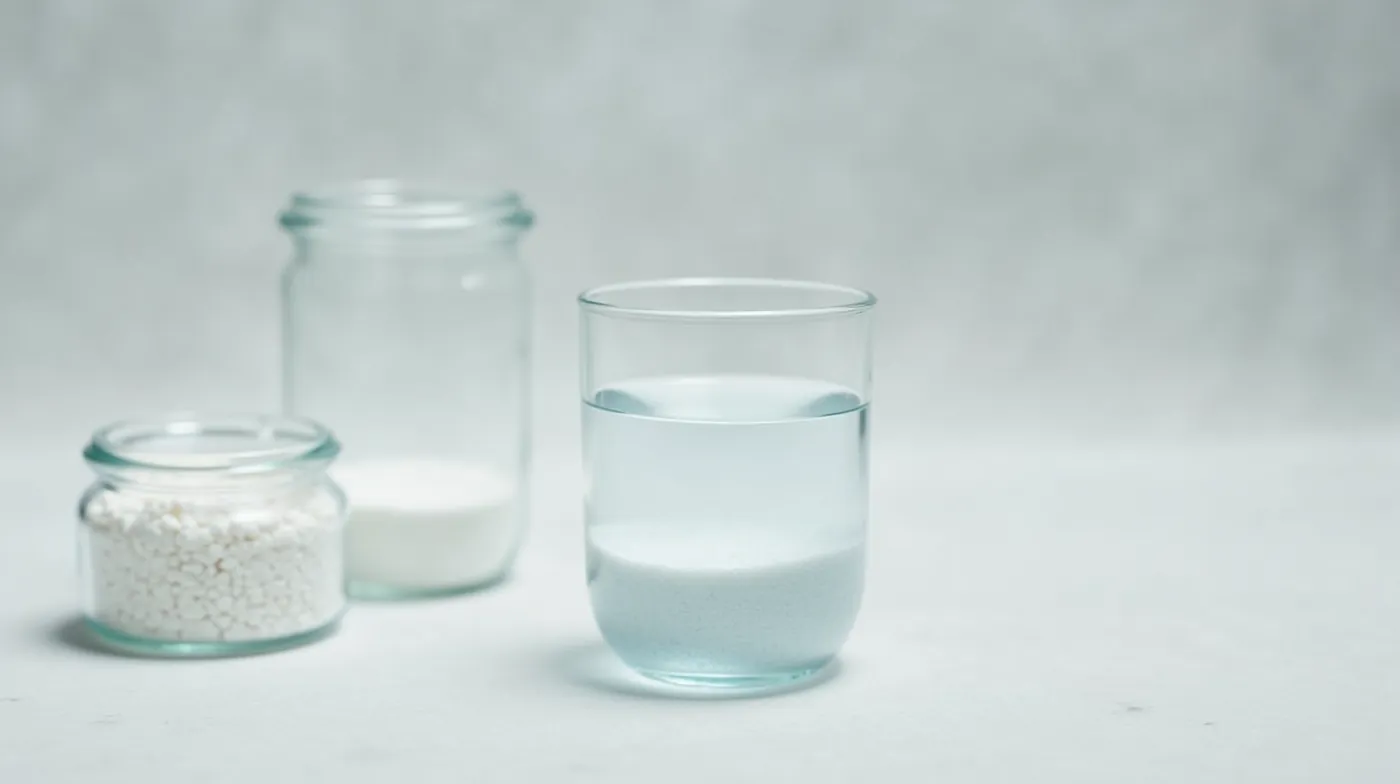
Why White Sediment Shows Up in Well Water
Well water is naturally untreated. As groundwater moves through rock and soil, it dissolves minerals and carries fine particles in solution. Municipal systems remove much of this material through coagulation, filtration, and softening before the water reaches your tap, but a private well delivers the aquifer chemistry as-is. Most of the time the minerals stay dissolved and invisible. White sediment appears when something forces them out of solution, or dislodges them from your pipes and equipment.
The usual triggers are temperature and pressure changes. Water leaves the well cool and under pressure; when it heats up in the water heater or cools down in a glass, dissolved calcium carbonate becomes less soluble and precipitates as fine white scale. That is why the first places to see white sediment are the kettle, the water heater, the pressure tank, and low-flow fixtures. Evaporation does the same job at a smaller scale: leave a glass of well water on the counter overnight and a white ring forms at the bottom as the water evaporates. Finally, physical disturbance — a new pump, a well development, or a pipe that was knocked loose — can stir up sediment that had been sitting in the well or the supply line.
Geology sets the baseline. Western and central US aquifers sit on limestone and dolomite formations that are high in calcium, which is why calcium scale dominates in those regions. Aquifers over gypsum-bearing formations, common in parts of the Great Plains and the Intermountain West, can produce a different kind of white sediment, as we will see below.
What the White Stuff Actually Is: 5 Common Culprits
Before you buy any treatment, identify what you are actually dealing with. The five substances below account for nearly every white sediment case we see on residential well systems.
1. Calcium carbonate scale (limescale)
The default suspect and, in most regions, the answer. Calcium carbonate (CaCO3) is the chalky white mineral that builds up in kettles, water heaters, and pressure tanks. It is the same mineral as chalk, limestone, and the calcium in antacids. Scale forms when water rich in dissolved calcium and bicarbonate loses bicarbonate through heat or pressure change, and the calcium precipitates as solid crystals. If your water is hard, the sediment will be fine, chalky, and slightly gritty, and it will accumulate fastest in hot-water fixtures and the tank.
2. Gypsum (calcium sulfate)
Gypsum is a white mineral that is only slightly soluble in water. In gypsum-bearing formations, well water can carry a fine white powder that does not always behave like scale: it may stay suspended, settle as a soft white silt, and give the water a slightly bitter or salty taste. Gypsum sediment is commonly confused with calcium scale, but a water softener will not remove it, because ion exchange targets hardness, not sulfate. Misdiagnosis here is one of the most common wasted purchases we see in the field.
3. Barite (barium sulfate)
Barite is a dense white mineral, and it has a special place in the well world because it is the main ingredient in drilling mud. If your well was recently drilled or reworked, white gritty material in the first weeks of water is often leftover drilling fluid working its way out of the formation. Barite is much denser than other sediments, so the flakes sink quickly and feel heavy. Small amounts are not a drinking-water concern, but the EPA primary limit for barium is 2 mg/L, so a lab test is the right move if the material persists after the well has been properly developed.
4. Elemental sulfur
Elemental sulfur can appear as white to pale-yellow flakes or powder, usually produced by sulfur-oxidizing bacteria that metabolize hydrogen sulfide. The tell is odor: the flakes themselves smell strongly of rotten eggs, and the water often has the same smell before the flakes settle. If your water also carries a sulfur odor, the treatment is well chlorination plus a sulfur-removal system, not a softener.
5. Equipment scale and corrosion flakes
Not everything in your water comes from the well. A failing pressure tank, an aging galvanized pipe, or a water heater with a worn anode rod can shed flakes of existing scale and corrosion products. This shows up as irregular white chips rather than a fine powder, and it often appears suddenly after equipment ages or after a long stretch of heavy usage. The fix here is maintenance or replacement, not water treatment.
| Substance | Appearance | Smell / Taste | How to Confirm | Risk | Typical Fix |
|---|---|---|---|---|---|
| Calcium carbonate scale | Fine white chalky grit, kettle ring | None | Vinegar test fizzes; high hardness reading | Cosmetic; clogs pipes and heating elements | Water softener plus periodic descaling |
| Gypsum (calcium sulfate) | Soft white powder or silt | Slightly bitter, salty | Lab panel: high calcium plus sulfate; softener will not remove it | Cosmetic; taste; EPA secondary sulfate standard is 250 mg/L | Ion exchange or RO for drinking water; monitor sulfate |
| Barite (barium sulfate) | Heavy white flakes or sand, sinks fast | None | Density check; lab barium test | EPA primary limit for barium is 2 mg/L | Well development, filtration, lab confirmation |
| Elemental sulfur | White to pale-yellow flakes | Rotten eggs | Odor; well chlorination removes the source | Odor and staining | Well chlorination plus sulfur treatment |
| Equipment flakes | Irregular white chips | Matches tank or heater scale | Inspect tank, anode rod, and pipes | Equipment failure in progress | Descaling, anode or tank replacement |
Source notes: EPA drinking water standards (barium MCL 2 mg/L, secondary sulfate standard 250 mg/L); USGS water hardness classification (above 120 mg/L as CaCO3 is “hard”).
The 60-second rule
Run the vinegar test before you spend a dollar on treatment. A spoonful of sediment in white vinegar that fizzes and dissolves is calcium carbonate, which a water softener solves. If the flakes do not react, stop and get a lab panel before buying anything.
How to Test White Sediment in Well Water (Step-by-Step)
These seven steps take under an hour and a few dollars. Work through them in order, and stop as soon as the cause is obvious.
- Collect a fresh sample. Run the cold tap for 3 to 5 minutes to clear the tank water, then collect about a cup of water in a clear glass. Let it sit undisturbed for 30 minutes and watch how fast the sediment settles and where it collects.
- Run the vinegar test. Scoop a spoonful of the settled sediment into a small jar of white vinegar (5 percent acidity). If it fizzes and dissolves within a few minutes, it is calcium carbonate or another carbonate. This single test settles the diagnosis in most cases.
- Check water solubility. Put another spoonful in plain water and swirl. Gypsum dissolves partly and slowly; calcium carbonate does not dissolve in plain water; sulfur and barite barely dissolve at all.
- Check the density. Barite is distinctly heavy: the flakes sink almost instantly and feel gritty and heavy on the fingertip. Scale and sulfur are much lighter and may float briefly.
- Look at the flakes up close. Pour the sample through a coffee filter and examine the residue under bright light or a magnifier. Scale flakes are sharp-edged and crystalline; sulfur is powdery and slightly waxy; barite grains look like fine white sand.
- Test hardness and TDS at home. A water hardness test kit gives you grains per gallon in minutes, and a digital TDS meter gives a total dissolved solids reading. If hardness is above 120 mg/L (the USGS “hard” threshold) and the vinegar test was positive, you have your answer: calcium scale.
- Send a lab panel when home tests are inconclusive. A full panel from your state extension service or a private lab reports calcium, sulfate, barium, total alkalinity, and TDS. Ask specifically for barium if the well was recently drilled, and for sulfate if you suspect gypsum. A well water test kit covers the basics at home, but the lab panel is the definitive step. Panels run $50 to $250 depending on scope.
How to Fix White Sediment in Well Water: 5 Solutions With Costs
The right fix depends entirely on what the sediment is. Here are the five solutions mapped to their causes.
Fix 1: Install or resize a water softener (calcium carbonate scale)
If the vinegar test fizzes and your hardness is above 120 mg/L, a water softener for well water is the standard fix. Ion exchange swaps the calcium that causes scale for sodium, so the scale never forms in the first place. Size the unit for your household’s daily usage, not just headcount. See our Water Softener for Well Water 2026 Buyer’s Guide for model picks, and our guide on sizing a water softener for your well for the exact grain calculation. A properly sized unit typically costs $500 to $1,500 installed.
Fix 2: Descale the pressure tank and system (existing scale)
A softener prevents new scale but does not remove what has already built up. A pressure tank or water heater with a heavy scale layer loses capacity and efficiency. Descaling means flushing a diluted acid solution, vinegar or a commercial limescale remover, through the system, or draining and treating a tank in place. Budget $20 to $60 in supplies and 1 to 2 hours. If the tank is severely scaled or waterlogged, replacement is often cheaper than the fight.
Fix 3: Filter for visible grit and residual minerals (barite, gypsum, general)
For sediments a softener cannot handle, filtration is the tool. A sediment pre-filter, 5-micron pleated or spin-down, catches visible grit before it reaches the fixtures, and a reverse osmosis unit under the sink removes gypsum and most dissolved minerals from drinking water. A whole house water filter at the point of entry serves the whole home, while a sediment cartridge is the cheapest first step. Expect $30 to $80 for a sediment pre-filter and $150 to $500 for a drinking-water RO unit.
Fix 4: Address the well source (recent drilling, formation-derived sediment)
If the sediment started after drilling or well work, the first step is development: running the well at full capacity for enough time to clear drilling residue and fine formation material. Many contractors include a development period in the work scope; if yours was skipped, ask them to come back. If heavy white material persists after development, a lab barium test tells you whether the formation itself is shedding barite, in which case the treatment is typically filtration plus monitoring against the 2 mg/L EPA limit.
Fix 5: Protect and maintain the equipment that sheds flakes
Replace the anode rod in the water heater on a 2 to 3 year cycle, since a spent rod starts shedding as it corrodes. Flush the pressure tank annually and confirm the tank air charge. These small jobs stop equipment-derived flakes at the source for under $100 a year.
| Solution | What It Solves | Parts Cost | Labor / Time |
|---|---|---|---|
| Water softener (correctly sized) | Calcium scale, at the source | $500-1,500 | Pro: 1 day; DIY: a weekend |
| System or tank descaling | Existing scale | $20-60 | 1-2 hrs |
| Sediment pre-filter | Visible grit (barite, general) | $30-80 | About 1 hr |
| RO or carbon POU unit | Gypsum taste, drinking water | $150-500 | 2-4 hrs |
| Lab panel plus source work | Barite, gypsum, sulfate | $50-300 plus development | Varies |
Where to Buy (Test Kits and Treatment)
| Item | Use | Price Range | Buy on Amazon |
|---|---|---|---|
| Water hardness test kit | Confirm the scale diagnosis | $15-40 | Water hardness test kit |
| Digital TDS meter | Dissolved solids reading | $15-50 | Digital TDS meter |
| Well water test kit | Baseline home panel | $20-60 | Well water test kit |
| Water softener | Removes calcium at the source | $500-1,500 | Water softener for well water |
| Whole house water filter | Whole-home grit and minerals | $150-600 | Whole house water filter |
| Limescale remover | Tank and heater descaling | $10-30 | Limescale remover |
Pro tip
If you are choosing between a softener and a filter for white sediment, run the vinegar test first. If it fizzes, a softener fixes the cause and protects every appliance in the house; a filter only hides the symptom. Filters win only when the sediment is not hardness-related.
Warning
Do not drink well water with persistent white sediment before you have ruled out barium and sulfate. A $50 to $100 lab panel is cheap insurance, and the EPA sets a 2 mg/L primary limit for barium in drinking water.
When White Sediment Is a Warning Sign
White sediment is mostly cosmetic, but a few patterns deserve faster action:
- Sudden onset after drilling or well work. Expect some, but if heavy grit persists beyond a few weeks of development, get a barium test.
- Rotten-egg odor with the flakes. That is sulfur, and it points to bacterial activity in the well. A well chlorination plus treatment is the fix.
- White film plus falling pressure. Scale may be clogging the pressure tank, the pipe, or the pump intake. Descaling or a softener is time-sensitive, because a clogged intake can dry-run the pump.
- White sediment plus other symptoms. Discoloration, odor, or a positive coliform test means you need a full panel, not a single-mineral diagnosis.
If any of those apply, a local well contractor or your state extension service is a reasonable call before buying equipment.
See Also
White Film on Dishes and Glass 2026: Causes and Fixes
Calcium in Well Water 2026: Levels, Testing and Removal
Hard Well Water 2026: Causes, Testing and How to Fix It
Frequently Asked Questions
Is white sediment in well water dangerous to drink?
In the common case, no. Calcium carbonate scale is the same mineral as chalk and the calcium in antacids, and there is no federal drinking-water limit for calcium. The exceptions are barium, which has an EPA limit of 2 mg/L, and very high sulfate, which has a 250 mg/L secondary standard based on taste. If the sediment persists, a lab panel is the way to be sure.
Why does my toilet tank fill with white grit but my tap looks clear?
The tank is a low-flow, still-water environment, so fine sediment that would wash past a running tap settles there and accumulates over days. A layer in the tank is one of the earliest visible signs of white sediment in well water, even when the tap glass still looks acceptable.
Will a water softener stop white sediment in well water?
It will if the sediment is calcium carbonate scale, which is the most common cause. A softener removes the calcium before it can precipitate, so the flakes stop at the source. It will not remove gypsum, barite, or sulfur, which is why the vinegar test and a hardness reading come first.
White sediment appeared after our well was drilled. Is that normal?
Short-term, yes. Drilling leaves fine formation material and, in many cases, traces of drilling fluid such as barite in the well. Development, running the well hard for a defined period, flushes most of it out. If heavy white grit is still present weeks later, have the contractor revisit development and get a barium test.
How much does it cost to fix white sediment in well water?
Most homeowners land between $20 and $1,500. Descaling and a sediment pre-filter cost under $100; a lab panel runs $50 to $300; and a correctly sized water softener, which fixes the majority of cases, runs $500 to $1,500 installed. The cost table above maps each solution to its cause.
#WellWater #WhiteSediment #HardWater #CalciumScale #Limescale #WellWaterQuality #WaterTesting #WaterSoftener #WellOwner #WellMaintenance #WellDrilling #Gypsum #Barite #WaterFilter #HomeWell