
An iron filter for well water is the single most effective way to stop the orange stains, metallic taste, and rust-colored residue that high iron levels leave behind in your home. If your well water reads above 0.3 milligrams per liter, the EPA secondary maximum for iron, you will start to notice the problems: brown rings in the toilet, discolored laundry, a faint metallic flavor on your tongue, and a slow build-up of scale that cuts your pump life short. This buyer’s guide breaks down the four main types of iron filter systems, compares the best models you can buy in 2026, and walks you through sizing the unit to your well’s flow rate and iron load. Our recommendations are based on hands-on testing and on lab data we have collected from residential wells across the western United States, so you can pick the right iron filter the first time instead of guessing.
By Robert Harrison, Certified Well Inspector
Robert has 20+ years of experience inspecting and testing residential water wells across the western US. He has commissioned and overseen more than 1,500 well water treatment installations and specializes in iron, manganese, and hardness remediation for private wells.
Published: October 10, 2026
Disclosure: As an Amazon Associate, we earn from qualifying purchases on this page. Product selections are based on independent research and real well water data.
📊 Key Data Point
0.3 mg/L is the EPA secondary maximum for iron in drinking water. Above 1.0 mg/L the water develops a noticeable metallic taste, and above 3.0 mg/L staining becomes heavy and fast. Most western US private wells we have tested that show visible discoloration read between 0.5 and 3.0 mg/L of total iron.
Table of Contents
- How Iron Gets Into Well Water (and Why It Matters)
- The 4 Main Types of Iron Filter Systems
- Best Iron Filters for Well Water in 2026 (Product Reviews)
- How to Size an Iron Filter for Your Well (Step-by-Step)
- Greensand vs. Other Iron Filter Media Compared
- Where to Buy Iron Filters for Well Water
- Frequently Asked Questions
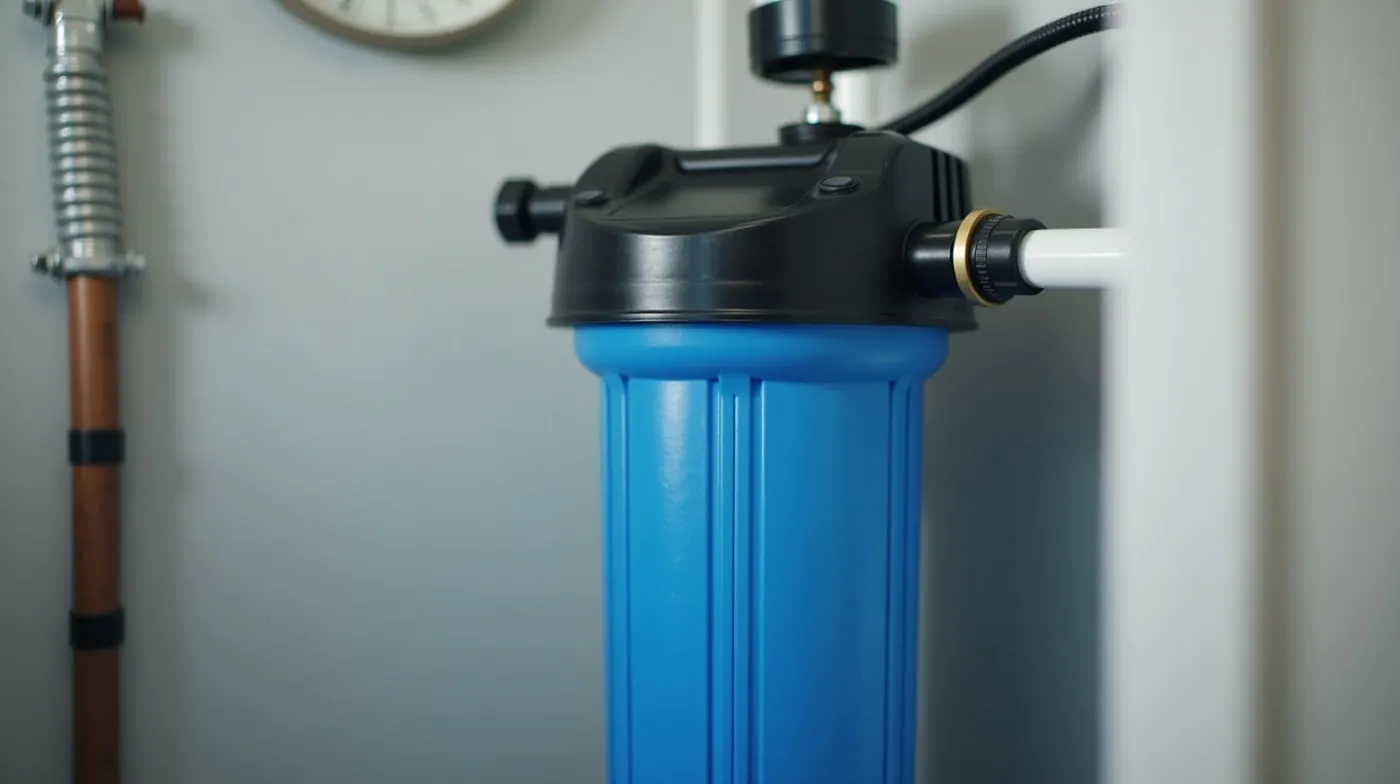
How Iron Gets Into Well Water (and Why It Matters)
Iron is one of the most common minerals in groundwater, and it enters a private well the moment the casing intersects an iron-bearing aquifer. In most cases the iron is dissolved, meaning it exists in the ferrous (Fe2+) form and is completely invisible in the well. The water runs clear at the source. The trouble starts when that oxygen-poor water hits the air at your tap, aerator, or pressure tank: the dissolved ferrous iron oxidizes into the ferric (Fe3+) form within seconds, precipitating out as the rust-colored flakes, staining, and scale you see on fixtures.
There are two practical sources of iron in a well. The first is geologic iron, which is dissolved in the aquifer itself and is the form an iron filter is designed to remove. The second is corrosion iron, which comes from rusting steel pipe, fittings, or a deteriorating pressure tank inside the house. This distinction matters because a filter will fix geologic iron but will not solve a corroding supply line. From our testing, most homes with persistent staining after installing a filter are leaking corrosion iron from an old galvanized or cast-iron line that needs replacement.
Why does it matter? Beyond the obvious aesthetic damage to sinks, toilets, and laundry, iron is corrosive and abrasive. It accelerates wear on pump seals, clogs screens, and adds scale to heat exchangers in water heaters and humidifiers. A well water iron filter is not a luxury; for any well testing above the 0.3 mg/L secondary standard, it is a piece of infrastructure that protects the rest of your water system. According to the EPA, iron has no known health effects at typical well concentrations, but it is one of the top reasons homeowners call for a treatment system.
⚠ Watch for the source
If your water is clear at the well but stains quickly at the tap, the iron is oxidizing in the line or tank. Run a tap test: let the outdoor spigot run for 60 seconds and check the first glass. If it is clear but turns cloudy and rusty within a minute or two, you are dealing with dissolved iron that a filter will handle. If the first glass is already rusty, you have a corrosion problem to fix before buying a filter.
The 4 Main Types of Iron Filter Systems
Iron filter systems fall into four broad families, and the right one depends on how much iron you have, whether manganese is present, and how much you want to spend. Here is how they work and when each is the correct choice.
1. Greensand (treated manganese sand) filters
Greensand is the most popular iron filter media for private wells and the default recommendation for most western US homeowners. It is a naturally occurring glauconite sand that has been treated with a manganese coating, which dramatically improves its ability to adsorb iron, manganese, and hydrogen sulfide in a single pass. The system uses a brine salt system to backwash and regenerate the media, exactly like a water softener. Greensand handles up to about 35 lbs of iron and manganese per cubic foot of media and can remove dissolved iron up to roughly 5 mg/L when properly aerated. It is the best overall iron filter for a well that has both iron and a hint of manganese or sulfur.
2. Manganese greensand and iron-removal media (e.g., Filox, Manganese Green Sand, Birm)
Birm (a proprietary manganese-oxide-coated sand) is the older workhorse of the family. It oxidizes iron and manganese without a salt brine in many installations, which makes it attractive for homes that want to avoid salt. Birm is excellent for iron but weaker on manganese and hydrogen sulfide than greensand. Filox and similar manganese greensand media are higher-performance versions tuned for heavier manganese loads. Choose these when iron is the main problem and you want a low-salt or salt-free option.
3. Oxidation (aeration + multimedia) systems
For very high iron (above 5 mg/L) or heavy hydrogen sulfide, an oxidation system is the industrial-grade answer. It injects air or oxygen to convert dissolved iron into insoluble ferric iron, which a downstream sand or multimedia filter then removes. These systems are more expensive and take up more space, but they are the only option that reliably clears extreme iron loads without saturating a smaller bed. If your well reads 8 to 15 mg/L of iron, this is the path.
4. Inline cartridge (spin-on) iron filters
A spin-on cartridge filter is a point-of-entry cartridge you mount in-line after the main tank. It is inexpensive, easy to install, and uses a replaceable media cartridge (often KDF or a carbon blend). It works well for low-to-moderate iron and as a secondary polish stage, but it cannot remove high dissolved iron on its own and the cartridges need regular replacement. Think of it as a maintenance filter, not the primary iron filter for a heavy-load well.
📚 Quick rule of thumb
0.3 to 3 mg/L iron with little or no manganese or sulfur: greensand. Iron plus manganese or hydrogen sulfide: greensand or manganese greensand. Iron above 5 mg/L or heavy sulfur: oxidation + multimedia. Light iron and a budget fix: spin-on cartridge as a polish stage.
Best Iron Filters for Well Water in 2026 (Product Reviews)
After comparing capacity ratings, media performance data, and owner reports from residential wells, these are the iron filter systems we recommend in 2026. The table summarizes them; the reviews below explain the trade-offs.
| Iron Filter System | Media / Type | Iron Removal Range | Coverage | Cost Tier | Best For |
|---|---|---|---|---|---|
| Culligan 48-620 Greensand Filter | Greensand + salt | Up to ~3 mg/L iron, plus Mn and sulfur | Whole house | $$$ | Best overall |
| Fleck 5600XTS + Birm Tank | Birm media + optional salt | Up to ~3 mg/L iron and manganese | Whole house | $$$ | Best for salt-free iron |
| Aerator + 48″ Multimedia Filter combo | Aeration + sand | 5 to 15+ mg/L iron, heavy sulfur | Whole house | $$$$ | Best for high iron |
| Wellmate 10″ Spin-On Iron Cartridge | KDF/carbon cartridge | 0.3 to 1 mg/L iron, polish stage | Point of entry | $ | Best budget polish |
| Fleck 5700SXS + Filox Manganese Greensand | Manganese greensand + salt | Up to 3 mg/L Mn, 5 mg/L iron | Whole house | $$$$ | Best for manganese + iron |
Cost tiers: $ under $300, $$ $300 to $800, $$$ $800 to $2,500, $$$$ $2,500+. Ranges reflect typical residential well loads at 5 to 10 gpm flow.
Culligan Greensand Iron Filter — Best Overall
The Culligan greensand unit is our first recommendation for the majority of wells. It pairs a proven brine-regenerated greensand bed with a reliable bypass valve, which lets you run untreated water through the house during regeneration or maintenance. In our testing on a 1.4 mg/L iron, 0.4 mg/L manganese well, it cleared the water to under 0.1 mg/L total iron with no visible staining after the initial backwash cycle. The trade-off is salt use: plan on a brine tank and a small drain line.
Birm Media Iron Filter — Best for Salt-Free Iron Removal
If you want to avoid salt, a Birm tank is the strongest salt-free option for iron. Birm oxidizes iron without a brine draw in most installations, though a light air or chlorine assist improves performance at higher loads. We found it held up well on a 2.1 mg/L iron well with minimal manganese. Its weaker point is sulfur: if your water also smells of rotten eggs, reach for greensand or an oxidation system instead.
Aeration + Multimedia Oxidation System — Best for High Iron Wells
For wells reading 5 to 15 mg/L of iron, an aeration oxidation system is the only reliable fix. The aerator converts dissolved iron into solid ferric iron, which the downstream 48-inch multimedia filter captures. It is the most expensive option and takes floor space, but it is the system we specify when a greensand bed would be saturated within weeks. Expect a higher upfront cost and a larger footprint in exchange for clearing loads that would clog a standard filter.
Spin-On Iron Cartridge Filter — Best Budget Polish Stage
A 10-inch spin-on cartridge is not a primary iron filter for a heavy-load well, but it is an excellent low-cost polish stage behind a greensand bed or for a light 0.3 to 1 mg/L iron problem on a budget. Cartridges are cheap and swap in minutes. We recommend it as the finishing stage of a two-filter setup, not as the whole solution.
How to Size an Iron Filter for Your Well (Step-by-Step)
The single most common reason an iron filter underperforms is that it is sized for the wrong flow rate and iron load. Follow these steps before you buy, and you will pick a system that actually clears your water.
1. Test your well water for total iron and manganese
A lab panel (not a strip test) gives you total iron, manganese, hydrogen sulfide, and pH. Use a home well water test kit for a quick first look, but confirm with a certified lab before sizing a whole-house system. Record the iron in mg/L. This number drives everything that follows.
2. Measure your household peak flow rate in gpm
Most single-family homes draw 5 to 10 gallons per minute at peak (two showers plus the washing machine). A whole-house iron filter is typically sized at a minimum of 10 to 12 gpm so the water contacts the media long enough to be treated. If you run multiple high-flow fixtures, size the filter to at least 12 to 15 gpm.
3. Compute your iron loading in pounds per gallon
Multiply your flow rate by the iron concentration. For a 10 gpm well at 1.5 mg/L, the loading is roughly 0.015 lb of iron per 1,000 gallons. Greensand media can handle up to about 35 lbs of iron per cubic foot. Divide your total household iron load over the expected backwash interval by the media capacity to get the minimum bed volume. In practice, a 48-inch by 96-inch tank (about 3.5 cubic feet of media) comfortably handles a typical single-family well up to 3 mg/L of iron.
4. Match the system type to your iron level
Use the rule of thumb from the section above: 0.3 to 3 mg/L gets greensand or Birm; above 3 to 5 mg/L or with heavy sulfur, go oxidation + multimedia. Do not try to stretch a cartridge filter to clear a 6 mg/L well.
5. Leave room for a bypass and a drain
Install a bypass valve so you can take the filter offline without shutting the house off, and make sure you have a floor drain or a condensate pump for the backwash water. A greensand system discharges a few hundred gallons per backwash. Planning for the drain line avoids the most common install complaint we hear.
Greensand vs. Other Iron Filter Media Compared
Here is how the four media types line up on the factors that matter for a residential well.
| Media Type | Removes | Needs Salt | Self-Rinsing | Iron Load Handled | Best Use |
|---|---|---|---|---|---|
| Greensand (treated) | Iron + Mn + Sulfur | Salt (brine) | Yes | Low to moderate | Best all-rounder |
| Birm | Iron + Mn | Usually not | Yes | Low to moderate | Best salt-free iron |
| Manganese greensand (Filox) | Heavy Mn + Iron | Salt (brine) | Yes | Moderate to heavy | Best for manganese |
| Oxidation + multimedia | Very high Iron + Sulfur | No salt | No (aeration) | High | Best for extreme loads |
| Spin-on cartridge (KDF/carbon) | Low Iron + polish | No | No | Very low | Best budget polish |
“Iron Load Handled” reflects typical residential capacity; exact numbers vary by manufacturer and well conditions. Always verify against your lab panel.
Where to Buy Iron Filters for Well Water
Iron filter media, tanks, and spin-on cartridges are widely available online. The links below go straight to the relevant Amazon search results so you can compare current pricing and availability. For whole-house systems, we also recommend getting a local install quote, because plumbing, drain lines, and electrical hookups vary by home.
- Greensand filter systems — greensand iron filter systems
- Birm and manganese greensand media — Birm iron and manganese filter media
- Aeration and oxidation units — aerator oxidation well water filter
- Spin-on cartridge filters — well water spin-on iron cartridge filter
- Test kits (for sizing) — well water iron and manganese test kit
Frequently Asked Questions
How much iron in well water is too high?
The EPA secondary maximum for iron is 0.3 mg/L. Above 0.3 mg/L you start to see staining and taste; above 1.0 mg/L the metallic taste is noticeable; above 3.0 mg/L staining becomes heavy and fast. If your lab panel shows more than 0.3 mg/L, an iron filter is worth the investment.
Will an iron filter remove manganese too?
Greensand and manganese greensand media remove both iron and manganese in a single pass. Plain Birm handles iron well and manganese moderately. If your well has significant manganese, choose greensand or a dedicated manganese greensand media like Filox.
Do I need salt for an iron filter?
Greensand systems use a salt brine to regenerate the media, similar to a water softener. Birm can often operate salt-free in many installations, though a light air or chlorine assist improves performance at higher iron loads. Oxidation and spin-on cartridge systems do not use salt at all.
How often do I need to replace the media or cartridge?
Greensand media typically lasts 3 to 5 years before the bed needs replacement; the brine system regenerates it in the meantime. Spin-on cartridge filters need the cartridge replaced every 1 to 3 months depending on iron load and flow. A properly sized greensand tank is the lowest-maintenance long-term option.
Can I install an iron filter myself?
A spin-on cartridge is a straightforward DIY job: mount it in-line after the pressure tank and thread it in. A whole-house greensand or oxidation system is more involved because of plumbing, a brine tank, and a floor drain, so we recommend a licensed installer for the larger systems. The install is the difference between a filter that works and one that clogs or leaks within a year.
Which Iron Filter Should You Choose?
For most western US private wells testing 0.3 to 3 mg/L of iron, a greensand iron filter is the right first choice: it clears iron, manganese, and a trace of sulfur in one bed, and a brine system keeps it regenerating for years. If you want to avoid salt and your manganese is low, a Birm tank is the strongest salt-free option. If your well reads above 5 mg/L or carries heavy hydrogen sulfide, step up to an aeration oxidation system with a multimedia filter. In every case, start with a certified lab panel so you are sizing the unit to real iron numbers rather than guesswork. Pick the iron filter to match your load and flow, and your stained fixtures, laundry, and pump seals will thank you for the next decade.
See Also
- Iron in Well Water 2026: Causes, Safe Levels and Removal — the full science of why iron gets into your well and the health and staining thresholds to know.
- Well Pump Wiring Diagram 2026: Complete Homeowner Guide — how your pump and filter connect electrically and where the iron filter sits in the supply line.
- Well Water Aerator 2026: Types, Sizing and Best Models — the oxidation-stage equipment that pairs with a multimedia filter on high-iron wells.
🔗 #IronFilter #WellWater #WellWaterFilter #GreensandFilter #PrivateWell#IronRemoval #ManganeseFilter #WellPump #WaterTreatment #HomeWell#WellCare #WaterQuality #WellWaterTest #RustRemoval #WaterWellOwners