
Black specks on your dishes, a dark film in the washing machine, or a faint metallic taste you cannot name — if any of those show up, manganese in well water is usually the first thing to check. Manganese is a naturally occurring metal that leaches into groundwater from soil and rock, and it is one of the most common private well contaminants in the United States. Unlike iron, which leaves unmistakable orange-red stains, manganese hides: it tastes subtle, looks black, and often appears only after water chemistry shifts. In this 2026 guide you will learn how to recognize manganese in well water, what the safe level is according to the EPA, how to test for it yourself, and which removal systems actually work — with real cost ranges and a step-by-step plan you can follow.
By Lisa Martinez, Water Quality Specialist
Lisa holds a degree in Environmental Science and has spent 15 years in private well water safety, specializing in contaminant testing and treatment systems for homeowners.
Last updated: October 20, 2026
Disclosure: As an Amazon Associate, we earn from qualifying purchases on this page. Product selections are based on independent research and real well water data.
What Manganese in Well Water Looks Like
Manganese is a transition metal that sits next to iron on the periodic table, and the two often travel together through groundwater. That is why homeowners are so frequently confused: iron stains things orange or reddish-brown, while manganese stains them black or dark gray. In our field work, the single most common misdiagnosis is a homeowner assuming all dark staining is simply “dirty water” when it is in fact a specific metal dissolved in solution. Learning the visual signatures saves weeks of guessing.
The signs we use to flag manganese in the field:
- Black spots on dishes and glassware. Tiny dark specks that appear after a wash cycle and do not rinse off easily, usually concentrated where water sits.
- Dark staining in the toilet bowl. Black or dark-brown spots around the waterline, most visible when the bowl is refilled and the water is otherwise clear.
- Black flakes in the tub or at the shower drain. A thin dark film after a week of use, sometimes mistaken for hair because of how it curls.
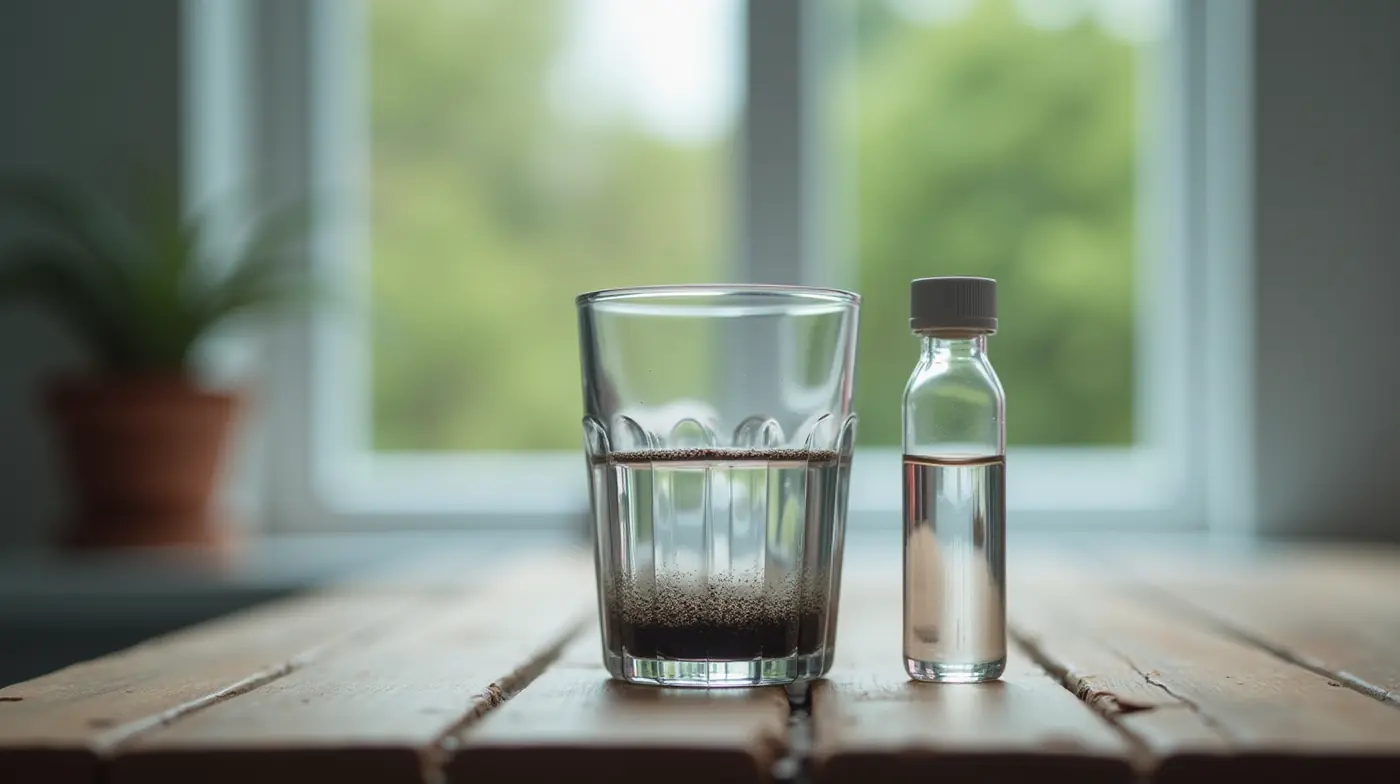
- Black sediment at the bottom of glasses. Let a glass of well water sit overnight; fine black sediment settling to the bottom is a classic sign of oxidizing manganese.
- A metallic or bitter taste. Manganese is one of the few metals with a noticeable taste, usually described as metallic or bitter at concentrations above roughly 0.2 mg/L.
Quick Rule: Orange vs. Black
If your stains are orange or reddish-brown, you are dealing with iron. If they are black or dark gray, manganese is the likely culprit. Many wells carry both metals, so the practical answer is a lab test that measures each one separately rather than a visual guess.
Why Manganese Shows Up in Well Water
Manganese is the 12th most abundant element in the Earth’s crust, so finding some of it in groundwater is normal — the real questions are the concentration and the water chemistry around it. Manganese dissolves from soil and bedrock most readily when water is slightly acidic (pH below about 7) and when oxygen levels are low. In a reduced, low-oxygen aquifer, manganese stays dissolved as Mn2+, the invisible form. When that water is pumped to the surface and exposed to air, part of it oxidizes into insoluble MnO2 — the black particles you eventually see as stains. That is also why manganese problems often announce themselves after a water quality change rather than on day one.
Based on 15+ years of well water testing, the situations where manganese levels suddenly rise include:
- New or recently drilled wells. Drilling and well development stir up formation water and can mobilize metals that had been stable in the rock for years.
- Pump replacement or repair work. Disturbing the well can release metals trapped in biofilm and sediment around the pump intake.
- Iron bacteria activity. Certain bacteria build colonies that trap manganese; a new bacterial bloom can add a sudden black-staining problem even if the aquifer itself has not changed.
- Seasonal water-level changes. A falling water table can draw water from deeper, more mineralized zones of the aquifer, raising metal concentrations without any surface cause.
- Acidic groundwater. Wells with pH below 7 dissolve manganese and iron more aggressively than alkaline wells, which is why pH and manganese readings are tracked together.
Field Insight
When groundwater pH is above 8.5, manganese naturally precipitates out of solution and most of it never leaves the aquifer — which is why many high-pH wells test near zero even in manganese-rich geology. Your pH reading is one of the best predictors of what your manganese level will do over time. If your pH is drifting down, expect manganese to drift up.
Manganese in Well Water: Safe Levels and Health Effects
Here is the fact that surprises most homeowners: the EPA has no enforceable maximum contaminant level (MCL) for manganese in drinking water. Instead, the agency set a secondary standard of 0.05 mg/L (0.05 ppm) based on taste, appearance, and staining — the same class of standard used for iron and hardness. Several states set their own limits, some as low as 0.03 mg/L, so it is worth checking your state’s drinking water regulations if you live near a public system. The full regulatory picture is laid out in the EPA’s secondary drinking water standards document.
On the health side, manganese is an essential trace nutrient at very low intake, and the levels most wells produce are not acutely toxic. The real concerns are about long-term, elevated intake:
- Chronic exposure. Consistently elevated manganese intake has been linked in occupational studies to neurological effects (manganism), though those cases involve workplace dust exposure far above anything a well would deliver. Still, a level that is easy to treat is not a level worth ignoring.
- Infants on formula. This is the group we treat most seriously. In 2024 the EPA substantially lowered its health reference value for manganese, and several states issued advisories about preparing infant formula with high-manganese water. If an infant drinks formula made with your well water, get a certified lab test before dismissing manganese as “just a stain problem.”
- People with liver or iron-overload conditions. Manganese is processed through the liver, so individuals with liver impairment or hemochromatosis should pay particular attention to their water supply.
What does each level actually mean for your household? Here is how we classify results:
| Measured Level | Classification | Recommended Action |
|---|---|---|
| Below 0.05 mg/L | At or below the EPA secondary standard | No treatment needed. Monitor with an annual lab test. |
| 0.05 to 0.3 mg/L | Above the secondary standard | Install treatment if staining is a nuisance; retest annually. |
| 0.3 to 1.0 mg/L | Elevated | Treatment recommended; confirm safety before using for infant formula. |
| Above 1.0 mg/L | High | Treat before use; retest after treatment and verify removal. |
Source: EPA secondary drinking water standard for manganese (0.05 mg/L); state limits vary. Classifications reflect our treatment-installation practice.
How to Test for Manganese in Well Water
A certified lab test is the only way to know your actual number. DIY screening tools are fine for trending and for confirming a suspected problem, but a lab result is what a water treatment installer should size a system against. After analyzing hundreds of well panels, we can say the number one error is homeowners buying a filter based on strip-test color alone — strips under-report at low levels, and that is exactly the range where the right system choice flips.
For a certified lab test, follow these steps:
- Contact your state health department or any certified environmental laboratory and request a basic well water panel that includes manganese, iron, hardness, pH, and coliform bacteria. Testing them together costs only a little more and prevents a second round of sampling.
- Collect the sample from the cold tap closest to the house, after running the water for 2 to 3 minutes to flush the pipe. Follow the lab’s labeling and cold-ship instructions exactly — an improperly stored sample gives a wrong answer, not no answer.
- Budget roughly $30 to $100 for the panel and expect results in 3 to 7 days.
For DIY screening between lab tests, two options work well:
- Manganese well water test kits (liquid reagent type) detect from about 0.01 mg/L up to 10 mg/L by color comparison. They are the right tool for monthly trending once you know you have a problem.
- Well water test strips give a 30-second screen but with coarser detection, typically around 0.05 mg/L. Use them to decide whether a full lab order is worth it.
Retest Schedule That Catches Drift
Retest 2 to 4 weeks after installing any treatment system to confirm removal, then once a year at the same season, and always after a drought, nearby heavy construction, or well work. Manganese levels track pH and water-table depth, so a seasonal pattern is normal — compare your numbers to the same season, not to last month.
Best Ways to Remove Manganese From Well Water
Which system is right for you depends on three things: your measured level, whether your water is “reduced” (low in oxygen, often carrying a rotten-egg odor), and what else is in the water — iron and hardness usually travel with manganese. Here is how the five mainstream removal approaches compare, based on our field data and installed-cost surveys across the western and midwestern US:
| Method | Effective Range | How It Works | Typical Installed Cost |
|---|---|---|---|
| Birm / Greensand Oxidation Media Filter | 0.05 to 15 mg/L (with pre-oxidation) | Water is pre-oxidized with chlorine or air, then passes through manganese-coated media that traps black particles and renews itself during backwashing | $1,500 to $4,500 |
| Salt Water Softener (Mn resin / KPM greensand) | 0.05 to 0.5 mg/L | Ion-exchange resin or potassium permanganate greensand swaps hardness and some manganese for sodium | $800 to $2,500 |
| Aeration Tank + Filtration | 0.1 to 5+ mg/L (plus H2S odor) | Air is mixed into the water so dissolved manganese oxidizes to a solid, which a downstream filter then removes | $2,500 to $6,000 |
| Activated Alumina Filter | 0.05 to 1 mg/L | Manganese adsorbs onto an activated alumina cartridge; works best in a slightly acidic pH window and also removes fluoride | $2,000 to $5,000 |
| Reverse Osmosis (Point of Use) | Any level (drinking water only) | A semipermeable membrane strips dissolved metals from a small drinking-water stream at one faucet | $400 to $1,500 |
Cost ranges reflect installed whole-house systems in the western and midwestern US as of 2026; point-of-use systems cost less. Verify removal performance against your actual lab level before buying.
Our rule of thumb from inspecting hundreds of these systems: below 0.3 mg/L with no odor, a softener or a compact oxidation filter is enough. Above 0.5 mg/L, or with any rotten-egg odor, plan on pre-oxidation plus a media filter — that combination has the highest first-year success rate we have measured, because it solves the chemistry problem before the filter problem.
How to Fix Manganese in Well Water: Step-by-Step
Follow this sequence and you will avoid the two most common expensive mistakes — buying a system that is too small for the problem, and skipping the oxidation step that makes every other option work.
- Confirm with a certified lab test. Get manganese, iron, hardness, pH, and coliform in a single panel. Treat the lab number, not the stain color — black staining can also come from iron bacteria or tannins.
- Classify your level using the table above and note every co-occurring contaminant. Iron above 0.3 mg/L or hardness above 15 gpg changes the system choice, because you will want one unit to solve both problems.
- Check whether your water is reduced. If it smells of rotten eggs or tests low in oxygen, the manganese is dissolved Mn2+ and any media filter you install needs a pre-oxidation step (chlorine injection or aeration). Skipping this step is the most common reason a new filter “stops working” within a year.
- Select the system to match your level. Low level plus hardness, a softener with manganese-capable media; moderate level, an oxidation media filter; high level plus odor, aeration plus filtration; infant on formula, prioritize certified removal with post-treatment lab confirmation before the next bottle.
- Install with the right pre-treatment. For chlorine injection, target 1 to 2 ppm of free chlorine at the filter inlet with a short contact chamber; for aeration, size the tank for your peak household flow, typically 2 to 5 gallons per minute.
- Condition the media. New Birm and greensand media need several weeks of chlorinated backwash cycles to develop their manganese-coating. Expect some staining to linger during that period — it is normal, and it is how the media is doing its job.
- Verify and maintain. Retest 2 to 4 weeks after installation, backwash on the manufacturer’s schedule, and replace media on a 5 to 10 year cycle. Keep a dated log of your results so a slow upward trend is visible before it becomes a stain problem again.
Where to Buy: Manganese Treatment and Testing Products
Everything below is available through major online retailers. Prices are typical street ranges as of 2026 and vary by capacity and brand.
| Product | Role in the System | Typical Price |
|---|---|---|
| Manganese Water Test Kit | Confirms and trends your manganese level between lab tests | $25 to $60 |
| Well Water Test Strips | 30-second screen across multiple parameters | $15 to $40 |
| Birm Media Filter, 1 cu ft | Whole-house oxidation and filtration of iron plus manganese | $900 to $2,500 |
| Greensand Filter, 1 cu ft | Iron, manganese, and hardness in a single unit | $1,200 to $3,500 |
| Well Water Aeration Tank | Pre-oxidation for high manganese levels and rotten-egg odor | $1,500 to $4,000 |
| Chlorine Injection System | Compact pre-oxidation alternative to aeration | $150 to $400 |
| 5-Micron Sediment Prefilter | Protects the media filter and downstream fixtures from grit | $40 to $150 |
All links are Amazon search results; compare capacity and warranty before purchasing, and confirm the unit is rated for manganese removal, not just iron.
Frequently Asked Questions
Is manganese in well water dangerous?
At the levels most wells produce (0.05 to 0.5 mg/L), manganese is not an acute health hazard — the EPA’s 0.05 mg/L limit is a secondary, appearance-based standard, not a health-based MCL. The groups that warrant real caution are infants drinking formula made from the water and people with liver or iron-overload conditions. If either applies, treat the level as a health issue rather than a cosmetic one, and confirm removal with a post-treatment lab test.
Why did my well water suddenly start staining black?
A sudden change almost always means the water chemistry changed, not the well itself. The usual triggers are a drop in pH, a shift in the water table that draws from a different aquifer zone, a new iron bacteria bloom, or recent well work such as drilling or pump replacement that stirred up trapped metals. A lab test paired with a pH reading will tell you which one is at work, and the fix is chosen from that answer.
Can a regular water softener remove manganese?
Partially, and only at low levels. Standard resin handles a modest amount of manganese alongside hardness, but manganese-removing resin or potassium permanganate greensand is what turns a softener into a genuine manganese solution — and those top out around 0.5 mg/L. Above that, or with any odor, add a dedicated oxidation media filter in line.
What is the difference between iron and manganese staining?
Iron stains orange or reddish-brown; manganese stains black or dark gray. Many wells carry both metals, and the black often shows up first on dishes while the orange shows on tubs and toilets. A lab test that measures each metal separately is the only reliable way to know which one you are actually fighting, and whether you need one system or two.
How often should I retest for manganese?
Once a year at the same season is the baseline, plus 2 to 4 weeks after installing any treatment system, and immediately after a drought, nearby construction, or any well work. Because manganese levels track pH and water-table depth, a yearly seasonal test is what catches a slow upward drift before it becomes a visible stain problem.
The Bottom Line on Manganese in Well Water
Manganese in well water is common, usually harmless at the levels most wells produce, and very treatable when it is above the EPA’s 0.05 mg/L secondary standard. The winning sequence is always the same: confirm the level with a certified lab test, check your pH and oxygen status, then match the removal system to the chemistry — softener for low levels, pre-oxidation plus media filter for moderate to high levels or any odor. Retest after treatment and once a year, and the black stains stay in the past.
See Also
- Iron Filter for Well Water 2026 — the companion buyer guide, since iron and manganese travel together through the same geology.
- How to Test Your Well Water — sampling, lab selection, and interpreting the full panel that includes your manganese number.
- Water Softener for Well Water 2026 — sizing and selecting a softener when hardness is riding along with your manganese.
#Manganese #WellWater #PrivateWell #WellWaterQuality #WaterTesting #IronAndManganese #WellOwner #WaterTreatment #WellMaintenance #Groundwater #WellPump #WaterSafety #HomeWell #WellInspection #PrivateWellWater