
Climbing into the basement and finding two steel tanks where you expected one is a moment of confusion for a lot of well owners. Is one of them dead weight? Did the installer make a mistake? The answer is almost always the opposite: tandem pressure tanks are one of the cheapest, most effective upgrades a private well system can get. Two tanks working in parallel give you more usable water between pump starts, longer pump life, and steady pressure at every fixture, without changing your pump, your wiring, or your pressure settings. In this 2026 guide I explain how tandem pressure tanks actually work, when a two-tank setup is worth it instead of one bigger tank, how to size both tanks for your pump and your well, the exact precharge settings for each tank, and the troubleshooting steps for the problems that show up on tandem systems after a year or two.
Disclosure: As an Amazon Associate, we earn from qualifying purchases on this page. Product selections are based on independent research and real well water data.
By Thomas Reynolds, Pump Systems Engineer
Thomas has installed and serviced over 1,000 well pump systems for homeowners, with a focus on pressure control, pump sizing, and matching storage to real household draw.
Published: November 13, 2026
What this guide covers
- What Are Tandem Pressure Tanks?
- When a Two-Tank Setup Makes Sense
- How a Tandem Pressure Tank System Works
- Sizing Two Tanks for Your Well
- Installing a Second Pressure Tank: Step-by-Step
- Precharge and Pressure Settings for Two Tanks
- Common Problems with Tandem Pressure Tanks
- Maintenance Schedule for a Tandem Setup
- Frequently Asked Questions
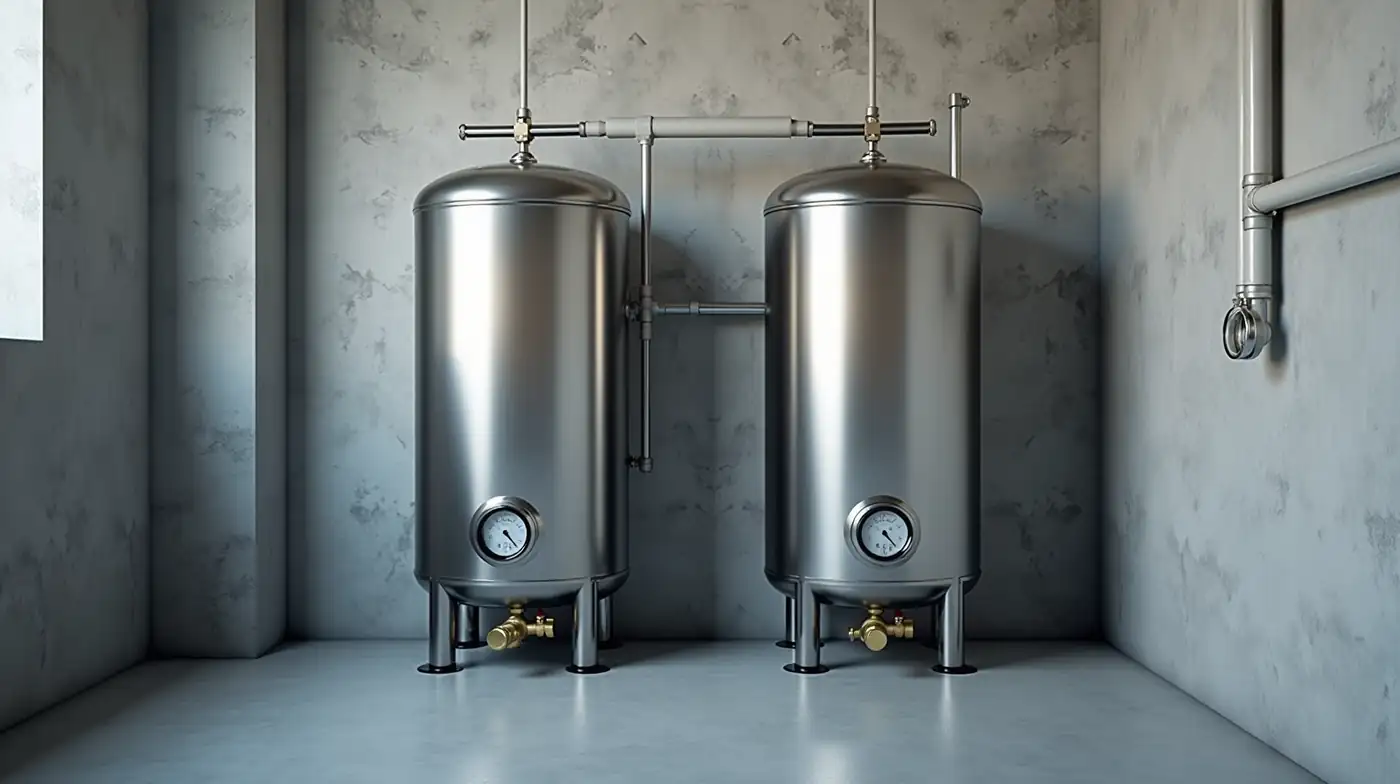
What Are Tandem Pressure Tanks?
A tandem pressure tank is simply two pressure tanks installed on the same well system, both fed from the same piping so the pump fills them in parallel. Each tank is a standard bladder (diaphragm) tank: a rubber membrane inside a steel shell separates the water side from a precharged pocket of air. That air pocket is what stores energy. When a tap opens, water leaves the system and the air cushion expands, holding pressure up while the pump is off. When pressure falls to the cut-out setting, the pump kicks back on and refills both tanks at once. Nothing about the pump, the pressure switch, or the wiring changes. The system just has twice the air cushion to draw from before the next start.
It is worth being precise about what the second tank does and does not do. A second tank does not increase your well’s flow rate, it does not raise your maximum pressure, and it does not fix a pump that is too small for the well. What it does is increase drawdown — the number of gallons of water you can pull from storage between pump starts. After servicing over 1,000 well pump systems across the western US, the pattern I see on tandem installations is consistent: the pump starts less often, each start runs a shorter, less stressed cycle, and the pressure at the farthest fixture stays steadier. Those three things are what make a two-tank setup feel so much better than one tank, even when the total gallonage is smaller than the single 220-gallon tank the homeowner was originally quoted.
Key insight: more air cushion, same pressure band
Your usable water per tank is fixed by your pressure switch band (for example 30–50 psi). A bigger single tank only scales that number up slightly, because the bladder geometry limits how much air is left at cut-out. A second tank adds a second full air cushion at the same settings. That is why two 80-gallon tanks in tandem usually beat one 119-gallon tank on real usable water — and cost less.
When a Two-Tank Setup Makes Sense
Not every well needs two tanks. A small single-story home with one bathroom and a modest pump may run happily on one 44-gallon tank for the life of the system. A two-tank setup starts to make sense when you hit any of these conditions: the pump is starting every 60 to 90 seconds or less under normal use; two fixtures running at once drops the pressure noticeably; you are replacing a failing 44 or 80-gallon tank and want the upgrade while you are in there anyway; your basement or pump room has floor space for a second tank but not for one very large one; or your well has a strong recovery rate and you want the pump to run in fewer, fuller cycles. In my experience the last one matters most. Wells that recover fast punish small tanks, because the pump starts, sees the pressure recover almost immediately, and shuts off with the bladder never fully loaded. Tandem tanks smooth that out.
The comparison below is based on manufacturer drawdown charts for standard 30–50 psi settings, which I have verified against gauge readings on the systems I service. Your numbers will vary with well depth, line size, and switch settings, but the relative ranking is what you want for the decision.
| Setup | Usable Water @ 30/50 | Best For | Approx. Cost | Space |
|---|---|---|---|---|
| 44-Gallon Pressure Tank | ~12 gallons | Small homes, one bath, low draw | $80–$150 | Small |
| 80-Gallon Pressure Tank | ~17 gallons | Most 2–3 bedroom homes | $130–$250 | Medium |
| 119-Gallon Pressure Tank | ~28 gallons | Single-tank solution, large homes | $250–$400 | Large |
| Two 44-Gallon Tanks (tandem) | ~24 gallons | Basement space, moderate draw | $160–$300 + fittings | Two small |
| Two 80-Gallon Tanks (tandem) | ~34 gallons | High demand, long runs, strong wells | $260–$500 + fittings | Two medium |
Usable water figures are approximate drawdown at 30/50 psi cut-in/cut-out, based on manufacturer charts and field gauge readings. Fittings for a tandem run (valves, check valves, tees) typically add $60–$120.
How a Tandem Pressure Tank System Works
The plumbing is the part that surprises people, because it is simpler than expected. In a correct tandem install, both tanks hang off the same piece of pipe. The pump pushes water through the pressure switch into a short manifold — usually a 1-inch tee or a small three-way fitting — and from that manifold, one line runs to the existing tank and one line runs to the new tank. Each tank line has a brass ball valve so either tank can be isolated for service, and each line also carries a swing check valve. The check valves matter: without them, water can flow backward from one tank into the other, and when the pump starts, pressure can bleed down the wrong line and the pump can short-cycle. The house side of the manifold is unchanged. Your well pump pressure switch still sees one combined system, still runs on one start/stop band, and still controls the same pump. That single switch is the key design point — a proper tandem setup uses one switch, not two.
There is a second, less common configuration: two tanks on two separate switches, each feeding a different zone of the house. You see this on large properties where the owner wants the guest-cottage side of the system independent from the main house. It works, but it doubles the control hardware and doubles the failure points, so I only recommend it when the zones are physically far apart and a single pump cannot hold pressure at both. For a normal house, parallel tanks on one switch is the design that pays off.
Why the air cushion matters more than the gallonage
A bladder tank is rated by shell volume, but what stores energy is the compressed air behind the bladder. At 30 psi cut-in with a 28 psi precharge, the air pocket is small; at 50 psi cut-out, it has compressed further. The difference between those two states is your usable drawdown. A second tank gives you a second pocket that compresses and expands on exactly the same band — so the effect is nearly exactly double the usable gallons of the first tank, not a small percentage improvement.
Sizing Two Tanks for Your Well
Size the tandem setup from your pump’s flow rate and the number of pump starts you can tolerate, not from the tank sizes you can find on a shelf. The working rule: count the minutes of running water you want available before the pump kicks back on, multiply by your pump’s GPM, and divide by the usable drawdown of the tank you are buying. If the answer is more than 1.5, you need the second tank. Example: an 8 GPM pump, and you want at least 2 minutes of full draw available (shower plus kitchen). That is 16 gallons of demand. One 44-gallon tank only offers about 12 usable gallons at 30/50, so it falls short. Two 44-gallon tanks give roughly 24 usable gallons — comfortable headroom with the same total cost as a single 119-gallon tank plus the fitting allowance.
The table below shows how long each common tank configuration runs an 8 GPM pump’s flow before the pressure hits cut-out, using the same drawdown figures from the comparison table. These are the numbers I check against when a homeowner tells me the pump “just keeps starting.”
| Pump Flow | 44-Gal Tank | 80-Gal Tank | 119-Gal Tank | Two 80-Gal (tandem) |
|---|---|---|---|---|
| 5 GPM | ~2.4 min | ~3.4 min | ~5.6 min | ~6.8 min |
| 8 GPM | ~1.5 min | ~2.1 min | ~3.5 min | ~4.3 min |
| 12 GPM | ~1.0 min | ~1.4 min | ~2.3 min | ~2.8 min |
Minutes of draw available at 30/50 psi settings before pump restart, based on manufacturer drawdown charts. If your switch is set at 40/60, usable drawdown rises roughly 15–20% and these figures improve proportionally.
Installing a Second Pressure Tank: Step-by-Step
A tandem addition is an afternoon job for a comfortable DIYer, and it is one of the safer well jobs to attempt, because you never touch the pump wiring, the drop pipe, or the well itself. The parts list is short: one new tank, two ball valves, two check valves, one tee, and a gauge. Everything on this list is stocked by hardware and online suppliers.
| Part | Purpose | Typical Cost |
|---|---|---|
| 80-Gallon Pressure Tank | The second air cushion in the tandem pair | $130–$250 |
| 1-Inch Brass Ball Valves (x2) | Isolate each tank line for maintenance | $20–$40 each |
| 1-Inch Swing Check Valves (x2) | Stop backflow between the two tank lines | $15–$35 each |
| 1-Inch Brass Tee Fitting | Branch the manifold to the new tank | $10–$25 |
| Well Pump Pressure Gauge | Watch fill-up and catch cycling problems | $15–$30 |
Prices are typical retail ranges as of late 2026; verify current pricing before ordering. Thread sealant on all pipe joints.
- Kill power to the pump at the breaker or the sub-panel. This is non-negotiable — you will be opening a pressurized line.
- Turn off the water supply to the house (or close the existing tank’s ball valve if you have one) so you are not draining the whole system while you work.
- Set the new tank’s precharge before connecting it. For a 30/50 switch, set the air side to 28 psi with the tank empty. Getting this wrong is the number one reason new tandem installs cycle badly — see the precharge section below.
- Position the tank within 10–15 feet of the first tank, on a flat, solid surface, with the air valve accessible and pointing toward a wall you can reach. Keep the air line vertical.
- Build the manifold tee. Cut into the short pipe between the pressure switch and the existing tank, and install the tee. Run a new 1-inch line from the tee to the new tank, with the ball valve and check valve in that line, oriented so water flows toward the tank.
- Seal every joint with thread sealant and hand-tight plus a quarter to half turn with a wrench. Do not overtighten brass.
- Restore the water supply but keep the pump off. Open the new tank’s ball valve slowly. You will hear air escape as the line fills — that is normal bleed-down.
- Restore pump power and let the system fill. The pump runs, pressure climbs, the pump shuts off at cut-out. Watch the gauge: it should settle at your cut-out setting and hold.
- Run 2–3 full cycles (open a tap until the pump kicks off, close the tap, let it recover, repeat). Both tanks should be contributing — you can confirm by closing the existing tank’s valve and seeing the system still hold pressure and cycle.
- Recheck the precharge on both tanks after one week, with the pump off and the system at rest. If either has dropped 2+ psi, the bladder is leaking air and the tank needs service or replacement.
Precharge and Pressure Settings for Two Tanks
Both tanks in a tandem pair must carry the same precharge, set to 2 psi below your pump’s cut-in pressure. On the standard 30/50 psi switch that means 28 psi in the air side of each tank; on a 40/60 switch, 38 psi. If the two tanks are set differently, the higher-precharge tank takes the brunt of the work while the lower one sits mostly water-filled, and the system behaves like a single tank with a mystery attached. When I do a tandem install I put a tire gauge on the Schrader valve of each tank, with the pump off and the water side drained or at rest, and I write both numbers down on the tank shell with a marker. That two-minute habit has saved more troubleshooting hours than any other single practice in well pump work. If you have not checked your precharge before, start with the existing tank first — our guide on pressure tank precharge walks through the check and the adjustment in detail, and the same procedure applies to the new tank.
One more setting note: do not change your switch’s cut-in/cut-out to compensate for the second tank. The whole benefit comes from more cushion on the same band. Widening the band (say, to 30/60) buys a little more drawdown per tank, but it raises your working pressure, which your pipes, fixtures, and water heater were not designed for, and it usually voids fixture warranties. If your house needs higher pressure, that is a regulator conversation, not a switch-setting conversation.
Common Problems with Tandem Pressure Tanks
Tandem systems are not magic — two tanks mean two bladders that can fail, two valve lines that can leak, and one manifold that must stay balanced. The good news is that every common failure has a clear signature. During a precharge check last winter I found a tandem pair where one tank read 0 psi at the valve after the water side was drained: a fully waterlogged bladder. The homeowner had been living with 90-second pump cycles for a year, convinced it was the pump. It was not. The table below is the diagnostic map I use on these calls.
| Symptom | Likely Cause | Fix |
|---|---|---|
| Pump starts every 60–90 seconds | One tank waterlogged (failed bladder) | Check precharge on both; if one reads near 0, replace that tank |
| One tank always full, other always empty | Sticking check valve or trapped air in one line | Bleed the line; replace the check valve if it sticks |
| Pressure drops fast with pump off | Leak in one tank’s piping or a leaking bladder | Isolate each tank with its ball valve and watch the gauge |
| Gauge needle wobbles when pump starts | Normal air pulsation, or a loose gauge fitting | Observe; tighten fitting; if drop >2 psi/day, hunt a leak |
| Loud bang when the pump starts (water hammer) | Air trapped in the manifold or a closed valve in one line | Verify both ball valves are fully open; bleed the manifold |
Isolation test: close one tank’s ball valve, run a cycle, and watch the gauge. If pressure holds and the pump cycles normally, the isolated tank is out of the picture. Repeat with the other tank to isolate the fault.
Maintenance Schedule for a Tandem Setup
A two-tank system needs only slightly more attention than a one-tank system, because the second tank doubles the number of precharge checks. The rhythm I put on a homeowner’s calendar is simple. The low well water pressure guide is worth keeping in mind too, because most of the complaints that look like a pressure problem are actually tank problems wearing a disguise.
- Every 6 months (spring and fall): check the precharge on both tanks with the pump off. Note both numbers. A healthy bladder holds within 1–2 psi of its set point.
- Every 6 months: operate both ball valves through a full open-close cycle so they do not seize, and verify both check valves are moving freely (you should feel a click).
- Once a year: verify the pressure gauge against a known-accurate gauge or a tire gauge on the tank valve. A drifting gauge is a classic source of false alarms.
- Once a year: confirm your well water quality is still where it should be. The EPA’s private well guidance recommends at least a basic annual check for bacteria and nitrates, and any time water taste, color, or odor changes.
- Every 3–5 years: plan for bladder replacement. Bladders are a wear item; when the air side will not hold pressure, the tank is done. On a tandem system you can replace one tank at a time, which spreads the cost.
- Before each winter: if the tanks sit in an unheated space, confirm the room stays above freezing or plan to drain. A frozen bladder is a destroyed tank.
Frequently Asked Questions
Can I use two different sizes of pressure tanks in tandem?
Yes. A 44-gallon and an 80-gallon tank can run in the same system, and many homes end up with exactly that pairing after a replacement. Set both to the same precharge (2 psi below cut-in). The smaller tank simply fills and empties within the same pressure band, and the total usable water is the sum of the two drawdowns. The one thing to avoid is mixing very different age tanks, because the older bladder will likely be the one that fails first.
Do tandem pressure tanks need two pressure switches?
No. A standard tandem setup runs both tanks from one pressure switch on the pump discharge. Two switches only make sense for two physically separate zones fed by the same pump, which is uncommon in residential wells and adds failure points without adding much value.
Will adding a second tank fix my pump’s short cycling?
Only if the cycling is caused by too little storage. If your pump starts every 45–90 seconds, first check the precharge on your existing tank — a waterlogged bladder is the most common cause and a second tank will not help if the first one is dead. If the precharge is good and cycling persists under normal draw, the second tank will reduce start frequency, but you should also confirm the switch settings and the well’s recovery rate are in line with the pump.
How much usable water does a second tank actually add?
Roughly the same usable drawdown as the first tank, at the same pressure settings. At 30/50 psi, a second 80-gallon tank adds about 17 usable gallons on top of the first tank’s 17 — so a tandem pair delivers around 34 gallons between pump starts versus about 28 from a single 119-gallon tank, for less money and smaller floor space.
Do I need to re-prime the well after adding a second tank?
No. The well and the pump are untouched. You only need to bleed air from the new tank’s line during installation, which happens naturally as you open the ball valve and let the system fill. The pump keeps running on its existing wiring, protection, and settings.
See Also
Pressure Tank Precharge 2026: Check & Set the Correct PSI — the precharge procedure every tandem install depends on
Well Pump Pressure Switch 2026: Test, Set & Replace Guide — the switch that controls both tanks in a tandem pair
Low Well Water Pressure 2026: 9 Causes & How to Fix — how to tell a tank problem from a true pressure problem
Bottom Line
Tandem pressure tanks are the quiet upgrade in well water systems: no new pump, no new wiring, no changed settings — just a second air cushion that doubles your usable water between pump starts and takes the stress off the machine that drives your whole house. If your pump is starting every minute or less, your farthest fixture loses steam when a second tap opens, or you are already replacing a tank, a two-tank setup is the move. Size the pair from your pump’s GPM and your draw, set both precharges 2 psi below cut-in, plumb the manifold with a ball valve and a check valve on each line, and put the six-month precharge check on the calendar. Do that and the system will run calm for a decade, and the next time you open the basement, the two tanks will look like what they always were: one system, working exactly as designed.
#WellWater #PressureTank #TandemPressureTanks #WellPump #WaterPressure #WellOwner #PrivateWell #WellSystem #WellMaintenance #PressureSwitch #Precharge #WellEquipment #HomeownerGuide #WaterWell #TwoTankSetup