
How much water should a well produce? For most private wells in the United States, the answer is 10 to 15 gallons per minute (GPM) of sustainable flow. Shallow wells served by a jet pump typically deliver 5 to 10 GPM, while deep, low-yield wells may only supply 4 to 8 GPM. The number that matters is your well’s yield — the volume of water your aquifer can reliably replace after you draw it. In this guide, we break down normal yield ranges by well type, show you how to measure your well’s GPM at home with a bucket or a flow meter, and explain when a low reading means a real problem rather than a normal variation.
If your faucets feel weaker than they used to, your irrigation runs shorter, or the pump cycles more often, you may be drawing down a well that is producing less than it should. Understanding what healthy flow looks like is the first step in diagnosing the cause — and it takes less than five minutes to test at home.
By Robert Harrison, Certified Well Inspector
Robert has 20+ years of experience inspecting and testing residential water wells across the western US. He specializes in well yield testing, aquifer assessment, and pump system diagnostics for homeowners.
Published: November 28, 2026
Disclosure: As an Amazon Associate, we earn from qualifying purchases on this page. Product selections are based on independent research and real well water data.
Table of Contents
What Is Well Yield?
Your well’s yield is the maximum amount of water you can draw from the well over a given period — usually expressed in gallons per minute (GPM) — while the water table can keep up. Think of it as the well’s sustainable output, not a one-time number. Two related terms make the picture precise:
- Static water level — the depth to water when the pump is off and the well has fully recovered.
- Recovery rate — how quickly the water level refills after you pump. A high-yield well recovers in minutes; a low-yield well can take hours between draws.
According to US Geological Survey data on domestic wells, the median completed well in the US yields roughly 10 to 15 GPM, which comfortably covers a typical household’s peak demand. What a well should produce depends on the geology, the well’s depth, and how it was drilled — which is why “normal” is a range, not a single number. In our field work inspecting residential wells, we have seen perfectly healthy wells in the same county vary by as much as 3:1 in yield because the aquifer thickness changes from property to property.
Quick Answer
A healthy private well should produce 10–15 GPM of sustainable flow. If your well cannot sustain at least 5 GPM, households larger than three people will start to feel the shortfall — especially when running irrigation, a washing machine, and a shower at the same time.
How Much Water Should a Well Produce? (Normal GPM Ranges)
The most reliable way to know if your well is producing normally is to compare your measured flow against what wells like yours typically deliver. The table below summarizes the ranges we see most often in residential wells, based on depth, pump type, and aquifer conditions.
| Well Type | Typical Depth | Normal Yield | Household Coverage |
|---|---|---|---|
| Shallow well (jet pump) | 25–100 ft | 5–10 GPM | 1–3 people |
| Deep well (submersible pump) | 100–300 ft | 10–15 GPM | 3–6 people |
| Deep well (submersible pump) | 300–500 ft | 8–12 GPM | 2–5 people |
| Deep, low-yield well | 500+ ft | 4–8 GPM | 1–3 people |
Ranges reflect typical US residential aquifers (sand and gravel, limestone, fractured rock) per USGS domestic well data and manufacturer sizing charts.
A few patterns worth knowing before you read your own number:
- Deeper is not always better. Depth alone does not set yield. A 200-foot well in a thick gravel aquifer can out-produce a 400-foot well in tight sandstone.
- Seasonal variation is normal. In our experience, summer droughts commonly cut a well’s sustainable yield by 20–40% as the water table drops. Test in dry season if you want a worst-case number.
- Peak household demand is 10–15 GPM. A shower (2.5 GPM), washing machine (3 GPM), and kitchen sink (2.5 GPM) running together approach 8 GPM before irrigation. That is why the pressure tank exists: it banks water between pump cycles.
- Your well’s original test card is the best baseline. The drilling contractor’s yield test from install day tells you what the well should do; comparing today’s number against it is the fastest way to spot decline.
How to Test Your Well’s GPM at Home
You do not need a drilling rig to find out what your well produces. Two methods work at home: the free bucket-and-timer test, and a more accurate inline flow meter test. Both take under ten minutes. We recommend testing at a single outdoor spigot on the well line with all indoor fixtures closed, and running the test on a day you expect normal use.
Method 1: The Bucket-and-Timer Test (Free)
- Shut off every faucet, appliance, and irrigation zone in the house.
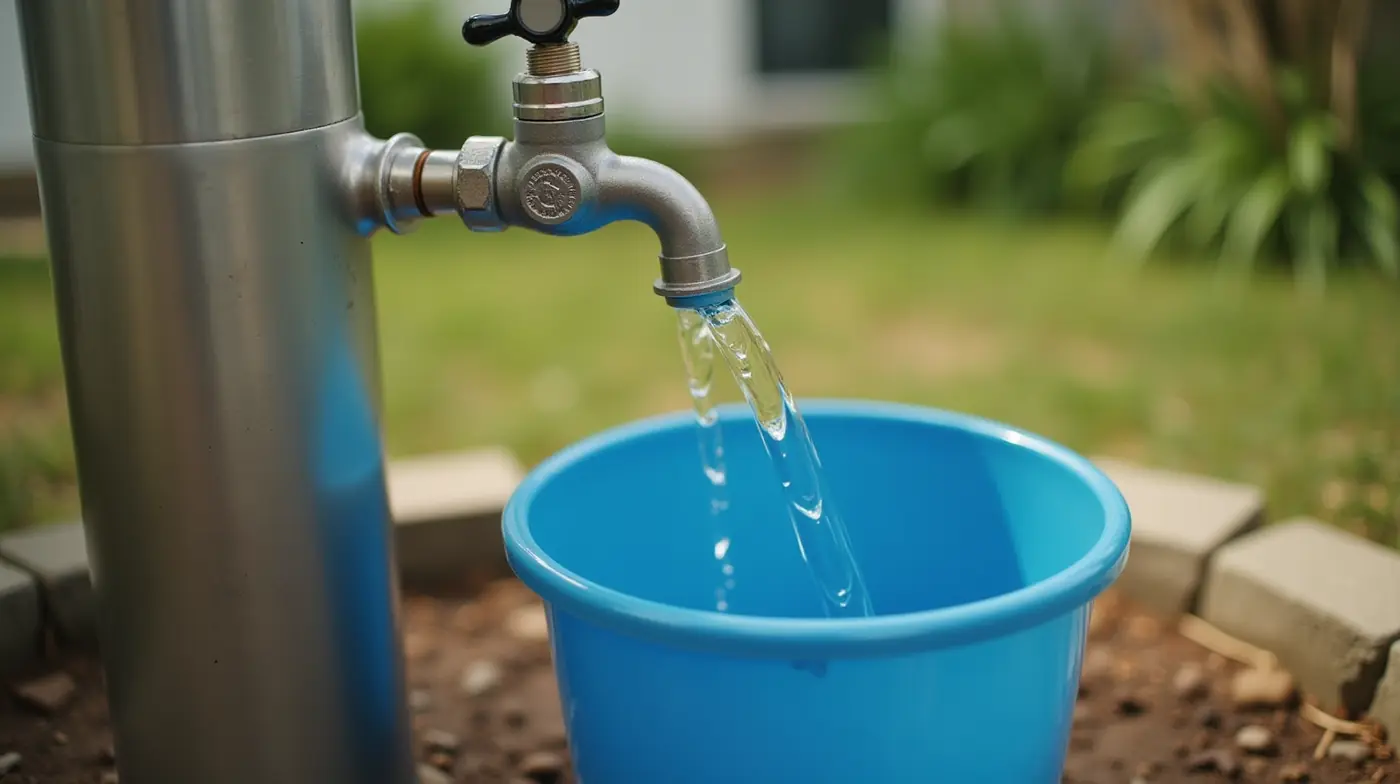
- Place a 5-gallon bucket directly under an outdoor spigot on the well line.
- Open the spigot fully and start a phone stopwatch at the same moment.
- Stop the timer the instant the bucket reaches the 5-gallon line.
- Calculate GPM: 5 ÷ minutes. For example, 5 gallons in 0.6 minutes equals 8.3 GPM; 5 gallons in 1 minute equals 5 GPM.
- Keep the spigot running and repeat the fill for a total of 5 minutes. If each successive fill takes longer, your well cannot sustain that rate — the first fill is your peak, not your yield.
Method 2: The Inline Flow Meter Test (Most Accurate)
- Screw a digital flow meter onto a hose bibb or inline fitting on the well line.
- Run the pump continuously for 5–10 minutes with all fixtures closed.
- Read the GPM display. Take the average of the last three minutes — that is your sustainable flow, not the initial surge.
- Compare the reading to your well’s original yield test and to the ranges in the table above.
| Feature | Bucket-and-Timer | Inline Flow Meter |
|---|---|---|
| Cost | $15–$30 (bucket) | $60–$200 |
| Accuracy | ±10–15% (depends on your timing) | ±2–5% |
| Repeatability | Fair — manual start/stop error | Excellent — log every test |
| Best for | Quick one-off check | Ongoing monitoring of a marginal well |
Pro Tip
Record every test date, the GPM reading, and the weather/season. A well’s yield is a moving target — a year-over-year log is what lets you distinguish a normal summer dip from a declining aquifer or a clogged screen.
What Affects Well Yield
When your measured GPM is below what you expected, six factors explain most of the difference. In our inspections, the first three account for the majority of “my well used to run stronger” cases:
- Aquifer type and thickness. Sand and gravel aquifers typically yield the most; fractured rock (like much of the western US) can be productive but inconsistent; tight sandstone and shale produce the least. No amount of equipment changes what the geology holds.
- Water table level. A lower water table means the pump works against a longer suction column and, for submersibles, sits closer to the static level. Drought years and heavy neighbor pumping both drop the table.
- Clogged screen or foot valve. Sand intrusion, mineral scale, or a failed foot valve can cut a well’s effective intake by 30–50%. If flow declined gradually over a year or two, intake restriction is the first thing we check.
- Well construction. Casing size, screen length, and whether the well was properly developed after drilling all cap the maximum deliverable flow. A short screen in a productive aquifer will under-produce no matter how big the pump is.
- Pump size and condition. An undersized pump delivers less than the well can; a worn pump (eroded impeller, leaking seal) delivers less than the pump once did. A pump cannot make water that the aquifer will not supply, but it can definitely fail to deliver water that is there.
- Season and climate. Recharge slows in dry months. Wells in arid regions routinely show 20–40% lower sustainable yield in August than in April.
When Is Well Water Flow Too Low?
Flow numbers are only half the story — the day-to-day behavior of your system tells you when yield is under pressure. Any two or more of these symptoms warrants a formal GPM test:
- Weak shower pressure after 2–3 minutes — the pump holds the first surge, then the well cannot keep up.
- Pump cycles more frequently than it did last year, or short-cycles on and off.
- Air or sputtering at high fixtures, especially upstairs, when the water level is dropping toward the pump intake.
- Longer fill times for the pressure tank — you can time it by ear or with a pump cycle timer.
- Visible drop in the pitless adapter or submersible level after a full irrigation run, with recovery taking hours instead of minutes.
- Flow only recovers after days of no pumping — a classic low-yield well that is being over-drawn.
Watch Out
Running a well below its recovery rate is how pumps die young. A submersible that runs dry or near-dry for extended periods can overheat and burn out in months instead of years. If your well shows the symptoms above, test its yield now rather than after a pump failure — our well pump runs but no water guide covers the full dry-run diagnosis.
How to Improve Low Well Yield
Some of the limit is geology you cannot change, but in our experience most “low yield” homes lose 20–40% of available flow to fixable problems. Work down this list in order — each step is cheaper than the next:
- Verify your pump matches the well’s test card. If the well was drilled for 10 GPM and you are running a 2.5 HP pump rated for 20 GPM, you are drawing down the well faster than it recovers. Right-size the pump to the well, not to the house.
- Check the pressure tank precharge. A tired bladder or air-locked tank makes low yield feel much worse by banking almost no water. A 15-minute fix can restore most of your perceived flow.
- Clear the intake path. Inspect the foot valve and screen for scale, sand, or debris. Flushing a clogged screen has restored 30%+ of flow on marginal wells we have serviced.
- Rebalance peak demand. Stagger irrigation, laundry, and showers; install a low-flow showerhead where possible. Reducing simultaneous draw is the free fix for a 5–8 GPM well.
- Bank more water. A larger or tandem pressure tank smooths out a low-yield well by storing more between cycles. See our guide on increasing well water flow for the full set of ten fixes.
- Replace the pump with a properly sized submersible. When the well’s yield is fine but the pump is worn, a new submersible well pump matched to your measured GPM restores the original flow.
Well Yield vs. Flow Rate
These two terms get mixed up in every well conversation, so let us be precise. Flow rate is how fast water is moving through your system right now — it is what a flow meter reads at any moment and what your pump’s nameplate rates. Yield is how much water the well can sustain over time before the water table drops too far to keep up. A well can momentarily push 20 GPM (flow rate) and still only sustain 8 GPM (yield). Your pump should be selected against the yield, and your comfort is determined by the flow rate the tank and pump can hold between cycles. For a deeper walkthrough of measuring both, see our step-by-step well pump GPM test guide.
Frequently Asked Questions
How many GPM should a 100-foot well produce?
A 100-foot well typically sustains 5 to 15 GPM depending on the aquifer — shallow gravel wells sit at the top of that range, tight sandstone at the bottom. The depth tells you the pump type (usually a jet pump under 200 ft), not the yield; the geology does.
Is 5 GPM enough for a house?
For one to three people, yes — 5 GPM of sustainable flow covers daily use if you stagger big appliances. For larger households or in-home irrigation, 5 GPM is marginal; you will feel it when a shower and washing machine run at the same time.
How do I know if my well is running dry?
Watch for sputtering air at the faucets, the pump cycling short and fast, a visible drop in the water level toward the pump, and flow that only recovers after the pump rests for hours. A dry-run submersible can burn out quickly, so shut the pump off and test the well if you see these signs.
Will a new, bigger pump increase my well’s yield?
No. The aquifer sets the maximum; the pump only decides how fast you approach it. A bigger pump on a low-yield well simply draws the water table down faster and cycles harder. Size the pump to your measured well yield, not to your wish list.
How often should I test my well’s yield?
Once a year in your driest season is the right cadence for most homes, plus any time you notice a flow change, after a pump repair, or after a drought. Keep the readings in a log — the trend matters more than any single number.
See Also
#WellYield #WellWater #GPM #PrivateWell #WaterWell #WellPump #WellTesting #WaterSupply #HomeownerGuide #WellMaintenance #SubmersiblePump #JetPump #Aquifer #WellCare #WellOwner