
How do you tell if a well pump is bad before it quits on you completely? If your pressure pump is humming, short-cycling, or the water pressure has been slowly declining, you are probably asking exactly that question. A failing well pump rarely dies overnight — it warns you for weeks or months through a specific set of symptoms: cycling too fast, running too long, drawing too much current, or losing flow. In this guide, we lay out the 12 warning signs of a dying well pump in 2026, the tests a homeowner can run in about 30 minutes with a multimeter and a pressure gauge, and the repair-versus-replace math that tells you when a $150 part will save a $2,000 pump and when it will only buy you another year.
This is a triage guide. It is not about a dead pump that will not start at all (for that, see our well pump not working guide) — it is about the pump that is still running but degrading: the bearings are wearing, the windings are weakening, or the impeller is clogging. Each of the 12 warning signs below links to the detailed diagnostic guide for that specific symptom, so you can go as deep as the problem requires.
By Robert Harrison, Certified Well Inspector
Robert has 20+ years of experience inspecting and testing residential water wells across the western US. He has pulled, tested, and replaced well pumps for hundreds of homeowners and runs annual inspection programs for private-well associations.
Disclosure: As an Amazon Associate, we earn from qualifying purchases on this page. Product selections are based on independent research and real well water data.
Published: November 27, 2026
Table of Contents
- What Does "A Bad Well Pump" Actually Mean?
- 12 Warning Signs That Tell If a Well Pump Is Bad
- Quick Diagnostic Chart: Symptom to Likely Cause
- How to Test If a Well Pump Is Bad: The 30-Minute Protocol
- How Long Do Well Pumps Last, and When to Replace
- Repair vs. Replace: What Each Costs in 2026
- Where to Buy: Parts and Replacement Pumps
- See Also
- Frequently Asked Questions
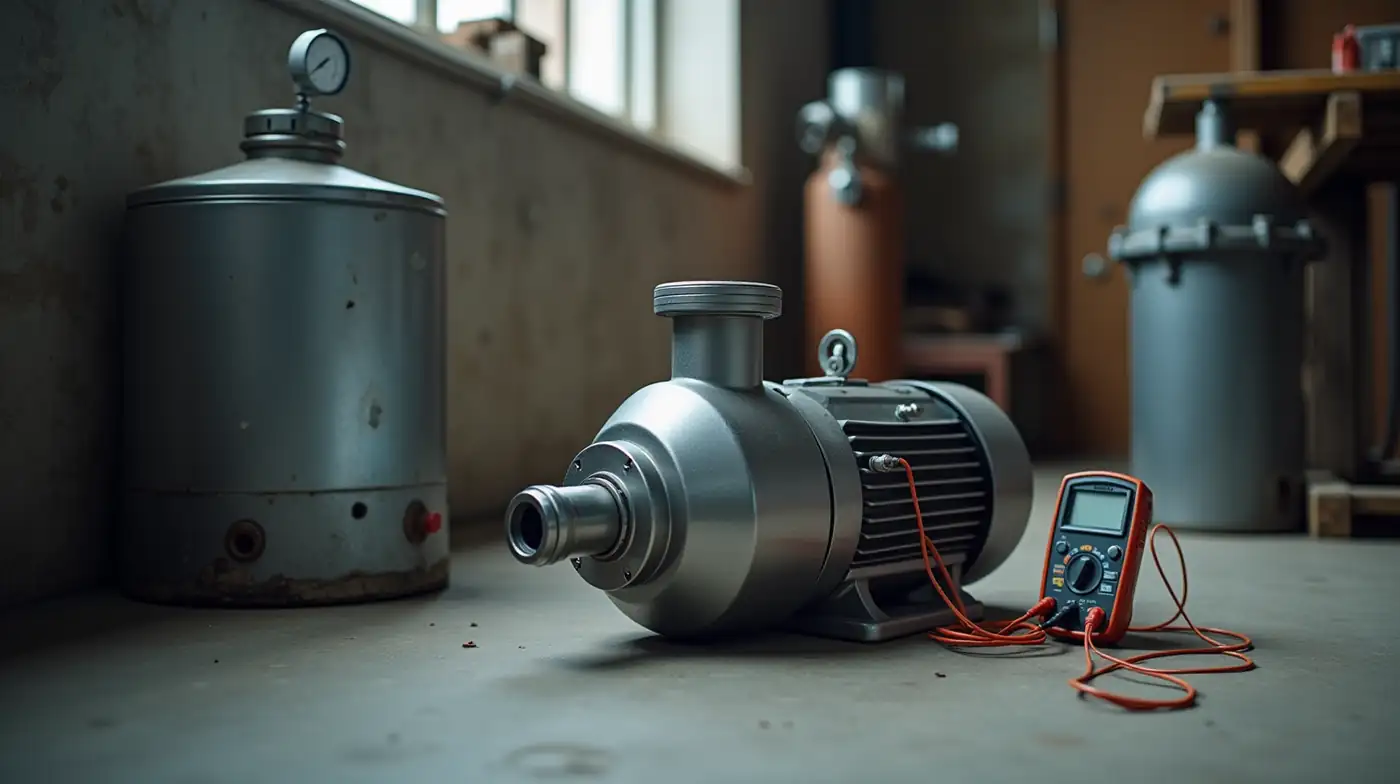
What Does "A Bad Well Pump" Actually Mean?
A typical residential well pump is a sealed electric motor with a stack of impellers bolted to its shaft. The motor pushes water up the discharge pipe; a pressure switch in the basement (or at the pitless unit) starts it when pressure drops to cut-in (usually around 28–30 PSI) and stops it at cut-out (usually around 40–42 PSI). When people say "the pump is bad," they are really describing one of three failure families:
- Electrical failure — degraded windings, a failing overload protector, a stuck contactor, or (on capacitor-assisted 115V units) a weak run capacitor. These show up as high amperage draw, tripping breakers, and overheating.
- Mechanical failure — worn bearings, a corroded or clogged impeller, or a seized shaft. These show up as new noise, falling flow, and the tell-tale hum-with-no-water.
- System-level failure that mimics a bad pump — a waterlogged pressure tank, a leaking pressure switch, a failed check valve, or a settling well. Roughly a third of "pump problems" we diagnose in the field turn out to be one of these, which is why the 30-minute protocol below always rules the rest of the system out first.
Because the pump is submerged and sealed, you cannot inspect it directly — diagnosis is done through behavior: how long it runs per cycle, what the pressure gauge does, how much water it moves, and how many amperes it draws. That last one is the single most objective number in the whole system, and it is the anchor of the 30-minute protocol. Before we get there, here is the full warning-sign list.
12 Warning Signs That Tell If a Well Pump Is Bad
These are the twelve symptoms that, in our inspection experience, most often precede a total pump failure. Read all of them before diagnosing — most failing pumps show two or three signs at once, and the combination narrows the cause fast.
1. Short Cycling: On and Off in Under Two Minutes
If the pump starts and stops every 30 to 90 seconds, something in the system is not holding pressure. The usual culprits are a waterlogged pressure tank, a leaking pressure switch diaphragm, or a small leak in the house plumbing — not the pump itself. But a weak pump with a clogged impeller also short-cycles, because it cannot build cut-out pressure before the pressure switch drops it. Time ten consecutive cycles with a phone timer: if the pump is on less than 2 minutes between starts, investigate. Our well pump short cycling guide walks through the tank-bladder, switch, and leak checks in order.
2. Running Continuously and Never Shutting Off
The mirror image of short cycling: the pump runs for 20, 30, or 40 minutes at a time, or grinds along almost nonstop. A healthy pump should complete a cycle in one to three minutes under normal household use. Continuous running means the pump cannot reach cut-out pressure. The classic causes are a falling water table (the well simply has less water), a leak, a clogged impeller, or a weakening motor that has lost the torque to build head. Every extra minute of continuous running shortens the pump’s life, so treat this sign as urgent. If the pump is on for more than ten minutes with no faucet open, start with our well pump running all the time guide.
3. Loss of Prime: Air in the Line and Gurgling Water
Faucets gurgle, the pressure fluctuates, and the pump cycles on and off without moving real water. On a jet pump system this is the pump losing its prime; on a deep-well submersible system it usually means the check valve or the pitless unit seal has let air into the line, or the water level in the well has dropped below the pump intake. A submersible pump cannot lose prime the way a jet pump does — it is always submerged — so air in a deep-well system is a seal problem, not a pump problem. See our well pump losing prime guide for the eight causes and the how to prime a well pump procedure if yours is a jet system.
4. Flow Rate That Keeps Dropping Over Months
This is the quietest and most common early warning of mechanical wear. Fill a five-gallon bucket with a kitchen timer: a healthy residential system delivers roughly 2 to 4 gallons per minute at the tap. If you measured 3.5 GPM a year ago and now get 1.8, the impeller is likely clogging with sand or scale, or the bearings are wearing and the impeller stack is losing efficiency. Write the number down every six months — a slow, steady decline is the signature of a pump that has two to three years of life left, not a pump that will fail this week.
5. Low or Fluctuating Pressure at the Gauge
Stand at the pressure gauge next to the tank and watch a full cycle. If the cut-out point has drifted from 40 PSI down to 34, or the pressure bounces around wildly during a cycle, the pump may be losing its ability to build head. But check the pressure tank first — a tank with no air cushion reads exactly the same way. Bleed the tank and retest before you blame the pump; our well pressure tank sizing guide covers the pre-charge math, and the how to increase well water pressure guide covers the switch-side fixes.
6. Humming or Buzzing With Little or No Water
This is the loudest warning sign and the one homeowners most often misread. A motor that hums steadily but the faucet delivers nothing (or a weak trickle) means the electrical side is still alive but the mechanical side is slipping: bearings have worn to the point where the impeller cannot spin up, or the impeller is clogged solid. The motor is drawing current, producing sound, and generating heat — and every minute it sits in that state stresses the windings further. Shut the pump off at the disconnect the moment you hear it. Our well pump runs but no water guide separates the pump-side causes from the line-side ones.
7. New Noise: Grinding, Rattling, or Whining
A well pump is not silent, but a healthy one has a steady, even drone. Grinding means bearing wear or debris in the impeller. Rattling usually means loose impeller vanes or a broken impeller bolt. A rising whine that climbs as the pump runs is a classic electrical symptom of winding degradation. The sound travels up the discharge pipe, so you can listen at the well cap or at the tank inlet without touching the pump. New noise is new problem — note when you first heard it, because it tells you how fast the failure is progressing.
8. Overheat: The Pump Trips Its Own Overload Protector
Most submersible pumps carry an internal thermal overload protector that opens when the motor temperature gets too high. The symptom: the pump runs for five or fifteen minutes, then cuts out, sits for ten to twenty, and restarts. In hot summer months this can happen even with a healthy pump under a heavy irrigation load, but if it starts happening in cooler weather, or the run time before the trip keeps getting shorter, the motor windings or bearings are running hotter than they should. This is one of the strongest predictors of an electrical failure within months. See the well pump not working guide for the overload section when the trip stops resetting at all.
9. Amperage Draw Above the Nameplate Rating
This is the single most objective test in this entire article, and it takes five minutes if you have a clamp meter. Every pump nameplate lists the full-load amperage (FLA). Measure the running current at the pump disconnect or contactor: a healthy pump draws within about 10 percent of FLA. A pump drawing 20 to 30 percent above FLA is working harder than it should — bearings are tight, the impeller is fighting scale, or the windings are degrading. A pump drawing far below FLA while producing no water has a stalled or slipping rotor. Write the number down and compare it year to year. A pump on a VFD for well pump setup logs this automatically, which is one of the strongest arguments for a drive on an aging system.
10. Breaker Trips or the Contactor Sticks
A failing pump loads the circuit: as windings degrade, the current climbs and the breaker trips at random points in the cycle. A stuck contactor (the relay that feeds the pump) is the other electrical tell — the pump keeps running after the pressure switch drops out, or it will not stop when you flip the pump switch off. Stuck contactor contacts are usually caused by years of arcing, and the arcing is fed by the extra inrush current a weakening motor demands. A $40 contactor and a $30 thermal overload are the cheapest diagnostics in the whole system; if a fresh set of both does not fix the tripping, the load itself — the pump — is the problem.
11. Sand, Grit, Rust, or Discolored Water Coming From the Pump
Water that runs gritty, rust-colored, or discolored after the pump has been off for a long stretch is the pump’s internal environment showing itself. Rust can be the well itself (iron-bearing water) or the pump: a corroding impeller, a worn motor housing, or a foot valve that has let well sediment settle around the intake. Grit that comes up only after the pump sits is the foot valve failing to hold the line full. This sign is a two-way street — it can be a water-quality problem or a pump-internals problem — which is why a water test belongs in the 30-minute protocol. If you are replacing the pump anyway, the foot valve for well pump guide covers what to swap at the same time.
12. Age Past 10 to 15 Years
The median well pump we replace in the field is 12 years old. A quality submersible pump with clean water and moderate run time lasts 10 to 15 years; the same motor in a high-run-time irrigation well with sandy water can be done in six or seven. Age alone is not a symptom, but it changes how you read every other sign. A short-cycling 14-year-old pump with a drifting amp reading is not a pump worth saving — it is a replacement budget with a deadline. The full lifespan data, by pump type and duty cycle, is in our how long do well pumps last guide.
Quick Diagnostic Chart: Symptom to Likely Cause
Use this chart to match what you are actually seeing to the most likely cause, and the first test that separates a real pump problem from a system problem. Start at the top of your symptom list and work down — the first two rows rule out the most common non-pump causes, which should save you an unnecessary pump pull.
| What You Are Seeing | Most Likely Cause | First Test to Run |
|---|---|---|
| Pump cycles every 30–90 seconds | Waterlogged tank or leaking switch | Bleed tank, check pre-charge |
| Pump runs 20+ min nonstop | Low water level, clogged impeller, weak motor | Bucket flow test + amp draw |
| Gurgling faucets, air in line | Failed check valve or pitless seal | Pump off 30 min, check for air |
| Flow slower than last year | Clogged impeller or scale | 5-gallon bucket GPM test |
| Hums but no water comes out | Seized bearings or clogged impeller | Kill power, amp draw at restart |
| New grinding or whining noise | Bearing wear or winding degradation | Listen at well cap, log amp draw |
| Pump trips after 5–15 min | Thermal overload, overheating motor | Check run time vs. season |
| Breaker trips mid-cycle | Rising current draw, arcing contactor | Clamp meter at disconnect |
| Gritty or rusty water after idle | Foot valve fail or pump corrosion | Water test + pump age check |
| Pump is 12+ years old | End-of-life probability rising | Annual amp + flow baseline |
How to Test If a Well Pump Is Bad: The 30-Minute Protocol
This is the exact sequence we run during annual inspections. It takes about 30 minutes, costs nothing beyond a clamp meter and a pressure gauge, and produces four numbers — amperage, run time, flow, and tank pre-charge — that together tell you with high confidence whether the pump is healthy, aging, or dying. Run the whole sequence, not just the parts that interest you: the numbers only mean something as a set.
- Read the nameplate (2 minutes). Kill the pump at its disconnect switch. The nameplate on the motor (or on the well head) lists voltage, horsepower, full-load amperage (FLA), and RPM. If the plate is gone or illegible, match the pump model to the manufacturer’s spec sheet — the numbers are also in our how to size a well pump guide. Write down the FLA; it is your baseline for everything that follows.
- Measure the running amperage (5 minutes). With the power restored, clamp a meter around one of the pump’s two hot conductors at the disconnect and let the pump complete a cycle. A healthy submersible draws within about 10 percent of FLA. Note where you land: under 70 percent of FLA with weak flow means a slipping or clogged impeller; 110 to 130 percent of FLA means mechanical drag or winding degradation; a spike at startup that never settles is a bad sign in itself.
- Time a full cycle and watch the gauge (5 minutes). Start with all faucets closed. Note the pressure, open the lowest faucet, let the pump start, and time it to cut-out. Record cut-in, cut-out, and run time. A residential system should cycle in one to three minutes. If the gauge never reaches the cut-out point you set on the switch, the pump (or the water supply) is losing head.
- Run the 5-gallon bucket test (5 minutes). At a hose bib, fill a five-gallon bucket as fast as you can and time it. Gallons per minute is 300 divided by the seconds it took. Five seconds is 60 GPM (far too fast — close the tap); 60 seconds is 5 GPM, which is healthy for a single-family system; over 150 seconds (under 2 GPM) is a flow problem worth chasing. Compare to last year’s number if you have one.
- Check the tank pre-charge (5 minutes). With the pump off and pressure at cut-out, bleed the air valve on the tank and take the gauge reading — that is the bladder pre-charge. It should sit about 2 PSI below your cut-in pressure. A tank that reads water pressure at the valve is waterlogged and will make a perfectly good pump look bad. This single check clears the most common false positive in pump diagnosis.
- Listen, feel, and look (3 minutes). Put an ear to the discharge pipe or the well cap during a cycle: new grinding, rattling, or a rising whine is diagnostic. Feel the pump housing (if accessible) or the tank inlet for unusual vibration. Look at the water from the first seconds of a cycle after the pump has sat: grit or rust that clears in a minute points at the foot valve or pump internals rather than the well.
Safety first
Residential well pumps run on 230V in most regions (some older 115V systems exist — see our 230V vs 115V well pumps guide). Kill the pump at the disconnect before touching anything, verify with a meter, and keep the disconnect locked out while you work. If you are not comfortable with live wiring, steps 2 and 3 are the ones a well service technician does for you — the other steps are all safe for any homeowner.
How Long Do Well Pumps Last, and When Is Replacement the Right Call
Most submersible well pumps last 10 to 15 years in normal residential duty, and the lifespan is driven by three things: the quality of the water (sand and iron are the two biggest killers of impellers and bearings), the annual run time (an irrigation well works ten times harder than a house well), and the quality of the motor itself. A pump that has run 1,000 hours a year in a sandy well for nine years has worked about as hard as a pump that has run 300 hours a year in a clean well for twenty. The full lifespan breakdown by pump type and duty cycle is in our how long do well pumps last guide.
Age is not the trigger for replacement — condition is. But age changes the math: when a 13-year-old pump shows two or more of the warning signs above, the repair is almost never the rational choice, because a rebuilt or repaired motor has no remaining warranty and the same worn water environment that aged the first pump will age the repair. The decision rule we give homeowners is simple: if the repair costs more than roughly half of a new pump plus the pull-and-set labor, replace the pump. The cost table below makes the comparison concrete.
Repair vs. Replace: What Each Costs in 2026
| Fix | Typical Parts Cost | Typical Total With Labor | When It Makes Sense |
|---|---|---|---|
| Contactor replacement | $30–$80 | $150–$300 | Stuck or arcing contactor, pump itself healthy |
| Run capacitor (115V systems) | $20–$50 | $120–$250 | Hard start or hum-with-no-water on capacitor pumps |
| Pressure switch | $30–$80 | $150–$300 | Short cycling or wild pressure, tank checks out |
| VFD installation | $150–$500 | $400–$1,000 | Aging pump, dry-run protection, soft start needed |
| Submersible pump motor rebuild | $300–$600 | $600–$1,200 | Rarely — only for high-output pumps where pull labor dominates |
| Full pump replacement (DIY parts) | $300–$900 | $300–$900 | Pump past repair economics; comfortable with the pull |
| Full pump replacement (pro) | — | $1,500–$4,000 | Deep well, high output, or no time for a DIY pull |
Two practical notes from the field. First, a DIY pump replacement is very doable on a standard 3/4-inch or 1-inch submersible — the procedure is in our how to remove a well pump guide — and it is usually cheaper to buy a new pump than to rebuild a 12-year-old one. Second, if your replacement is a different class of pump (a 115V system being upgraded to 230V, or a jet system going submersible), read the deep well vs shallow well pump guide before you buy, because the wrong class of pump is the most expensive mistake in the whole project.
Where to Buy: Parts and Replacement Pumps
Everything in the table above can be bought online. When shopping, match three numbers to your old pump’s nameplate: voltage, horsepower, and (for replacements) the discharge pipe size. For the electrical parts, buy the same class of part your system already uses — a 230V contactor on a 230V system, a run capacitor only on a 115V capacitor-start pump.
| Item | What to Match | Where to Buy |
|---|---|---|
| Submersible well pump | Voltage, HP, pipe size to old nameplate | 1 HP 230V Submersible Well Pump |
| Pump contactor | Voltage and amp rating (20A typical) | Well Pump Contactor |
| Run capacitor | Microfarad and volt rating of old cap | Well Pump Run Capacitor |
| Variable frequency drive | Voltage and motor HP | Well Pump Variable Frequency Drive |
| Digital multimeter | AC amps capability for the amp test | Digital Multimeter |
| Pressure switch | Cut-in/cut-out range, 1/4-inch NPT | Well Pump Pressure Switch |
| Foot valve | Matches discharge pipe size | Well Pump Foot Valve |
| Pressure tank | Gallons and pre-charge to switch settings | 44-Gallon Well Pressure Tank |
Pricing and availability checked November 2026. Always confirm the voltage and horsepower match your existing system before ordering.
See Also
If you are diagnosing a pump that has already stopped, or planning the replacement, these companion guides cover the rest of the failure picture:
- Well Pump Not Working 2026: 10 Causes and How to Fix — the dead-pump version of this article: power checks, the ten causes, and when to stop and call a pro.
- Well Pump Losing Prime 2026: 8 Causes and How to Fix It — the air-in-the-line diagnosis, which is the third most common "pump is bad" misdiagnosis we see.
- How to Size a Well Pump 2026: The Complete Guide — how to pick the right replacement pump so the next one lasts the full 10 to 15 years.
- VFD for Well Pump 2026: Sizing and Best Models Guide — the protection layer that extends the life of an aging pump and logs the amperage data this article is built on.
Frequently Asked Questions
How can I check if my well pump is failing without pulling it?
With the 30-minute protocol above: measure the running amperage against the nameplate FLA, time a full pump cycle, run the bucket flow test, and check the tank pre-charge. A pump drawing well over its FLA, taking longer than three minutes to build pressure, and losing flow versus last year’s numbers is telling you it is failing — no need to pull it to know. If those three numbers are all in the healthy range, the pump is fine and the symptom you are chasing is probably the tank, the switch, or a house leak.
What is a normal amperage draw for a submersible well pump?
Within about 10 percent of the full-load amperage printed on the nameplate. A 1/2 HP 230V pump typically lists 4 to 5 amps FLA; a 1 HP 230V pump lists 8 to 10 amps; a 1.5 HP unit lists 12 to 15. Startup inrush can be two to three times FLA for a fraction of a second — that is normal. What is not normal is a steady-state reading that stays 20 to 30 percent above FLA, which means the motor is working harder than it was designed to.
How long do submersible well pumps typically last?
Ten to fifteen years in normal residential duty, less in high-run-time or high-sand applications. The practical rule: a pump that has passed its tenth year and is showing two or more warning signs from this list should be budgeted for replacement rather than repaired. The full lifespan data by pump type, duty cycle, and water quality is in our well pump lifespan guide.
My well pump hums but no water comes out. Is the pump bad?
Usually yes, but check the line first. On a jet system, a hum with no water can be a lost prime; on a submersible system it is almost always a mechanical problem — worn bearings or a clogged impeller that lets the motor turn without moving water. Kill the pump at the disconnect immediately (a stalled motor burns windings fast), then work through our well pump runs but no water diagnosis to separate the pump-side causes from the line-side ones.
Is it cheaper to repair an old well pump or replace it?
For an old pump, almost always replace. The parts that are worth replacing on a well system — contactor, capacitor, pressure switch, VFD — cost $20 to $500 and buy a healthy pump many more years. But a motor rebuild on a 10-to-15-year-old submersible runs $600 to $1,200 with labor, with no warranty on the remaining life, while a new pump with the same pull labor costs $1,500 to $4,000 done professionally or far less in parts for a competent DIYer. If the repair approaches half the cost of a new installation, the replacement wins on every axis except the first few days of convenience.
The Bottom Line
You do not need to pull the pump to tell if a well pump is bad — you need four numbers and your ears. Time a cycle, read the gauge, measure the flow, and clamp the amperage against the nameplate; add the tank pre-charge and any new noise to that, and the pump will tell you its condition in about 30 minutes. A healthy pump draws near its FLA, cycles in one to three minutes, and moves 2 to 4 gallons per minute. A failing pump drifts: the amp reading climbs, the cycles lengthen, the flow falls, and the noise changes — usually over months, which is the whole point of checking twice a year.
When two or more signs show up on a pump past its tenth year, stop repairing and start budgeting: a new pump, a matched correctly sized replacement, and the contactor and switch refreshed at the same time. That is the difference between a $1,500 project you plan for and a $3,000 emergency you live through without water. The warning signs in this article are free; the ones that show up after a total failure are not.
#WellPump #WellWater #WellMaintenance #SubmersiblePump #PumpFailure #WellOwner #PrivateWell #HomeWell #WellDrilling #PumpRepair #WaterPressure #RuralLiving #WellEquipment #WellCare #DiagnoseYourPump