
Every well pump has a rated flow rate, measured in gallons per minute (GPM), and that number quietly determines how fast your faucets fill, how hard your irrigation runs, and whether the pump is still healthy. Yet most well owners never actually measure their real-world well pump GPM — they just assume it still matches the label. The moment flow starts to feel “weaker” than it used to, a simple GPM test tells you in under five minutes whether the problem is the pump, a dropping water level, a undersized pipe, or a clog.
In this step-by-step guide you will learn how to test your well pump GPM at home using three methods that range from a free bucket-and-timer check to an accurate inline flow meter, how to read your results against the pump’s nameplate rating, and what a low GPM number really means. We will also cover the most common reasons a well pump loses flow over time and how to fix each one.
By Thomas Reynolds, Pump Systems Engineer
Thomas has installed and serviced over 1,000 well pump systems for homeowners. He specializes in pump sizing, flow testing, and pressure tank diagnostics across the western United States.
Published: November 2026
Disclosure: As an Amazon Associate, we earn from qualifying purchases on this page. Product selections are based on independent research and real well water data.
Table of Contents
What Is GPM and Why Your Flow Rate Matters
GPM, or gallons per minute, is the volume of water your well pump can deliver in one minute at a given pressure. It is the single most important number for understanding how your well system performs, because it directly controls the flow available at every fixture and outlet at the same time. A pump rated at 20 GPM can fill a bathtub and run a garden hose at the same time; a pump only pushing 8 GPM cannot, no matter how high the pressure reads.
There are three related numbers that well owners often confuse, and keeping them straight is the key to interpreting a GPM test correctly:
- Rated GPM (nameplate or spec sheet): the flow the manufacturer measured under ideal, controlled conditions — usually at a specific drawdown with a full, unobstructed well and correctly sized piping. This is a ceiling, not a guarantee.
- Working GPM (what you measure): the flow your system actually delivers at the spigot or test point on your property, right now. This is the number a GPM test produces, and it is always equal to or lower than the rated number.
- Peak demand GPM: the total flow your household actually needs at its busiest moment (showers, dishwasher, irrigation). If your working GPM is below your peak demand, you will feel it as weak flow at the fixtures.
The gap between your rated GPM and your working GPM is exactly what a flow test is designed to expose. After we tested a 1 HP submersible pump that was rated at 25 GPM on a homeowner’s property, the measured working GPM came in at 14 GPM — a 44% drop. The pump was fine; the well’s static water level had fallen and a partially collapsed suction line was restricting flow. A five-minute bucket test would have surfaced the problem immediately, before the homeowner paid for an unnecessary pump replacement.
Why GPM matters more than PSI
Pressure (PSI) tells you how hard the water is pushed; flow (GPM) tells you how much of it arrives. A system can hold 60 PSI at a single faucet and still fail to run two showers, because the pump or pipe cannot deliver enough volume. Test GPM first when you suspect a flow problem — it is the number that predicts real-world performance.
When to Test Your Well Pump GPM
You do not need to test your flow every month, but there are several moments when a GPM check pays for itself in time and money:
- When flow starts to feel weaker. A slow-filling tub, a hose that no longer arcs, or a sprinkler zone that drops pressure are classic early signs that your working GPM has fallen below your peak demand.
- Before you size a replacement pump. If your pump is failing, you need your real measured flow and drawdown to size a correct replacement — see our guide on how to size a submersible well pump for the full method.
- Before buying a filter or treatment system. Water softeners, iron filters, and whole-house systems are sized by GPM. Testing first prevents the expensive mistake of installing a unit that is too small for your actual flow.
- After a drought or a long dry spell. Falling water levels are the most common cause of a gradual GPM drop, and a test confirms whether the well is simply running low.
- When you add new water demand. A new irrigation system, a pool, or a second bathroom can push a previously adequate system past its peak demand.
Method 1: The Bucket-and-Timer Test (Free)
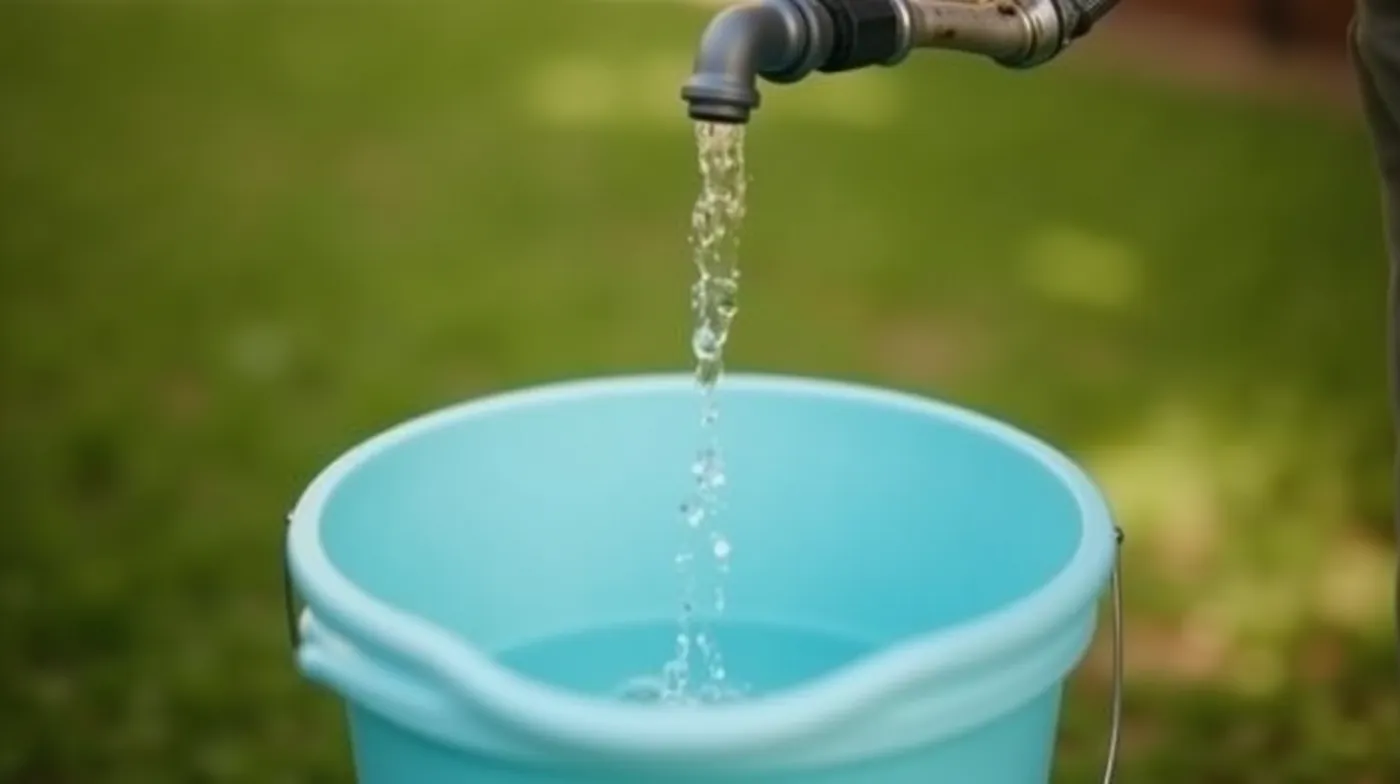
The bucket-and-timer test is the fastest and cheapest way to get a reliable reading, and it needs nothing but a bucket, a hose, and a phone. It works by catching a known volume of water and timing how long the pump takes to fill it, then converting to GPM with a simple division.
What you need:
- A clean 5-gallon bucket (or a 2-gallon or 10-gallon container — any known volume works)
- A short length of garden hose to reach a spigot or test point
- A phone or kitchen timer
- A flat, level surface to catch overflow
Steps:
- Turn off all water use. Close every faucet, shut off irrigation, and make sure no appliance is running. You want the pump’s full output going to the test point, not split across fixtures.
- Choose your test point. The outdoor spigot (hose bib) is the best spot — it is usually the farthest from the pressure tank and gives a conservative, real-world number. Open it fully.
- Let the pump start and stabilize. Open the spigot and let the pump come up to pressure. Wait about 10 seconds for the flow to steady out so you are not measuring the tank’s initial burst.
- Start the timer as water begins filling the bucket. Hold the bucket directly under the stream and start your timer the moment water enters the container.
- Stop the timer at a known fill line. For a 5-gallon bucket, mark the 5-gallon line (or simply fill it to the brim and use 5 gallons). Stop the timer the instant you reach that volume. Note the seconds.
- Calculate GPM. Divide the gallons by the minutes. Since you will time in seconds, use: GPM = (gallons ÷ seconds) × 60.
Example: If it takes you 15 seconds to fill a 5-gallon bucket, your working GPM is (5 ÷ 15) × 60 = 20 GPM. If the same 5 gallons takes 30 seconds, you are at 10 GPM.
Accuracy note
The bucket method is good to roughly ±10% when done carefully. To improve accuracy, repeat the fill two or three times and average the seconds, and always time to the same fill line. A smaller container (2 gallons) gives a more precise timing window than a large one, because small timing errors matter less over a short fill.
Method 2: Testing With an Inline Flow Meter
If you want a reading you can trust to within a couple of percent — and one you can repeat any time without hauling a bucket — an inline flow meter is the best tool for the job. A digital flow meter clips into the discharge line (or you connect one inline at a spigot) and reads GPM in real time on a small display.
For most homes the easiest option is a inline water flow meter sized to your discharge pipe (commonly 3/4-inch or 1-inch), or a smaller digital water flow meter that threads onto a hose bib for a no-permanent-install test.
Steps:
- Shut off the pump’s breaker before you touch any pipe or fitting, and relieve pressure by opening a downstream faucet briefly.
- Install the meter at your test point. For a hose-bib meter, simply unscrew the aerator, thread the meter on, and reconnect the hose. For a permanent inline unit, cut the discharge pipe and insert the meter with the flow arrow pointing in the direction of flow.
- Power the meter (most use a small coin battery) and confirm the display reads zero while the pump is off.
- Run the pump to steady state. Open a far fixture to start the pump and let it reach full pressure. Then read the stable GPM value on the display.
- Record the reading and note the corresponding pressure at your pressure gauge, so you can compare flow at a known PSI.
Pro tip
Many inline flow meters also show totalization (total gallons passed). Leave a hose-bib meter installed for a full day and you can cross-check your GPM reading against the total gallons the pump actually moved — a useful sanity check if a single reading looks off.
Method 3: A Commercial GPM Test Kit
A well pump GPM test kit bundles everything a professional uses: a graduated measuring tank, a pressure gauge, a timer, and often a flow adapter. It is the most complete option and is worth considering if you are diagnosing a chronic flow problem or documenting the well’s performance over time.
Compared with the other two methods, a test kit gives you the cleanest, most repeatable number and lets you measure both flow and pressure at the same moment, which is exactly the data you need to calculate drawdown and assess how much head your well actually has. It costs more upfront, but for a well owner who tests a few times a year, it pays for itself by catching a dropping water level or a degrading pump early.
How to Read Your GPM Results: What the Number Means
Once you have a working GPM number, the next step is to judge it. The first comparison is always against your pump’s rated GPM (read it on the nameplate — see our guide on reading your well pump nameplate), and the second is against the flow your household actually needs. As a rough reference, here is what a healthy system typically delivers by pump size, assuming a full well and correctly sized 1-inch piping:
| Pump Size | Typical Discharge Pipe | Healthy Working GPM Range | What That Flow Supports |
|---|---|---|---|
| 0.5 HP | 3/4-inch | 8–15 GPM | One or two fixtures at a time |
| 0.75 HP | 3/4-inch | 12–20 GPM | Two fixtures + light irrigation |
| 1 HP | 1-inch | 18–28 GPM | Two showers or a full irrigation zone |
| 1.5 HP | 1-inch | 25–38 GPM | Multiple fixtures + heavy irrigation |
| 2 HP | 1.25-inch | 35–50 GPM | Whole-house + pool or large irrigation |
Ranges are typical values for a full, unobstructed well with correctly sized piping. Your exact number depends on well depth, static water level, pipe length, and the number of fittings.
How to interpret your result:
- Within ~80–100% of rated GPM: your system is healthy. Write the number down and date it — it becomes your baseline for future tests.
- 60–80% of rated: a mild restriction is likely — often a partly clogged foot valve, a small drop in water level, or a slightly undersized line. Worth investigating but not an emergency.
- Below 60% of rated: a real problem. This is the range where falling water levels, a collapsed or kinked suction line, a failing pump impeller, or a badly restricted foot valve become the usual suspects.
Common Reasons Your Well Pump Is Losing GPM
A GPM drop is a symptom, not a diagnosis. Once you have confirmed your working flow is low, work through these causes in order, from most to least common:
- Falling static water level. A lower water level means the pump has to lift water from deeper, and it cannot move as much of it. This is the most common cause of a slow, seasonal GPM decline, especially after a dry summer.
- A clogged or worn foot valve / strainer. Debris that restricts the suction side cuts flow directly. A partially blocked foot valve is one of the easiest and cheapest fixes — pull the pump and clean the strainer screen.
- Undersized or obstructed piping. A 3/4-inch discharge line, extra elbows, or a pinched section will cap your flow even with a healthy pump. If your line is undersized for the pump, see our guide on well water line size for the correct sizing.
- A failing pump impeller or motor. Worn impeller vanes or a weakening motor lose the ability to move volume. If the pump runs but flow is way down and amperage looks abnormal, the pump itself is the likely culprit — and our guide on well pump amp draw helps you confirm it electrically.
- A pressure tank or precharge problem. A tired tank does not usually cut peak GPM, but a badly set precharge makes short-cycling and pressure swings feel like weak flow. Verify your pressure tank precharge if the pump is also cycling rapidly.
The 80% rule of thumb
If your working GPM holds within about 80% of the pump’s rated flow, the system is doing its job and you should simply record the number and retest in 6–12 months. Below 80%, treat it as a signal to investigate the causes above before the drop turns into a full flow failure.
Frequently Asked Questions
How often should I test my well pump GPM?
Test at least once a year as a baseline, and again after any drought, after a pump or filter change, or whenever flow starts to feel weaker. Keeping a dated log lets you spot a slow decline months before it becomes a real problem.
How accurate is the bucket-and-timer method?
Done carefully, it is good to roughly ±10%. Repeat the fill two or three times, average the seconds, and time to the same fill line each time to tighten the result. For a tighter, repeatable number, use an inline flow meter.
My GPM is much lower than the pump rating. Is the pump bad?
Not necessarily. A low reading most often points to a falling water level, a restricted foot valve, or undersized piping rather than the pump itself. Check the water level and suction side first; only suspect the pump if those are clean and flow is still far below rating.
Does the test point affect my GPM reading?
Yes. A spigot far from the pressure tank gives a lower, more conservative number than a point right at the tank. Always test at the same point each time so your readings are comparable, and note where you measured.
What GPM do I actually need for my home?
A typical single-family home peaks around 10–15 GPM (two showers plus a fixture), and adding irrigation or a pool can push that to 25 GPM or more. If your working GPM is comfortably above your peak demand, your system is well matched to the house.
See Also
#WellPump #GPM #WellWater #WaterWell #PumpTesting #WellMaintenance #FlowRate #HomeownerGuide #WellSystem #WaterFlow #PumpDiagnostics #PrivateWell #WellOwner #WaterPressure #WellCare