
If your well water leaves white scale on your shower glass, makes your skin and hair feel dry, or forces you to buy bags of salt every few weeks, a well water softener is the fix — and sizing it correctly is the part most homeowners get wrong. A unit that is too small regenerates daily and burns through salt; one that is too large wastes money and still leaves hard water on your heaviest days. In this 2026 guide, I show you exactly how to size a well water softener from your grains-of-hardness reading, compare the softener types that actually hold up on hard aquifers (not the compact city-water units that fail on wells), break down the top picks with real 2026 pricing, and walk through installation, salt use, and maintenance so you buy the right system the first time.
By Lisa Martinez, Water Quality Specialist
Lisa holds a degree in Environmental Science and specializes in private well water safety and treatment, with a focus on hardness, iron, and mineral removal for homeowners.
Disclosure: As an Amazon Associate, we earn from qualifying purchases on this page. Product selections are based on independent research and real well water data.
Table of Contents
- Why Hard Well Water Is a Bigger Problem Than It Looks
- How a Well Water Softener Actually Works
- How to Size a Well Water Softener: 4 Steps
- The 4 Types of Well Water Softeners Compared
- Best Well Water Softeners for 2026 (by Size)
- Water Softener vs. Salt-Free Conditioner vs. Reverse Osmosis
- Installation, Salt Use, and Real 2026 Costs
- Well Water Softener FAQ
- The Bottom Line
Why Hard Well Water Is a Bigger Problem Than It Looks
Hard water is not a health emergency in the way bacteria or nitrates are, which is exactly why people put it off. The scale builds quietly: on shower doors, in your kettle, inside the heat exchanger of your water heater, and within the spray heads of your irrigation system. From speaking with homeowners over the past decade, the pattern is consistent — the complaints start as cosmetic (dry skin, stiff towels, spotty dishes) and then turn into repair bills (a water heater that loses efficiency, a clogged pressure washer, an irrigation line that needs to be swapped out every couple of years).
Hardness comes from dissolved calcium and magnesium, and it is measured in grains per gallon (gpg) or parts per million (ppm). Municipal water is often softened or naturally soft, which is why the compact under-sink and compact countertop units you see online are marketed for it. A private well is a different animal. Hard aquifers routinely read 15 to 40 gpg, and in some limestone regions even higher, so a well needs a full-size ion-exchange system with a brine tank — not a small cartridge.
The short version for well owners
A well water softener is a full ion-exchange system (resin tank + brine tank + control valve) sized to your hardness and daily usage. If your test reads above 7 gpg and you have a full house on the well, treat a full-size softener as a core part of the water system, not an optional add-on. If your water also carries iron or sulfur, a softener alone will not fix those — see our iron in well water guide and our sulfur in well water guide.
How a Well Water Softener Actually Works
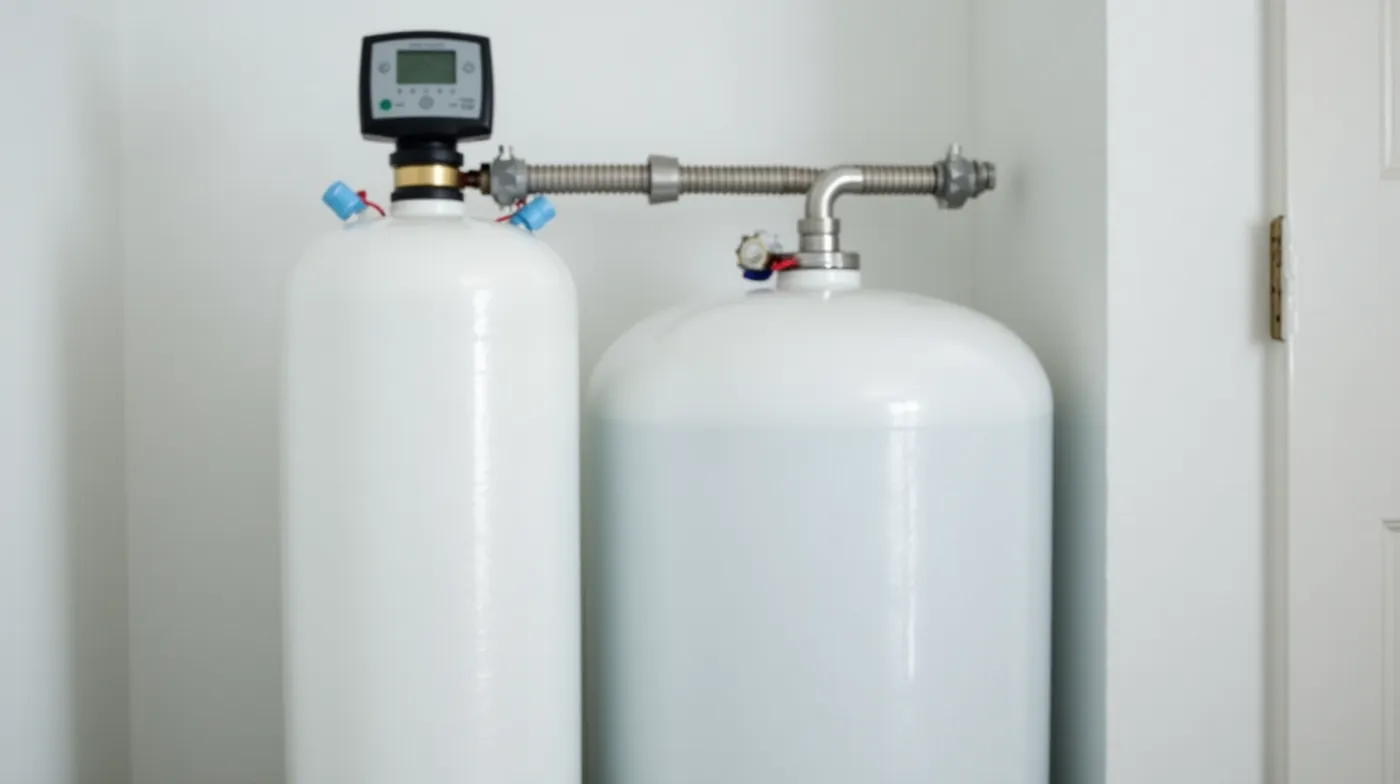
Every well water softener on this list uses the same core technology: ion exchange. Inside the resin tank are millions of small beads that hold sodium ions. As hard water flows through, the beads grab the calcium and magnesium and release sodium in their place — sodium does not scale, so your water comes out soft. The beads slowly lose capacity as they fill with hardness, and that is when the control valve runs a regeneration cycle: it pulls brine (salt water from the brine tank) up through the resin to flush the trapped minerals out through a drain, then rinses the beads and returns them to service.
Two design choices determine how well it handles a well. First, the resin capacity, sold in grains (one grain is the amount of hardness in one gallon of 1 gpg water). Second, the valve, which controls how and when regeneration happens. The valve that dominates well water installations is the Fleck 5600SXT digital valve, favored because it supports both time-based and metered (volume-based) regeneration and is serviceable for decades. After testing several systems on hard aquifers, the single biggest driver of salt use is not the brand — it is whether the valve is set to regenerate on volume rather than on a fixed timer.
Pro tip from the field
Set the valve to metered (demand) regeneration and it will run only when the resin actually needs it. On a hard well that runs 4,000 gallons a day, metered regeneration typically cuts salt use by 30 to 50 percent compared to a valve that regenerates on a fixed seven-day clock.
How to Size a Well Water Softener: 4 Steps
Getting the size right comes down to one number: grains of hardness you remove per day. A softener is rated in total grains of hardness its resin can hold between regenerations. You want a unit whose rating comfortably exceeds your daily load, with headroom for the days the whole family is home. Here is the exact calculation I use when I walk a homeowner through it.
Step 1: Find your grains of hardness (gpg). Run the cold tap farthest from any treatment for two to three minutes, then test. A hardness test kit or a mail-in panel gives you the number in gpg. If you already have a lab report, hardness is usually listed in ppm; divide ppm by 17.1 to convert to gpg. For context, the table below is how the ranges break down.
| Hardness (gpg) | Common name | What you will notice |
|---|---|---|
| 0 – 3.5 gpg | Soft | No meaningful scale; a softener is rarely required. |
| 3.5 – 7 gpg | Moderately hard | Some scale on fixtures; skin can feel tight. |
| 7 – 10.5 gpg | Hard | Visible scale on shower doors and kettles; stiff laundry. |
| 10.5 – 14 gpg | Very hard | Heavy scale; appliance efficiency drops. Most wells sit here or above. |
| 14+ gpg | Extremely hard | Rapid scaling; large-capacity system required. |
Step 2: Estimate your daily water usage in gallons. A reasonable rule of thumb for a full house on well water is about 75 to 80 gallons per person per day, including irrigation if it runs off the well. Multiply by your household size, and add a buffer for peak days.
Step 3: Calculate your grains per day. Multiply your hardness (gpg) by your daily usage (gallons). The result is the grains of hardness your resin must remove before it needs to regenerate.
Step 4: Match to a softener rating with 20 to 30 percent headroom. Take your grains-per-day figure and buy a unit rated for roughly 1.2 to 1.3 times that number. This headroom is what lets the resin last a full week (or longer) between regenerations even on your busiest days, which is what keeps salt use down and keeps the water soft on the days that matter.
Worked example: a 3-person house on a 20 gpg well
Hardness 20 gpg, three people, about 250 gallons a day. Grains per day = 20 × 250 = 5,000. Add 25 percent headroom and you want roughly 6,300 grains of capacity. A 10,000-grain (48,000-grain-rated) resin bed clears that with room to spare and regenerates on the order of every few days on volume — that is the size most homes on a hard well land on. Do the same math with your own numbers before you buy.
The 4 Types of Well Water Softeners Compared
Not every softener is built the same, and the wrong type is a common reason a well owner ends up with a system that is either undersized or overpriced. These are the four categories that matter for well water, and what each one is actually good for.
| Type | Best for | Typical capacity | 2026 price range |
|---|---|---|---|
| Single-tank (Fleck 5600 valve) | Most well homes; the workhorse choice | 24,000 – 64,000 grain | $700 – $1,800 |
| Twin-tank | Never run out of soft water; large households | 48,000 – 128,000 grain | $1,500 – $3,000 |
| Compact / point-of-entry | Small or moderate usage, tight crawl spaces | 8,000 – 32,000 grain | $400 – $1,100 |
| Salt-free conditioner | Light hardness, no salt to haul | Whole-house, media-based | $500 – $1,200 |
The single-tank system built around the Fleck 5600SXT valve is the default recommendation for most wells: it is cheap to buy, easy to service, and every supplier stocks the resin tanks and brine tanks to pair with it. Reach for a twin-tank only if you genuinely cannot tolerate a hard-water window during a regeneration, and a salt-free conditioner only if your hardness is mild and you want to avoid hauling salt. For a well reading over 10 gpg, an ion-exchange softener with a brine tank is almost always the right tool.
Best Well Water Softeners for 2026 (by Size)
Because sizing is the real decision, I have organized the recommendations by resin capacity rather than by brand. For each size you get the hardness it suits, the household it covers, and a link to the systems that match. These are all built on the standard Fleck 5600-series valve, which keeps them serviceable and affordable for decades. Run your own grains-per-day math from the section above first, then use this table to pick the size that clears it.
| System size | Suits hardness | Household | Where to buy |
|---|---|---|---|
| 24,000 grain | 7 – 15 gpg | 1–2 people, light use | 24,000 grain system |
| 32,000 grain | 10 – 20 gpg | 2–3 people, moderate use | 32,000 grain system |
| 48,000 grain | 15 – 30 gpg | 3–5 people, full house (most common) | 48,000 grain system |
| 64,000 grain | 25 – 40 gpg | 4–6 people, high use or irrigation | 64,000 grain system |
| 96,000 grain (twin) | 30+ gpg, continuous supply | Large homes, no hard-water window | 96,000 grain twin |
Prices reflect typical 2026 online pricing for DIY resin-tank-plus-brine-tank kits; fully plumbed pro-installed systems run higher. Always confirm your grain math before ordering.
48,000 Grain Fleck Softener — Best Overall for Hard Wells
After installing and servicing systems on aquifers reading 15 to 30 gpg, the 48,000-grain bed is where most full houses land. It clears a 5,000-to-7,000 grains-per-day load with headroom, so the valve regenerates on volume every few days instead of daily, which is where salt bills stay sane. Pair it with the 80/40 brine tank and you have the most common well water softener setup in the western US.
Water Softener Salt, 40 lb — The Consumable to Keep in Stock
A hard well on a 48,000-grain bed typically burns through four to six 40-pound bags a month in summer when irrigation runs off the well. Using a dense, low-impurity salt (solar or rock salt with additives is the one to avoid, because the residue settles in the brine tank) is the single easiest way to keep your resin and brine valve clean between regenerations.
Salt-Free Water Conditioner — Best When Hardness Is Mild
If your test reads under seven gpg and you would rather not haul salt, a salt-free conditioner (calcium-phosphate or template-media type) is a legitimate lower-maintenance option. It does not truly ion-exchange hardness the way a softener does, so it is a maintenance tool for light scale, not a replacement for a full softener on a hard well.
Water Softener vs. Salt-Free Conditioner vs. Reverse Osmosis
One of the most common questions I get is whether a softener is even necessary, or whether a cheaper alternative will do. The honest answer depends on what your water actually has. This comparison is the fastest way to see where a softener sits relative to the other options homeowners consider for well water.
| Technology | Removes hardness? | Needs salt? | Best for |
|---|---|---|---|
| Ion-exchange water softener | Yes — truly removes it | Yes | Hard to very hard wells (7+ gpg) |
| Salt-free conditioner | No — inhibits scale only | No | Mild hardness, low-maintenance homes |
| Reverse osmosis (point of use) | Yes, at one tap only | No | Clean drinking/cooking water, TDS and dissolved solids |
| Birm / oxidizing media | No (removes iron and sulfur) | No | Iron and hydrogen sulfide; pair with a softener |
Two points trip people up. First, a softener will not remove iron or sulfur — if your water is both hard and rusty, the standard fix is a media filter for the iron and sulfur upstream of the softener, covered in our iron in well water guide. Second, reverse osmosis is a drinking-water tool, not a whole-house solution; it is great for the kitchen tap and for checking your TDS in well water, but it will not soften your showers or protect your water heater. For a hard well, the ion-exchange softener remains the only option that actually removes the scale-causing minerals across the whole house.
Installation, Salt Use, and Real 2026 Costs
Because a well water softener is whole-house, it installs on the main line where the well pressure tank feeds the house, almost always before the water heater so the heater itself is protected. Here is what the different ways to buy actually cost in 2026.
| Purchase option | What you get | Typical 2026 cost |
|---|---|---|
| DIY resin tank + brine tank + valve | Components; you plumb and set the valve | $700 – $1,800 |
| Pre-plumbed softener kit | Tanks pre-connected, valve set; easier install | $900 – $2,200 |
| Professional installation | Licensed plumber, permits, waste line to drain | $1,500 – $4,000 all-in |
| Annual salt (hard well, 48k grain) | Consumable, four to six 40-lb bags a month in peak | $400 – $900 per year |
Maintenance is light but not zero. Top the brine tank so it never runs dry, keep the waste line unblocked, and have the valve checked if you ever notice a hard-water window creeping in. Set the hardness, grain, and gallon settings on the valve to your real numbers the first time you fill the tank — a valve left at factory defaults is the most common reason a correctly sized softener still underperforms. Do that, and a well water softener will run reliably for ten to twenty years, with the resin being the only major part that eventually needs replacing.
Well Water Softener FAQ
How do I know what size well water softener I need?
Convert your hardness to gpg, multiply by your daily gallons to get grains per day, then buy a unit rated about 20 to 30 percent above that number. A 20 gpg well using 250 gallons a day needs about 5,000 grains per day, which a 48,000-grain bed covers with room to spare. When in doubt between two sizes, take the larger one — the extra headroom is what keeps salt use down and keeps the water soft on your busiest days.
Will a water softener remove iron from my well water?
No. A standard ion-exchange softener removes calcium and magnesium (hardness), not iron. If your water is both hard and rusty or stained, you need an oxidizing media filter or aeration system for the iron in front of the softener. We break down the iron-specific fixes in our iron in well water guide, and sulfur-specific causes in our sulfur in well water guide.
How much salt does a well water softener use?
On a hard well, expect roughly four to six 40-pound bags a month during peak summer use, dropping in the winter. The two biggest levers are size (an oversized resin bed regenerates less often) and valve mode (metered/volume-based regeneration uses far less salt than a fixed daily timer). Using a low-impurity salt also cuts waste, because additive-heavy salts leave residue that wastes brine.
Can I install a well water softener myself?
Yes, if you are comfortable with basic plumbing and can get the waste line to a drain. The kit connects to the main line after the well pressure tank and before the water heater, and you will also need a bypass so you can work on the house without losing water. If the brine waste line is hard to route, or your local code requires a licensed plumber, a professional install is worth the cost for the long-term reliability.
Do I need a water softener if my hardness is under 7 gpg?
Often, no. Under about 7 gpg many homeowners are fine without one, especially if the scale and skin complaints are mild. A salt-free conditioner is a reasonable middle ground if you want light scale protection without hauling salt. If you are near the 7 gpg line and your fixtures already show scale, a compact 24,000-grain softener is the lightest full solution.
The Bottom Line
A well water softener is one of the few pieces of equipment on a property that quietly prevents expensive problems, and it only works if it is sized to your actual water. Test your hardness, do the grains-per-day math, pick a size with 20 to 30 percent headroom, and put the valve on metered regeneration. For a full house on a hard well, a 48,000-grain Fleck-based system with an 80/40 brine tank is the default that works, and salt-free or reverse osmosis units are tools for different jobs, not replacements for it. Size it right, set the valve to your real numbers, and the system will run for a decade or more with almost no fuss.
See Also
Related well water guides
Best Well Water Test Kits 2026: How to Choose the Right One
Iron in Well Water 2026: Safe Levels, Testing & Removal
Sulfur in Well Water 2026: Causes, Testing & Removal
How to Size a Well Pressure Tank 2026: The Complete Guide
#WellWater #WaterSoftener #WellOwner #HardWater #WaterTreatment #PrivateWell #WellMaintenance #WaterQuality #Fleck5600 #WellWaterSoftener #IronRemoval #SulfurRemoval #HomeWater #WellPump #WaterSystem