
Performing a well drawdown test is one of the most useful things a well owner can do for themselves. It tells you two things you cannot guess: how much water your well actually produces, and how far the water level drops when you pump it. In this guide you will learn exactly how to do a well drawdown test at home, what the numbers mean, and when the results say you need a bigger pump, a bigger tank, or a new well.
By Robert Harrison, Certified Well Inspector
Robert has 20+ years of experience inspecting and testing residential water wells across the western US, and has personally run thousands of drawdown and yield tests.
Disclosure: As an Amazon Associate, we earn from qualifying purchases on this page. Product selections are based on independent research and real well water data.
Table of Contents
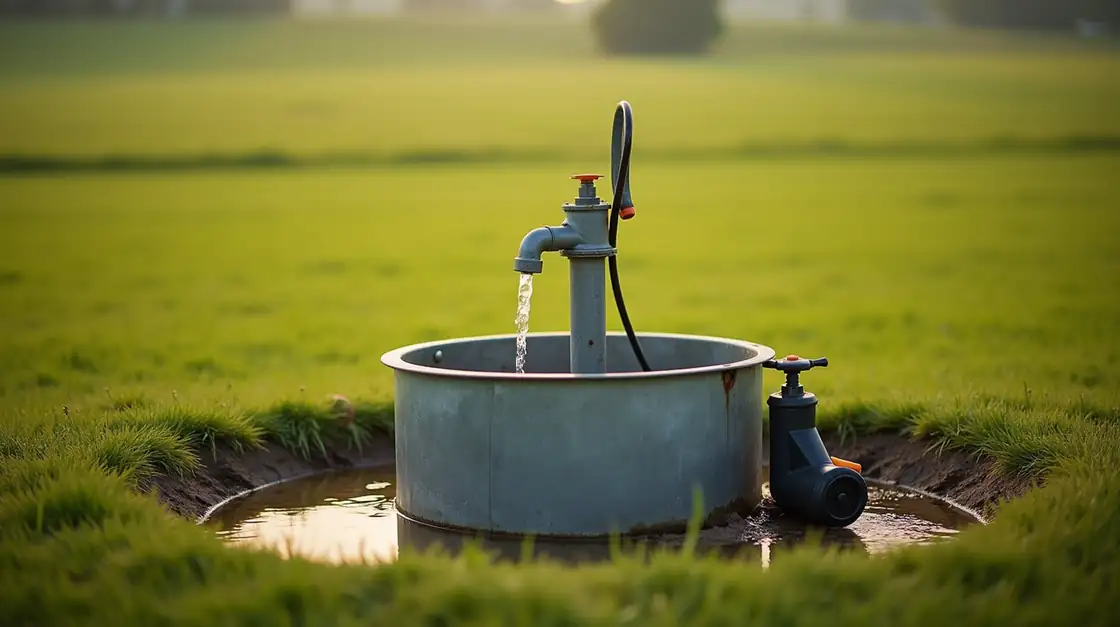
What Is a Well Drawdown Test?
A well drawdown test measures how your well behaves under the load of an actual pump. You record the static water level (the depth to water when the pump is off and the well is at rest), then run your pump and record the pumping water level (the depth while the pump is running). The difference between the two is your drawdown — the number of feet the water level drops while you are pumping.
Along the way you also measure flow rate, usually expressed in gallons per minute (GPM). Between those two numbers you learn the real capacity of your well and whether your current pump is being asked to do more than the well can sustain. A drawdown test is the single most informative piece of data when you are sizing a pump, troubleshooting low pressure, or deciding whether a well has enough yield.
Key term to remember
Drawdown = pumping water level minus static water level. If your water sits at 60 ft when the pump is off and drops to 95 ft while pumping, your drawdown is 35 ft. A large drawdown in a short time is a warning sign the well is not keeping up with demand.
Why Do a Well Drawdown Test?
You do not need a reason to run a drawdown test, but there are moments when it is especially valuable. In my field work, these are the situations where the test pays for itself:
- Buying or installing a new pump. A pump is only as good as the well it is in. A drawdown test tells you the maximum sustained flow the well can deliver, so you can pick a pump that matches reality instead of guessing.
- Troubleshooting low pressure. If flow is weak only when multiple fixtures run at once, the well may not be recovering fast enough. The test shows whether the problem is the well or the pump.
- Before drilling or re-developing a well. Drawdown data is what a driller needs to confirm a new or existing well has adequate yield for your household.
- After a dry spell or low water season. Yield changes with the seasons. A test in the low-water months shows your true minimum capacity.
- Sizing a pressure tank or adding a VFD. Knowing your real GPM helps you size storage and controls so the pump does not short-cycle.
For the numbers themselves, the drawdown test is the foundation for sizing a well pump correctly, and it pairs directly with measuring your well water level, which is the first step of the test.
What You Need to Run a Well Drawdown Test
A well drawdown test is a DIY job that costs very little. You need a way to measure the depth to water, a way to measure flow, and a way to keep time. Here is the core kit.
| Item | Purpose | Typical Cost |
|---|---|---|
| Digital water-level tape | Measures static and pumping water depth | $25-$90 |
| Well flow meter (gallon meter) | Measures flow in gallons per minute | $30-$150 |
| Phone timer or stopwatch | Times the run and recovery phases | Free |
| Labeled dry bucket (optional) | Backup bucket-method flow estimate | $10 |
Costs reflect 2026 retail ranges for common DIY well-testing equipment.
If you want to record the whole test hands-free, a water-level data logger logs depth over time so you can chart recovery without standing at the pit. For a first test, the tape plus flow meter is all you need.
How to Do a Well Drawdown Test (Step-by-Step)
Run the test when no other water is being used in the house and the pump has been off for at least 12 hours (overnight is ideal). That lets the well fully recover to its true static level before you start.
- Measure the static water level. Lower your water-level tape into the well and read the depth to the water surface. Write it down. This is your starting number.
- Install or check the flow meter. Connect your flow meter in line at the pump outlet or at a spigot. Confirm it reads zero before you start.
- Turn on the pump at full flow. Open a single full-flow spigot (or run the pump at its normal system flow). Start your timer the moment water begins moving.
- Record flow for the first minute. Read the flow meter and note your GPM. This is your peak sustained flow.
- Let it run 15 to 60 minutes. The longer you run, the truer the pumping water level. For a quick test, 15 minutes is enough; for capacity planning, run 45-60 minutes.
- Measure the pumping water level. While the pump is still running, lower the tape and read the depth to water again. This is your pumping water level.
- Turn the pump off and watch recovery. Note the time, then re-measure the water level every 10-15 minutes until it climbs back near the static level. Recovery speed is a key sign of a healthy well.
- Write down every reading. Static level, pumping level, GPM, run time, and recovery times. These four numbers are your entire test.
Do not pump dry
If the water level keeps dropping toward the pump intake and your pressure tank is small, stop the test. Pumping a well dry can pull sediment and damage the pump. Watch the flow: if GPM is falling fast, the well is being over-drawn.
How to Read Your Well Drawdown Results
Once you have your four numbers, here is how to interpret them.
Calculate your drawdown
Subtract the static water level from the pumping water level. The result, in feet, is your drawdown. A steady, moderate drawdown that holds while the flow stays constant is a healthy well. A drawdown that keeps climbing while your GPM falls means the well cannot sustain that flow.
Check the flow rate
Your GPM is the well’s real production at that point in the test. Compare it to your household’s peak demand (a typical home uses 8-12 GPM across a shower, dishwasher, and laundry at once). If your test flow is below your peak demand, you will feel weak pressure when the whole house is on.
Read the recovery
After you shut the pump off, a healthy well recovers most of its drawdown within 30-60 minutes. If the level barely climbs after an hour, the aquifer is recharging slowly and the well is low-yield. Slow recovery is exactly why your pump may be short-cycling, which we cover in our guide to well pump short cycling.
Finally, hold your numbers against the pump’s pump curve. The flow your well actually delivers at the real head is what determines whether your pump is the right size — not the number on the box.
What a Normal Well Drawdown Looks Like
There is no single “correct” drawdown because every aquifer is different, but these ranges are typical for residential wells and give you a benchmark for your own numbers.
| Well Type | Typical Drawdown | Typical GPM | Recovery |
|---|---|---|---|
| High-yield / shallow | 10-20 ft | 15-25 GPM | Fast, under 30 min |
| Average residential | 30-50 ft | 8-12 GPM | 30-60 min |
| Deep / low-yield | 30-60 ft+ | 3-7 GPM | 1-3+ hours |
Ranges are field-typical values; your well will differ based on aquifer, casing size, and season.
If your drawdown is well above these bands and your GPM falls off quickly, the well is under-producing for your demand — a sign to look at a bigger tank, a VFD, or (in the worst case) a new or deeper well. For the drilling side of that decision, see how deep a well should be.
Drawdown Test vs. Well Yield Test
People use these terms interchangeably, but they are related, not identical. A drawdown test measures how far the level drops during a timed pumping period; a yield test is a longer, more formal version that keeps pumping until the well reaches a steady state (or is exhausted) to determine true capacity.
| Aspect | Well Drawdown Test | Well Yield Test |
|---|---|---|
| Measures | Depth the level drops during pumping | Total recoverable volume / sustained capacity |
| Duration | 15-60 minutes | 1-4+ hours (to steady state) |
| Best for | Quick pump sizing and troubleshooting | Full well capacity and drilling decisions |
| DIY cost | $0-$200 | $50-$500+ |
For most homeowners, a drawdown test is the right first step. If the results are borderline — the well runs but is clearly near its limit — that is the moment to commission a formal yield test or bring in a driller before making a big equipment decision.
Frequently Asked Questions
How long should I run the pump during a drawdown test?
At least 15 minutes for a quick reading; 45-60 minutes to reach a true steady pumping water level. The longer, the more reliable the numbers — as long as you are not drawing the well dry.
How much drawdown is too much?
There is no universal cutoff, but a drawdown that keeps climbing while your GPM drops is the warning sign. If the water level approaches the pump intake, stop — you are over-drawing the well.
Do I need a flow meter, or can I estimate?
A flow meter gives you real GPM, which is what matters for pump sizing. In a pinch you can time how long it takes to fill a known-size bucket, but a meter is far more accurate and cheap.
Should I do the test in the dry season?
Yes, if you can. Wells produce the least in the low-water months, so a test in the dry season shows your true minimum capacity and protects you from buying a pump sized to summer flow.
How often should I re-test my well?
Re-test after any major change (new pump, new fixture load, a long dry spell) and about every 3-5 years otherwise, or sooner if you notice a real drop in pressure or flow.
See Also
#WellDrawdown #WellYield #WellWater #PrivateWell #WellTesting #WellPump #DrawdownTest #WellOwner #WaterWell #WellMaintenance #HomeownerGuide #WellFlowRate #WellWaterLevel #WellDrilling #WellPumpSizing