
Hard water is the norm on a private well, and the fix is a salt-based water softener. But most well owners never give a second thought to the one part of the system they use every month: the water softener salt sitting in the brine tank. Add too little and the softener quietly stops pulling hardness out of your water. Add the wrong kind and you clog the brine well, waste salt on every cycle, and end up cleaning mineral residue out of the tank. After helping homeowners dial in their softening systems, we keep running into the same three questions — how much salt does a water softener actually use, what type should you buy, and how often do you need to top the tank off?
This guide answers all three with real numbers. You will learn how a salt softener works at a basic level, how to estimate the salt your specific unit will burn through, which of the five common salt types is actually worth your money (and which to steer clear of), a step-by-step for refilling the brine tank safely, and the small mistakes that quietly shorten a softener’s life. Everything below reflects what we have seen on hard well water systems running anywhere from 30,000 to 300,000 grains of resin capacity.
By Thomas Reynolds, Pump Systems Engineer
Thomas has installed and serviced over 1,000 well pump and water treatment systems for homeowners across the western U.S.
Disclosure: As an Amazon Associate, we earn from qualifying purchases on this page. Product selections are based on independent research and real well water data.
Last updated: November 7, 2026
Table of Contents
What Is Water Softener Salt?
Water softener salt is plain sodium chloride (NaCl) — the same chemical as table salt, but refined and formed so your softener can dissolve it efficiently. It is not an additive that treats the water directly; it is the fuel for regeneration, the process that resets the softener so it can keep working.
Here is the full loop, because understanding it makes every other part of this guide make sense:
- Hard water enters the resin tank. Your well water carries dissolved calcium and magnesium — that is what “hardness” means. The softener’s resin beads are charged with sodium ions.
- Ion exchange happens. As the water flows through, the calcium and magnesium swap places with the sodium on the beads. The water leaves softer; the beads hold onto the hardness they have captured.
- The resin saturates. After a fixed amount of hardness (the softener’s “grain capacity”) has passed through, the beads can no longer capture more. The unit is now “exhausted.”
- Regeneration kicks in. The softener draws a concentrated salt solution — brine — from the brine tank and flushes it through the resin. The brine strips the trapped calcium and magnesium off the beads and recharges them with sodium. The waste water flushes to drain.
The brine tank is simply a reservoir of solid salt that the softener dissolves on demand to make that brine. No salt in the tank means no brine, no brine means no regeneration, and no regeneration means your softener starts passing hard water straight to the house. That is why the salt is the single most common point of failure owners cause on their own — not by breaking anything, but by letting the tank run dry or by loading it with the wrong product.
How Much Salt Does a Water Softener Use?
There is no single number, because salt burn is driven by three variables that are specific to your home: how hard your water is, how much capacity your softener has, and how much water the household actually uses. A one-person household on 5 grains of hardness may use half a bag a month; a family of six on 25 grains with a large irrigation demand can burn through two bags a week.
The quick mental model: the more water you soften and the harder it is, the more salt you burn. Each regeneration cycle on a typical residential unit consumes roughly 10 to 20 pounds of salt, and the number of cycles per month is what moves the total. Use the table below as a realistic benchmark, then confirm against your own bag count over a month or two — that is the only number that is truly yours.
| Water Hardness | Light Use (1–2 people) | Average (family of 4) | Heavy Use (6+ / irrigation) |
|---|---|---|---|
| 5 gpg (moderately hard) | 5–8 lbs / month | 10–15 lbs / month | 20–30 lbs / month |
| 10 gpg (hard) | 8–12 lbs / month | 15–25 lbs / month | 30–45 lbs / month |
| 15 gpg (very hard) | 12–18 lbs / month | 25–35 lbs / month | 45–60 lbs / month |
| 25 gpg (extremely hard) | 18–25 lbs / month | 40–55 lbs / month | 70–90 lbs / month |
Benchmarks assume a standard 30,000–48,000 grain residential softener on demand-based regeneration. High-efficiency “metered” units can cut salt use 30–50% versus a fixed timer.
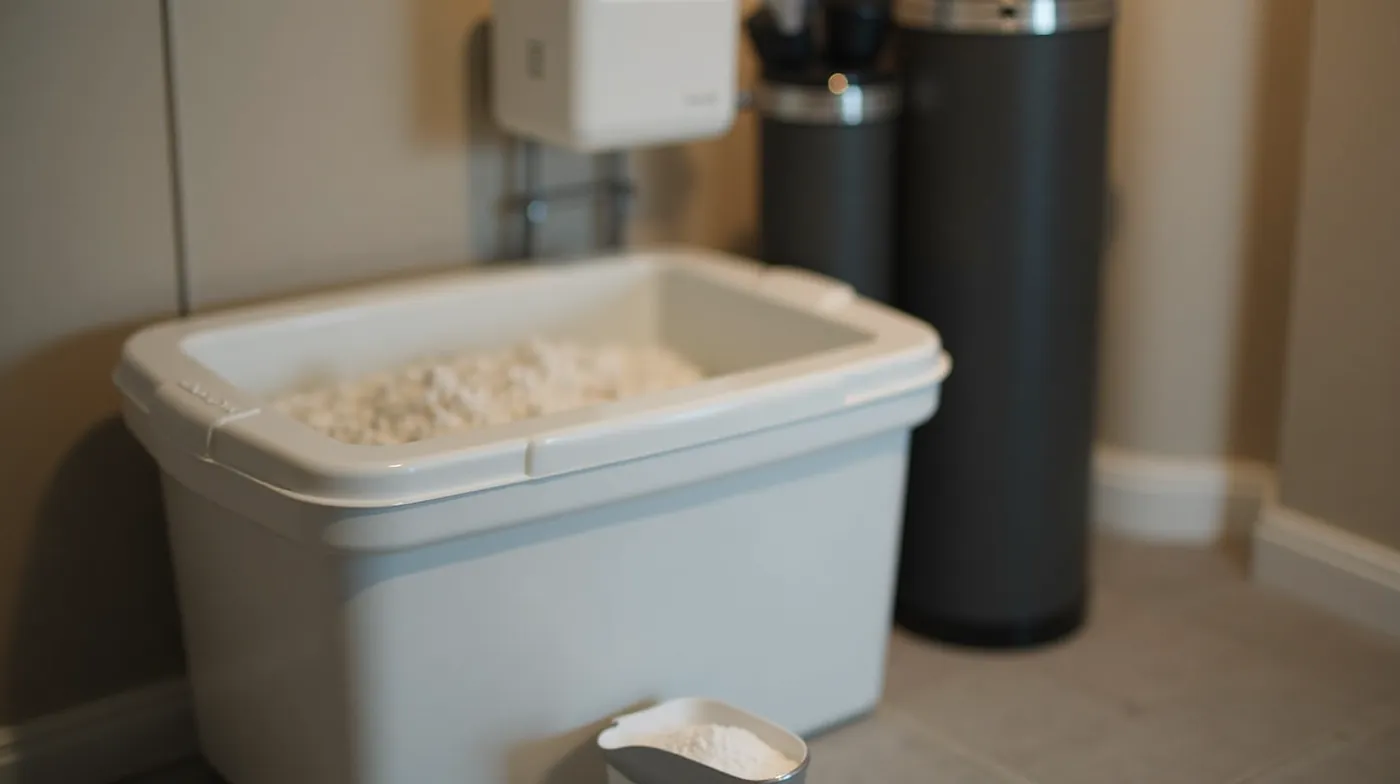
If your softener has a salt-level indicator or a digital display, use it; otherwise a simple rule works: when you can see the waterline in the brine tank sitting above the salt pile, it is time to refill. A typical home brine tank holds 200 to 400 pounds of salt, so most households top off with one 40- to 80-pound bag every two to four weeks.
What Type of Salt Should You Use?
Not all salt is created equal, and the type you pour into the brine tank has a real effect on how cleanly your softener regenerates and how often you have to clean it out. We have pulled brine wells caked with rock-salt residue and brine wells that stay glass-clean for years on pellet salt — the difference is the purity and the particle shape. Here is how the five common options stack up.
| Salt Type | Purity | Dissolves | Residue Left | Cost / Bag |
|---|---|---|---|---|
| Pellet / Evaporated Salt | 99.5%+ | Fast, complete | Minimal | $$$ (premium) |
| Rock Salt | 95–97% | Slower, uneven | High (minerals) | $ (budget) |
| Table Salt | ~99% + additives | Good | Clogs (anti-caking) | $$ (avoid) |
| Pickling Salt | ~99% + additives | Good | Some | $$ (avoid) |
| Potassium Chloride Salt | 99%+ | Good | Low | $$$$ (premium) |
Our recommended picks
If you want the softener that runs cleanest with the least maintenance, buy Morton Water Softener Salt or a comparable pellet / evaporated salt. Pellets are 99.5%+ pure, uniform in size, and dissolve completely, so they leave almost nothing behind in the brine well. Brands we see on the shelf most often include Redi-Soft water softener salt, Wessex water softener salt, and the larger 80-lb bulk bags that cut the cost per pound for higher-use homes.
Rock salt is the budget option and works fine in a pinch, but the 3–5% of impurities it carries (calcium, magnesium, and insoluble minerals) settles out as a sandy residue in the bottom of the brine tank. On a rock-salt system we typically recommend scooping that residue out every 6 to 12 months so it does not pack down and starve the brine well of clean salt. If you go rock salt, expect a bit more upkeep; if you want set-and-forget, go pellet.
Avoid table salt and pickling salt for the main supply. Both carry anti-caking agents (and table salt often carries iodine) that do not dissolve and can coat the brine well, the float valve, and eventually the resin. They are a cheap habit that becomes an expensive cleanup. The one legitimate exception is potassium chloride salt, which swaps sodium for potassium in the exchange cycle. It produces softened water with far less sodium — a real benefit for households on a sodium-restricted diet — but it costs 2 to 3 times more and is less efficient on very hard water, so most owners reserve it for a second “point-of-use” softener rather than the whole-house unit.
How Often Should You Add Salt?
As a working rule, check the brine tank every 2 to 4 weeks, and more often if your household is large or your water is very hard. You are not looking for an exact measurement — just enough to confirm the salt pile is still well above the waterline. Refill when the level drops to roughly one-quarter to one-third of the tank, or the moment your softener’s “add salt” indicator lights up, whichever comes first.
The clearest sign that you have run behind is the water itself starting to feel hard again — spots on the glass, a film in the shower, scale creeping back onto the water-heater inlet. That means the softener has exhausted its resin and has no brine left to regenerate. When that happens, top the tank up and then run a manual regeneration cycle so the unit immediately makes fresh brine and resets the resin instead of waiting for its next scheduled cycle.
Two practical notes from the field. First, refill in the morning: the softener will spend the day dissolving the fresh salt into brine, so you start the next evening with a fully charged tank. Second, do not let the tank sit completely dry for long stretches. A dry brine well can crack with temperature swings, and a softener that has been starved of salt for weeks may need a full manual rinse to get back to normal.
How to Add Salt to Your Water Softener
Refilling is one of the simplest maintenance tasks in the home, but a few details keep it clean and keep the salt from caking. Follow this sequence:
- Lift the brine tank lid. Most lids are a simple snap-on cap on top of the tank. Set it aside where it will not collect salt dust.
- Check what is already in the tank. You should see a pile of solid salt with some brine (salt water) around it. If you see a hard crust with liquid underneath, stop and read the bridging note below before adding more.
- Pour slowly. Lift the bag and tip it at a steady, slow angle. A wide-mouth funnel keeps salt out of the vent opening and onto the pile instead of the sides. Pouring too fast is what causes the salt to bridge and cake.
- Top to about two-thirds full. Add one 40- to 80-pound bag, or enough to bring the pile to roughly two-thirds of the tank height. Do not overfill — salt packed above the top of the tank can work into the vent and the float mechanism.
- Replace the lid and seat it firmly. The tank needs to stay sealed so the softener can build and draw brine correctly. A loose lid lets air in and weakens the brine draw.
- Note the date. Jot the refill date on the lid or in your phone. That is how you build the real cadence for your home instead of guessing.
Dealing with caked (bridged) salt: If the top of the pile has turned to a hard shell with empty space or liquid beneath it, the salt is “bridged.” The softener reads a full tank but cannot dissolve what it needs. Break the crust up with a broom handle or your fist before adding fresh salt, and if the tank is badly packed, let a full tank of fresh brine dissolve overnight, then flush and restart. Slow, steady pouring is what prevents bridging in the first place.
7 Common Water Softener Salt Mistakes
Most softener problems that owners blame on the unit are really salt-handling problems. These are the seven we see most often in the field.
- Using table salt. The anti-caking agents and iodine do not dissolve and clog the brine well and float valve. Switch to pellet or evaporated salt.
- Letting the tank run dry. No salt, no brine, no regeneration — the softener starts passing hard water, and a dried-out brine well can crack. Keep the pile above the waterline.
- Living with rock-salt residue. The mineral residue from rock salt packs down over time. Scoop it out every 6 to 12 months, or switch to pellet salt and skip the chore.
- Ignoring bridged salt. A hard crust with liquid underneath reads as “full” to the softener but dissolves poorly. Break it up before refilling.
- Overfilling the tank. Packed salt above the top of the tank works into the vent and float mechanism and can cause false readings and a weak brine draw.
- Mixing salt types. Going from rock to pellet (or vice versa) leaves a residue blend that can clog the brine well. If you switch, let a full tank dissolve and flush first.
- Not tracking refills. The softener fails quietly — there is no alarm until the water is already hard. A simple refill-date habit keeps you ahead of it.
See also
FAQ: Water Softener Salt
How much salt does a water softener use per month?
For an average family of four on moderately hard well water (10–15 gpg), plan on roughly 15 to 40 pounds per month. The total scales directly with hardness and how much water the household softens, so use the benchmark table above and then confirm against your own bag count over a month or two.
Can I use table salt in a water softener?
It will technically work, but it is not recommended. The anti-caking agents and iodine in table salt do not dissolve and they clog the brine well and float valve over time, and can foul the resin. Use a dedicated pellet or evaporated water softener salt instead.
What happens if my water softener runs out of salt?
The softener can no longer make brine, so it cannot regenerate the resin. The unit keeps running but starts passing hard water to the house. Top the brine tank back up and run a manual regeneration cycle so the resin is immediately recharged instead of waiting for the next scheduled cycle.
How do I know when to add salt?
Check the brine tank every 2 to 4 weeks. Refill when the salt pile drops to about one-quarter to one-third of the tank, or as soon as the unit’s “add salt” indicator lights. If the water starts feeling hard again, that is your cue that the tank is empty and the resin is exhausted.
Is water softener salt the same as regular (table) salt?
Both are sodium chloride, but softener salt is far purer — 99.5%+ in pellet or evaporated form — and it carries no anti-caking agents or iodine. Those additives are exactly what make ordinary table salt a poor fit for a softener’s brine tank.
#WaterSoftenerSalt #WaterSoftener #WellWater #WaterQuality #HardWater #WellOwner #WaterTreatment #SoftenerMaintenance #HomeownerTips #WellWaterSystem #SaltSoftener #WellCare #WaterWellOwners #DIYHomeMaintenance #WaterSoftening